
 Buy Crypto
- Markets
 Futures
- Spot
- Copy Trade
- Earn
- More
$2.5 Billion, Tesla Buys Ticket to Chip Arms Race Bottom Tier


Elon Musk is going to make his own chips. Not in terms of design—Tesla has been designing its own chips for seven years. This time it's about manufacturing. He announced a commitment of about $25 billion to build a chip super factory named Terafab, targeting a 2nm process, producing 100,000 wafers per month, integrating logic chips, memory, and advanced packaging in the same facility.
The reason behind this is not complicated. Tesla's appetite for computing power has grown so large that external foundries can't keep up anymore. Each generation of their self-driving chips sees a three- to five-fold increase in computing power, with Optimus robots and Robotaxis set for mass production. The global leading-edge wafer capacity has long been dominated by Apple, Qualcomm, NVIDIA. Relying on outsourcing contracts to secure capacity is just a stopgap measure; building their own fab is the endgame.
$25 billion. In any other industry, this amount could buy the entire supply chain. In semiconductor manufacturing, it's not even enough to build a standard 2nm wafer fab.
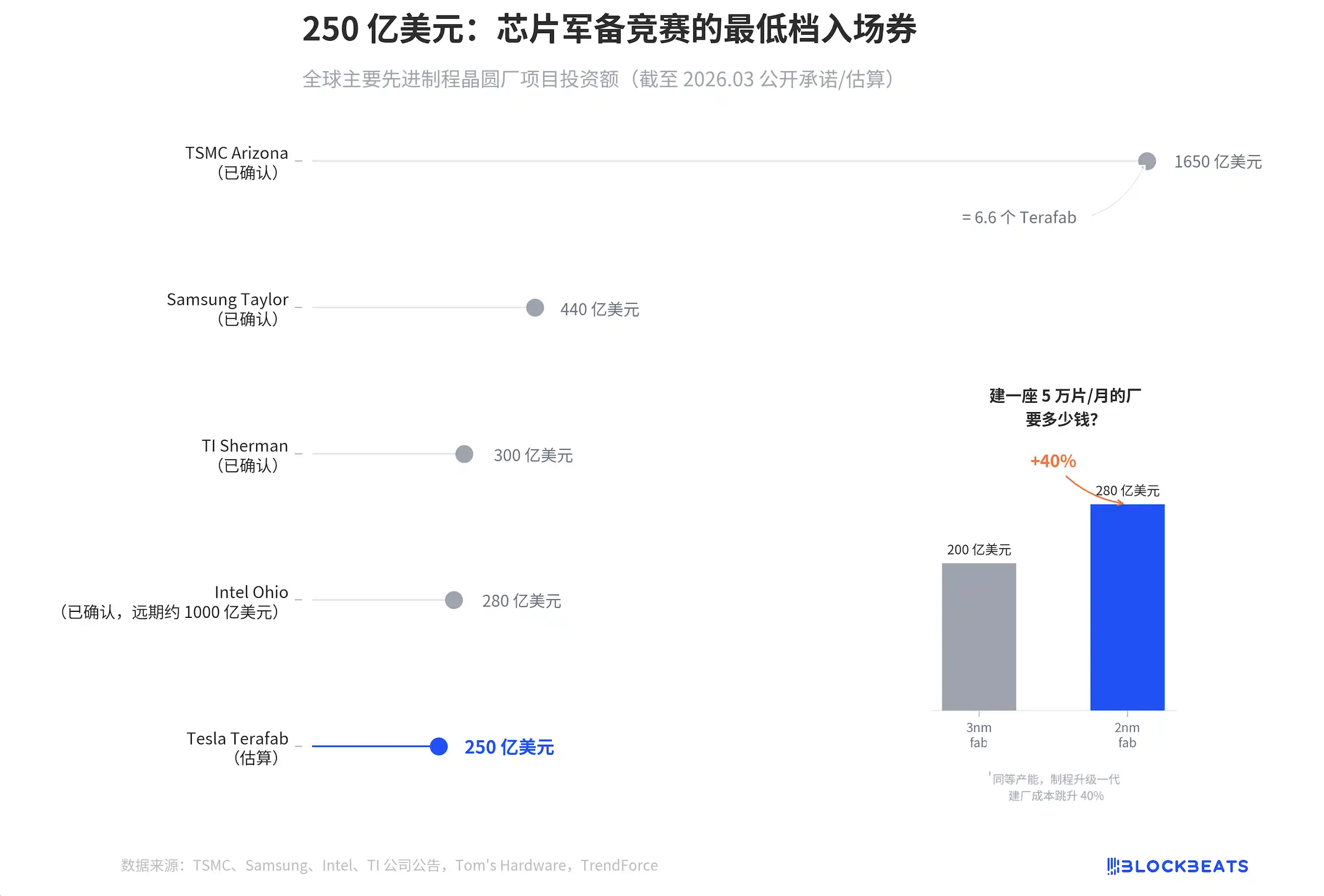
According to various company announcements and industry media reports, the total investment in the world's largest chip foundries includes $165 billion for TSMC's Arizona fab, $44 billion for Samsung's Taylor fab, $30 billion for Texas Instruments' (TI) Sherman fab, and $28 billion for Intel's Ohio fab. Tesla is at the bottom of the list. Moreover, according to estimates from various media outlets like Tom's Hardware, their $25 billion is still just an external estimate; Musk himself has not confirmed the precise number.
Even more crucial is the small image on the right. According to industry research, building a fab with a monthly output of 50,000 wafers, at a 3nm process, costs $20 billion, while at a 2nm process, it costs $28 billion. Going from 3nm to 2nm, the cost of constructing a fab jumps by 40%.
Tesla aims to achieve a monthly production of 100,000 2nm wafers with $25 billion. Based on industry standards, just one 50,000 wafers/month 2nm fab would cost $28 billion. Tesla aims to do the work of less than one standard fab with the money for two fabs and a packaging plant. This is not a budget; it's a wish list.
However, what truly makes Terafab breathtaking is not the money but the production capacity target.
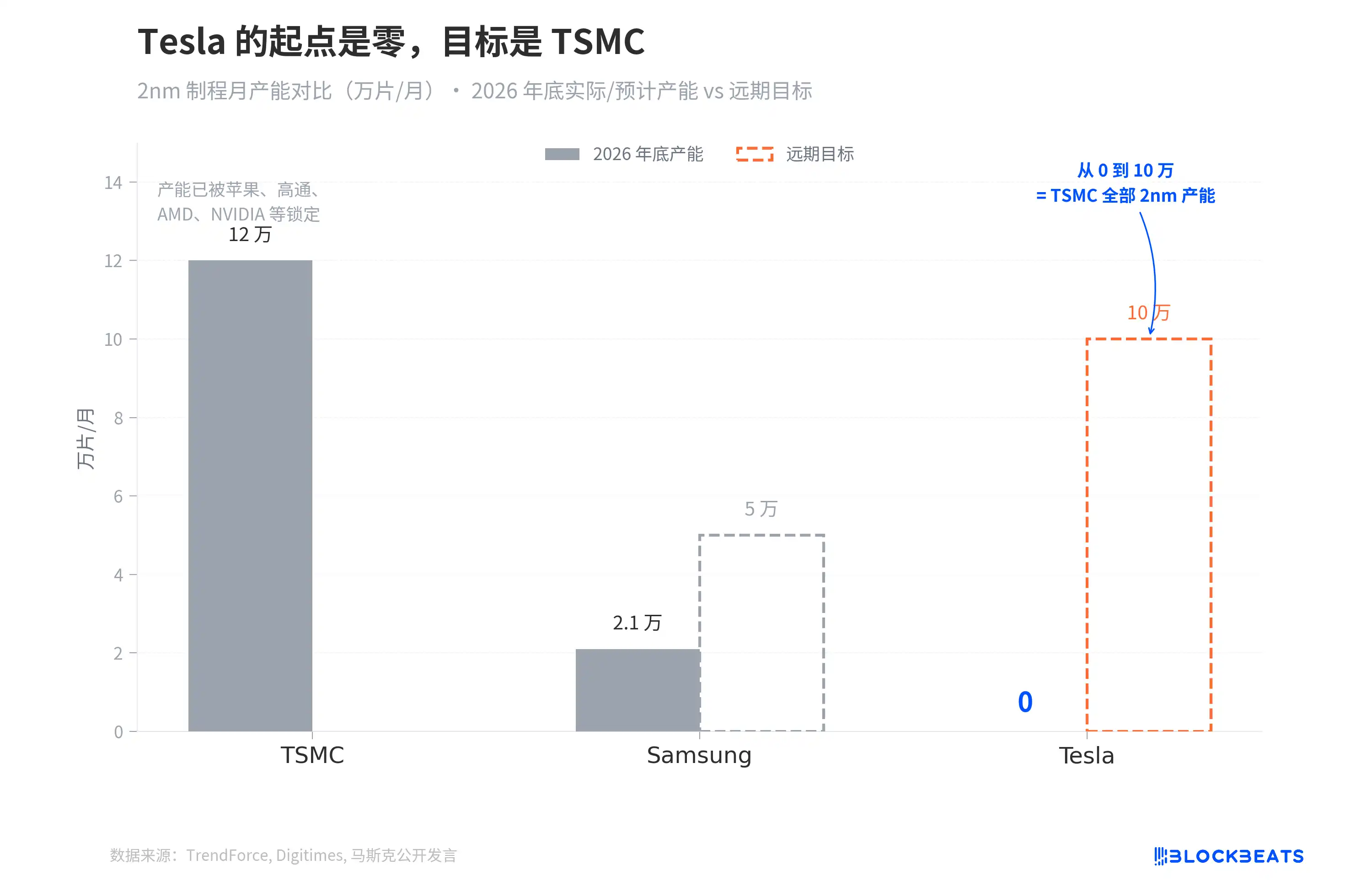
According to industry research firm TrendForce, TSMC's 2nm capacity is expected to reach 100,000 to 130,000 wafers per month by the end of 2026, but this capacity has already been secured by Apple, Qualcomm, AMD, NVIDIA. According to Digitimes, Samsung's 2nm capacity is only 21,000 wafers per month, with a long-term goal of 50,000.
Tesla started from zero. The goal is 100,000.
Going from 0 to 100,000 wafers per month is equivalent to catching up from scratch to TSMC's entire capacity on the most advanced process node worldwide. TSMC started building fabs in Arizona in 2021 and it took three and a half years to ramp up its first 4nm fab. TSMC has accumulated thirty years of manufacturing experience in Taiwan.
Tesla's speed in car manufacturing is indeed faster than anyone's expectations. However, the margin of error in wafer fabrication and vehicle manufacturing is not in the same league. A car's defect can be recalled, but a defect on a wafer means thousands of chips are scrapped.
Understanding why Terafab emerges in 2026 requires looking at a longer timeline.
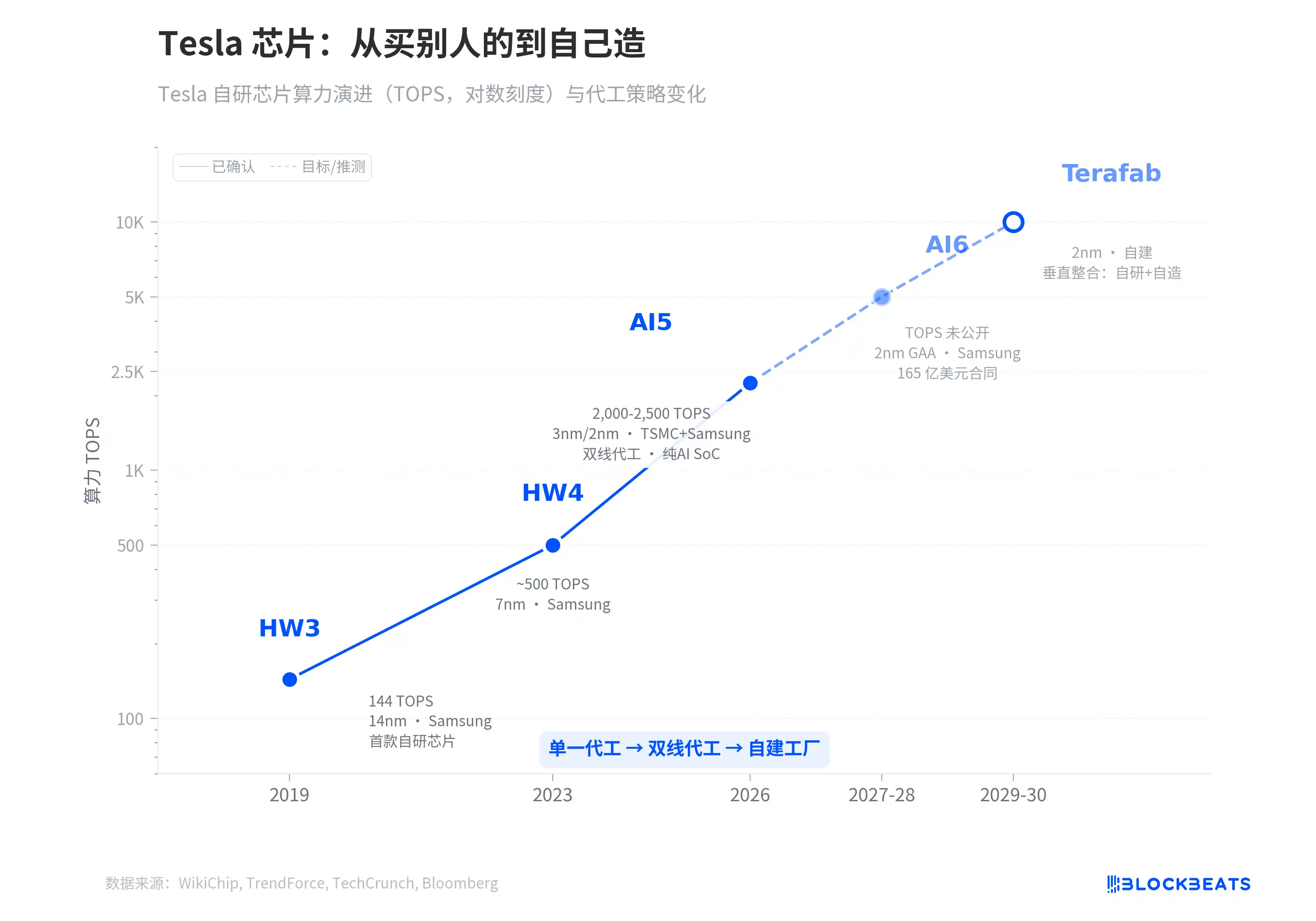
In 2019, Tesla's Chief Architect of Autopilot Chips, Jim Keller, led the team to deliver HW3. This was Tesla's first fully self-developed autonomous driving chip, manufactured on Samsung's 14nm process, with 144 TOPS. By 2023, HW4 upgraded to Samsung's 7nm process, more than tripling the computing power. According to TrendForce, by 2026 with AI5, transitioning to 3nm and 2nm dual-line production, the computing power is heading straight for 2000 to 2500 TOPS. Moreover, the GPU and ISP are completely stripped out, with the entire chip optimized only for transformer inference.
Each generation sees a three to fivefold increase in performance. But the foundry strategy is also evolving in parallel. From HW3's "Samsung-only" approach to AI5's "TSMC and Samsung dual-sourcing," and then to AI6. According to reports from TechCrunch and Bloomberg, AI6 directly signed a $16.5 billion long-term contract with Samsung to secure production capacity until 2033.
Terafab is a natural extension of this trajectory. As reported by Tom's Hardware, Tesla's AI6 contract last year essentially revived Samsung's Taylor fab, a $40 billion fab that had been put on hold due to "no customers." When your chip demand is large enough to support someone else's wafer fab, the next question is, why not build your own.
The AI6 and Terafab nodes on the dotted line segment in the chart are not labeled with specific TOPS because the specifications for these two generations have not been made public. But the trend is clear. Tesla's chip's computing power curve is exponential, and the reliance on foundries has reached an unavoidable point.
The remaining question is time.
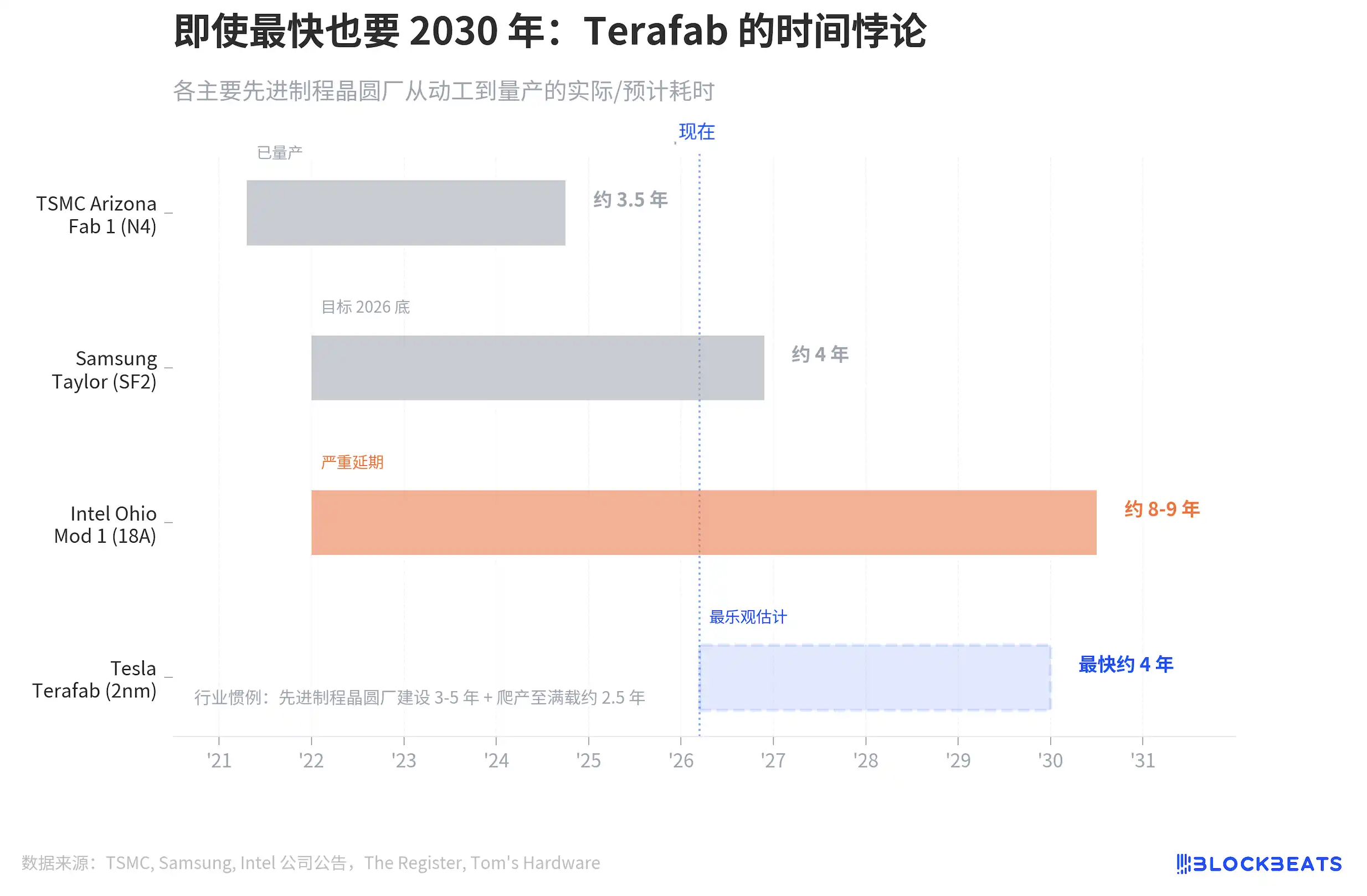
TSMC Arizona Fab 1 took about 3.5 years from groundbreaking to mass production, setting an industry record, but TSMC has thirty years of manufacturing accumulation. Samsung Taylor spent about 4 years, with a pause in the middle due to lack of customers. According to The Register, Intel Ohio is the most tragic, starting in 2022 and now delayed to 2030 to 2031.
Industry convention is construction takes 3 to 5 years, plus 2.5 years to ramp to full load. Even with TSMC's speed given to Tesla, Terafab will not be able to produce chips until late 2029 at the earliest.
This happens to coincide with Tesla's AI chip bottleneck timeframe. AI5's dual-line foundry can support until 2027 to 2028, and AI6's Samsung contract covers until 2033. But if the mass production scale of Optimus robots and Robotaxis explodes in 2029 as Musk plans, external foundry capacity is likely to be insufficient. Terafab doesn't need to produce chips by 2026; it needs to be ready by 2030.
Musk also openly discussed the possibility of collaborating with Intel. Intel has its most advanced 18A process (equivalent to the industry's 2nm level) and idle capacity urgently in need of external customers, while Tesla has clear chip demands and money. If this line goes through, Terafab will not be starting from scratch but will be a marriage of mutual needs.
$25 billion doesn't buy much certainty in chip manufacturing. But it buys a ticket. A ticket that turns Tesla from the largest chip buyer into a chip manufacturer. Looking back at this chart in three years, it will either be the starting point of Tesla's vertical integration strategy or Musk's most expensive pie in the sky.
You may also like

Naval personally takes the stage: The historic collision between ordinary people and venture capital

a16z Crypto: 9 Charts to Understand the Evolution Trends of Stablecoins

Refutation of Yang Haipo's "The End of Cryptocurrency"

Can a hairdryer earn $34,000? Interpreting the reflexivity paradox of prediction markets

6MV Founder: In 2026, the "landmark turning point" for crypto investment has arrived

Abraxas Capital Mints $2.89 Billion USDT: Liquidity Boost or Just More Stablecoin Arbitrage?
Abraxas Capital just received $2.89 billion in freshly minted USDT from Tether. Is this a bullish liquidity injection for crypto markets, or is it business as usual for a stablecoin arbitrage giant? We analyze the data and the likely impact on Bitcoin, altcoins, and DeFi.
A VC from the Crypto world said AI is too crazy, and they are very conservative
The Evolutionary History of Contract Algorithms: A Decade of Perpetual Contracts, the Curtain Has Yet to Fall

Kicked out by PayPal, Musk aims to make a comeback in the cryptocurrency market

Solana ETF News: What Is a Solana ETF and Why Is Goldman Sachs Betting $108 Million on SOL?
Solana ETF news today shows Goldman Sachs disclosed a $108M position while total SOL ETF inflows reached $1.45B. Analysts now expect up to $6B in institutional demand as Solana trades 71% below its all-time high.

Bitcoin ETF News Today: $2.1B Inflows Signal Strong Institutional Demand for BTC
Bitcoin ETFs news recorded $2.1B inflows over 8 consecutive days, marking one of the strongest recent accumulation streaks. Here’s what the latest Bitcoin ETF news means for BTC price and whether the $80K breakout level is next.
Michael Saylor: Winter is Over – Is He Right? 5 Key Data Points (2026)
Michael Saylor tweeted yesterday “Winter‘s Over.” It is short. It is bold. And it has the crypto world talking.
But is he right? Or is this just another CEO pumping his bags?
Let us look at the data. Let us be neutral. Let us see if the ice has really melted.

WEEX Bubbles App Now Live Visualizes the Crypto Market at a Glance
WEEX Bubbles is a standalone app designed to help users quickly understand complex crypto market movements through an intuitive bubble visualization.

Polygon co-founder Sandeep: Writing after the chain bridge chain explosion

Major Upgrade on Web: 10+ Advanced Chart Styles for Deeper Market Insights
To deliver more powerful and professional analysis tools, WEEX has rolled out a major upgrade to its web trading charts—now supporting up to 14 advanced chart styles.
Morning Report | Aethir secures a $260 million enterprise contract with Axe Compute; New Fire Technology acquires Avenir Group's trading team; Polymarket's trading volume surpassed by Kalshi

Why a Million-Follower Crypto KOL Chooses WEEX VIP?
Discover why top crypto KOL Carl Moon partnered with WEEX. Explore the WEEX VIP ecosystem, 1,000 BTC protection fund, and exclusive rewards for serious traders.

CoinEx Founder: The Crypto Endgame in My Eyes
Naval personally takes the stage: The historic collision between ordinary people and venture capital
a16z Crypto: 9 Charts to Understand the Evolution Trends of Stablecoins
Refutation of Yang Haipo's "The End of Cryptocurrency"
Can a hairdryer earn $34,000? Interpreting the reflexivity paradox of prediction markets
6MV Founder: In 2026, the "landmark turning point" for crypto investment has arrived
Abraxas Capital Mints $2.89 Billion USDT: Liquidity Boost or Just More Stablecoin Arbitrage?
Abraxas Capital just received $2.89 billion in freshly minted USDT from Tether. Is this a bullish liquidity injection for crypto markets, or is it business as usual for a stablecoin arbitrage giant? We analyze the data and the likely impact on Bitcoin, altcoins, and DeFi.


 App
App