
 Buy Crypto
- Markets
 Futures
- Spot
- Copy Trade
- Earn
- More
$5 Million Stolen Funds Blocked, Privacy Mixer Railgun Turns Into DeFi Protocol "Clawback Tool"?


Hacker's Loot, Can Actually Be Forced to Return?
On February 12, the zkLend lending protocol on Starknet was hacked, losing nearly $5 million. However, the hacker did not expect that after mixing the money into Railgun, the final step before whitewashing could be immediately blocked by Railgun's protocol policy, forcing a return.
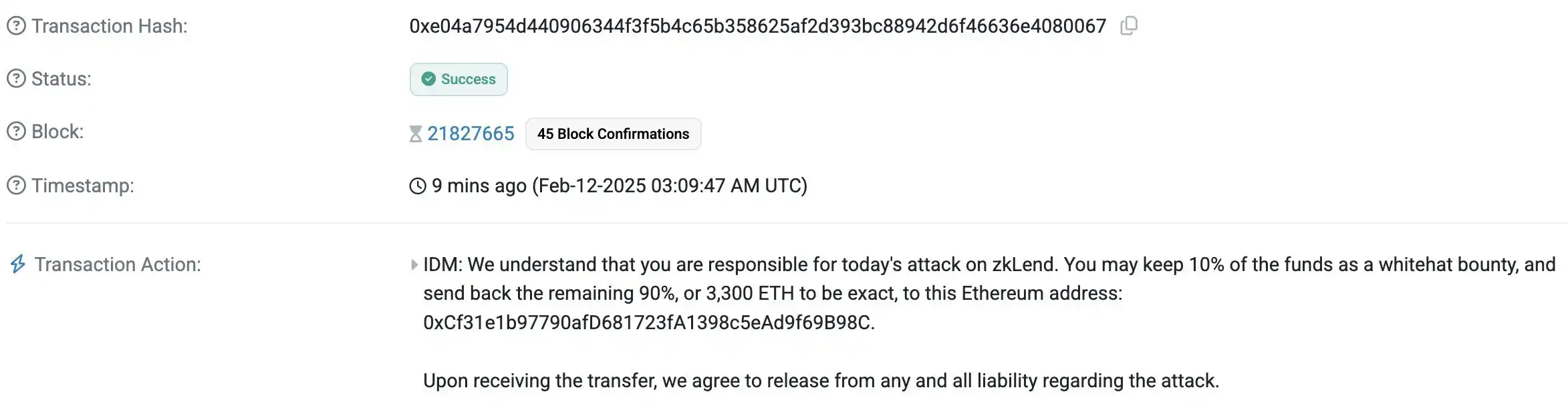
After the incident, zkLend suspended withdrawal services to safeguard the remaining funds and posted a message to the community stating that the team is actively working with multiple partners to track the hacker's identity and fund flow, promising transparency, and eventually will release a detailed investigation analysis report. In addition, zkLend also proposed to the hacker that they could keep 10% of the funds as a white hat bounty, with the remaining 90% (3,300 ETH) being transferred back to zkLend's Ethereum address. Upon receiving the transfer, the hacker would agree to waive any and all liability related to the attack.
As of the time of writing, there has been no response from the hacker regarding this proposal. zkLend posted on social media that they have reported the incident to the Hong Kong Police, the FBI, and the Department of Homeland Security and will initiate legal proceedings.
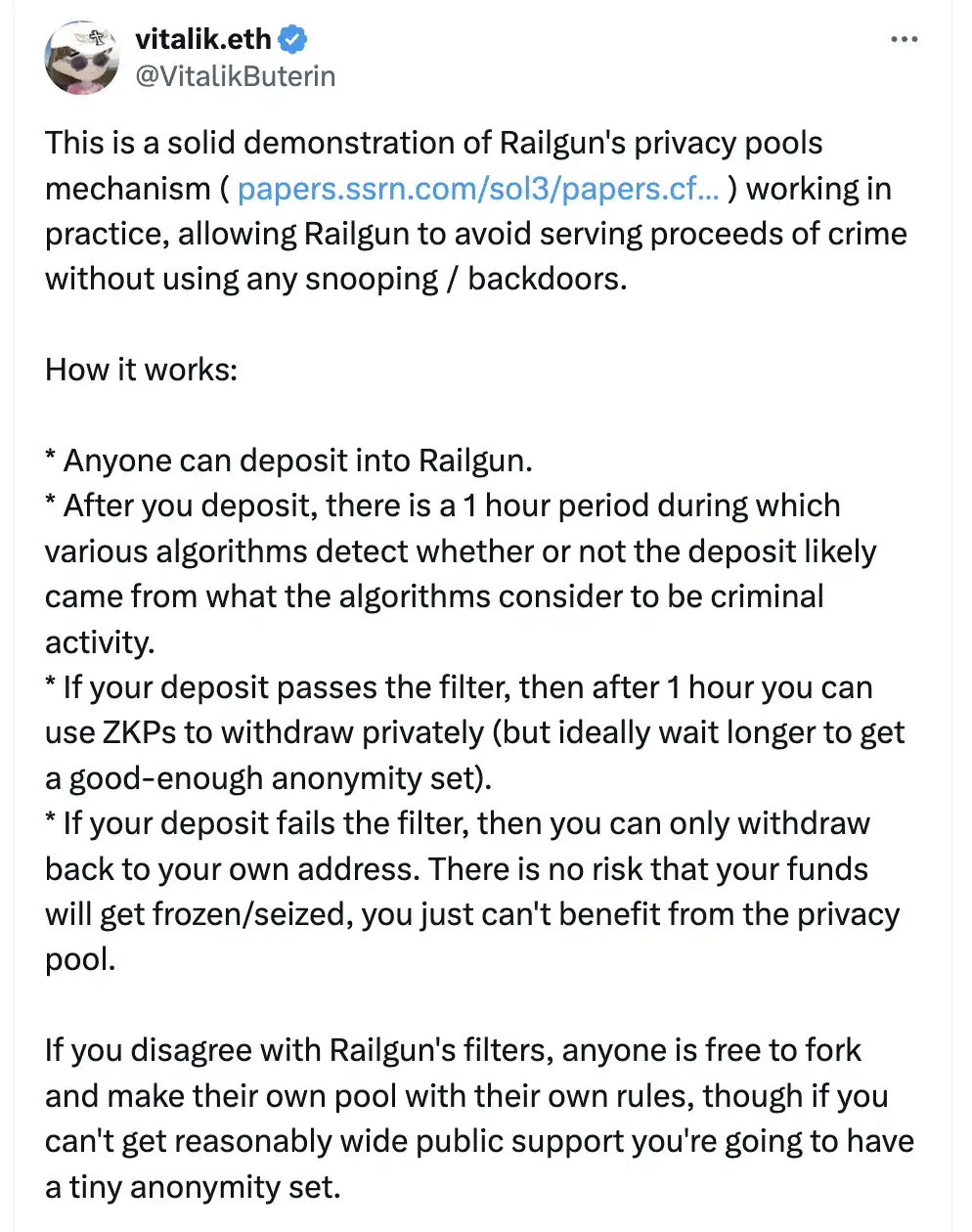
On February 13, Ethereum co-founder Vitalik, who has always supported Railgun, posted on social media, specifically explaining how Railgun successfully avoided dealing with criminal proceeds this time.
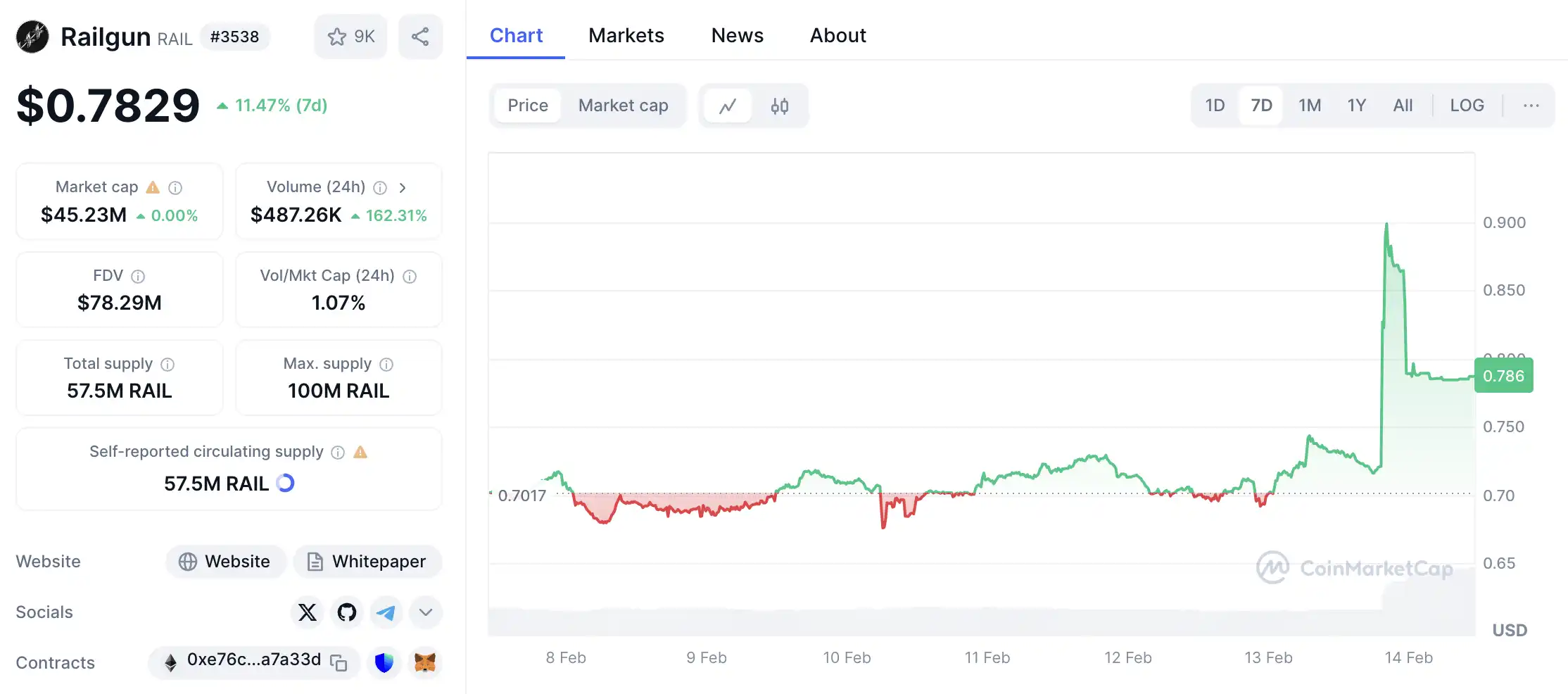
After Vitalik's post, the market's response to this news was very sensitive, and Railgun surged. According to market data, as of the time of writing, Railgun has seen a 7.00% increase in the past 24 hours, with trading volume up 162.31%.
On-Chain Anti-Money Laundering, How Does Railgun Do It?
Speaking of Railgun, this clearly anti-money laundering policy protocol, we have to mention the leading mixer service project, Tornado Cash.
Tornado Cash and Railgun both belong to the privacy track and are the first projects to provide mixer services. Its privacy protection features have made it a tool for hackers and criminals to launder money and hide funds, attracting the attention of governments and regulatory agencies worldwide, especially the U.S. Department of the Treasury's Office of Foreign Assets Control (OFAC) sanctions against it.
In August 2022, the U.S. Department of the Treasury imposed sanctions on Tornado Cash, stating that the service had facilitated money laundering of over $7 billion in the past three years and assisted the North Korean state-sponsored hacker group Lazarus Group in evading U.S. sanctions. In May 2024, one of the founders of Tornado Cash and core developer, Alexey Pertsev, was sentenced to 5 years and 4 months in prison.
Read more: "Guilty Verdict! What Does the Tornado Cash Case Judgment Mean for DeFi Regulation?"
Tornado Cash, due to its lack of anti-money laundering capabilities, became a convenient tool for hackers and money laundering criminals. The regulatory crackdown sounded an alarm for the entire privacy track. Learning from the lessons of Tornado Cash, Railgun, as a frontrunner in the privacy track, naturally had to learn from it and had a clear direction for improvement: anti-money laundering.
Railgun has adopted a more rigorous anti-money laundering strategy, focusing on enhancing compliance while maintaining privacy. The core of this strategy is to ensure that the platform can protect user privacy while effectively meeting regulatory requirements and preventing funds from being used for illicit activities. The following are the specific measures Railgun has taken:
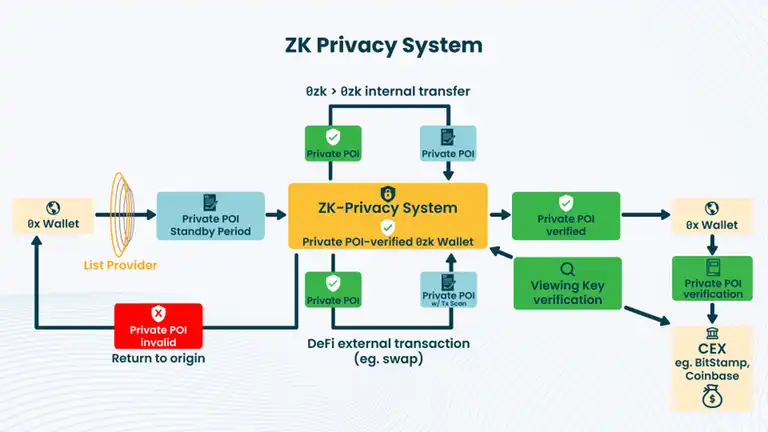
The first step, Railgun did not solely focus on optimizing the code but cleverly compiled a blacklist from regulators, compliance platforms, and other sources. The blacklist covers transaction data related to illegal activities such as money laundering, fraud, and sanctions violations, providing specific targets for precise enforcement.
The second step, after any user makes a deposit, there is a 1-hour detection period during which various algorithms analyze whether the deposit may be related to the blacklist. The entire process is fully encrypted, only outputting a conclusion of "association" or "non-association," without revealing sensitive information such as user addresses, transaction history, or balances, ensuring user privacy is technically protected.
The third step, one hour later, the user can utilize zero-knowledge proofs (ZKPs) for private withdrawals. Additionally, Railgun's internal protocol policy stipulates that if a suspicious address attempts to mix coins, the funds from that suspicious address will be forcibly returned.
Finally, Railgun proactively complies. All proofs generated by user wallets can be provided to exchanges or regulatory agencies, and these third-party entities can verify proof validity through validation algorithms without accessing user fund flows, wallet activity details, or identity data. This mechanism meets external organizations' scrutiny requirements for transaction compliance while completely avoiding the risk of user privacy leaks, achieving "trustless self-attestation."
It is precisely this combination of privacy protection, compliance mechanisms, and risk control strategies that formed the final line of defense in intercepting money laundering attackers in the zkLend incident.

The founder of Slowmist also stated, "This is a very good privacy solution."
Privacy Track, Where to Go Next?
While Railgun is building a regulatory moat, regulatory policies in the United States seem to be easing.
On November 27 last year, the U.S. Fifth Circuit Court of Appeals ruled that the U.S. Treasury Department's sanction on the Tornado Cash smart contract was illegal. For the cryptocurrency community and all who care about defending freedom, this was a historic victory. The founder of Uniswap referred to it as "an immutable smart contract beating the Treasury Department in court."
Will this ruling breed more and more calls in the privacy track for "code is law" while actually fostering criminal projects?
Related Reading: "Comprehensive Analysis of the Privacy Track: Defending Privacy or Fostering Crime, the Revolution Is Not Yet Successful"
Regardless, in the current environment of increasingly clear cryptocurrency regulations post-Trump administration, Railgun, which combines privacy and compliance, should set an example for the development of this track.
You may also like

6MV Founder: In 2026, the "landmark turning point" for crypto investment has arrived

Abraxas Capital Mints $2.89 Billion USDT: Liquidity Boost or Just More Stablecoin Arbitrage?
Abraxas Capital just received $2.89 billion in freshly minted USDT from Tether. Is this a bullish liquidity injection for crypto markets, or is it business as usual for a stablecoin arbitrage giant? We analyze the data and the likely impact on Bitcoin, altcoins, and DeFi.
A VC from the Crypto world said AI is too crazy, and they are very conservative
The Evolutionary History of Contract Algorithms: A Decade of Perpetual Contracts, the Curtain Has Yet to Fall

Kicked out by PayPal, Musk aims to make a comeback in the cryptocurrency market

Solana ETF News: What Is a Solana ETF and Why Is Goldman Sachs Betting $108 Million on SOL?
Solana ETF news today shows Goldman Sachs disclosed a $108M position while total SOL ETF inflows reached $1.45B. Analysts now expect up to $6B in institutional demand as Solana trades 71% below its all-time high.

Bitcoin ETF News Today: $2.1B Inflows Signal Strong Institutional Demand for BTC
Bitcoin ETFs news recorded $2.1B inflows over 8 consecutive days, marking one of the strongest recent accumulation streaks. Here’s what the latest Bitcoin ETF news means for BTC price and whether the $80K breakout level is next.
Michael Saylor: Winter is Over – Is He Right? 5 Key Data Points (2026)
Michael Saylor tweeted yesterday “Winter‘s Over.” It is short. It is bold. And it has the crypto world talking.
But is he right? Or is this just another CEO pumping his bags?
Let us look at the data. Let us be neutral. Let us see if the ice has really melted.

WEEX Bubbles App Now Live Visualizes the Crypto Market at a Glance
WEEX Bubbles is a standalone app designed to help users quickly understand complex crypto market movements through an intuitive bubble visualization.

Polygon co-founder Sandeep: Writing after the chain bridge chain explosion

Major Upgrade on Web: 10+ Advanced Chart Styles for Deeper Market Insights
To deliver more powerful and professional analysis tools, WEEX has rolled out a major upgrade to its web trading charts—now supporting up to 14 advanced chart styles.

Morning Report | Aethir secures a $260 million enterprise contract with Axe Compute; New Fire Technology acquires Avenir Group's trading team; Polymarket's trading volume surpassed by Kalshi

Why a Million-Follower Crypto KOL Chooses WEEX VIP?
Discover why top crypto KOL Carl Moon partnered with WEEX. Explore the WEEX VIP ecosystem, 1,000 BTC protection fund, and exclusive rewards for serious traders.

CoinEx Founder: The Crypto Endgame in My Eyes

Spark Coin (SPK): Explodes 73% as Aave Bleeds $15B, A Good Investment Now?
Spark coin (SPK) surged 73% as $15 billion fled Aave after the KelpDAO hack. This article explains what Spark is, why it’s pumping, and whether it is a good investment right now.

As Aave's building collapses, Spark's high-rise is rising

RootData: Q1 2026 Cryptocurrency Exchange Transparency Research Report

What Is Memecoin Trading? A Beginner's Guide to How It Works, the Risks, and 2026's Hottest Tokens
Memecoins surged 30%+ at the start of 2026 while Bitcoin was flat. RAVE spiked 4,500% then crashed 90% in days. MAGA jumped 350% overnight. This guide explains exactly how memecoin trading works — and how to not blow up your account doing it.
6MV Founder: In 2026, the "landmark turning point" for crypto investment has arrived
Abraxas Capital Mints $2.89 Billion USDT: Liquidity Boost or Just More Stablecoin Arbitrage?
Abraxas Capital just received $2.89 billion in freshly minted USDT from Tether. Is this a bullish liquidity injection for crypto markets, or is it business as usual for a stablecoin arbitrage giant? We analyze the data and the likely impact on Bitcoin, altcoins, and DeFi.
A VC from the Crypto world said AI is too crazy, and they are very conservative
The Evolutionary History of Contract Algorithms: A Decade of Perpetual Contracts, the Curtain Has Yet to Fall
Kicked out by PayPal, Musk aims to make a comeback in the cryptocurrency market
Solana ETF News: What Is a Solana ETF and Why Is Goldman Sachs Betting $108 Million on SOL?
Solana ETF news today shows Goldman Sachs disclosed a $108M position while total SOL ETF inflows reached $1.45B. Analysts now expect up to $6B in institutional demand as Solana trades 71% below its all-time high.






 App
App