
 Buy Crypto
- Markets
 Futures
- Spot
- Copy Trade
- Earn
- More
Daily Chart Showing Three "Doji Stars" - Is a Big Swing Coming? | Trader's Insight

The Bitcoin price fluctuated under multiple bearish factors and market speculation, showing a characteristic of "rapid rise and fall, tug of war between longs and shorts." The price fluctuated from a high of $99,168 on February 6 to a low of $95,320 on February 10, during which it failed to break through the $100,000 psychological barrier several times. Although there were bullish signals such as "breaking above the Bollinger Band upper boundary" and "Fibonacci extension target of $166,000," the uncertainty of the Trump administration's policies (repeated tariffs on Mexico and Canada, the fabrication of a cryptocurrency committee) combined with the dampening of the Fed interest rate cut expectations have shifted market sentiment from "eternal bull market" to "cautious wait-and-see."
It is worth noting that on February 7, Bitcoin briefly surged to $100,154, but then plummeted due to Ethereum Foundation selling and rumors of the U.S. Department of Justice planning to liquidate $6.5 billion in seized bitcoins, causing panic selling and quickly dropping the price into the $95,000 range. Traders' opinions on the market divergence intensified: some believe that the current situation is a "leverage cleanup and healthy pullback," with pinbars on the weekly chart indicating main force accumulation and the MACD green column regression signaling a rebound; while others worry that the "Trump effect" has been fully priced in by the market, the technical flag correction may turn into a "bull trap," and in the short term, it may test the $90,000 support level. The rumor of the Trump family fund's exit and ETH further deepens the trust crack in the policy narrative, with some investors joking that the "myth of getting rich overnight and thunder without rain are surprisingly both hands of the same government."
Analyst DOM identified an unprecedented "Doji" formation on Bitcoin's daily chart, a shape that usually heralds market uncertainty, similar to the trend after the FTX crash in November 2022. DOM stated, "For the first time in Bitcoin's 15-year history, we have seen three consecutive 'extreme Doji' candlesticks, with each candle's body accounting for less than 0.05% of the entire candle range. This indicates extreme market indecision, foreshadows a significant upcoming fluctuation." How do traders view this? Let's take a look at traders' perspectives in the market.

Technical Analysis
@Crypto_Laowai
BTC Short-term Key Levels. Pressured by the yellow trendline. 4-hour resistance at 98120, breaking above will target 102-103k. Pressured pullback eyes 93600 for liquidity grab. But whether going up directly or after a dip, 102-103k is the high probability zone to test in the near future.

@Patrade_Buer
BTC's trend view remains unchanged: Weekly oscillation (indicating exhaustion before further rise);
Daily downtrend, currently in a bearish trend. There is a probability of upward liquidity grab at the hourly level, with IDM liquidity and EQH liquidity being built up above, leaning towards liquidity acquisition on the upside. Looking slightly above, targets at $99,700, $102,000 with a bearish outlook at $106,000. Here, in the contract, it needs to be seen if a pullback can be given down to around 965 to grab FVG liquidity for better buying opportunity in OB buy-in.
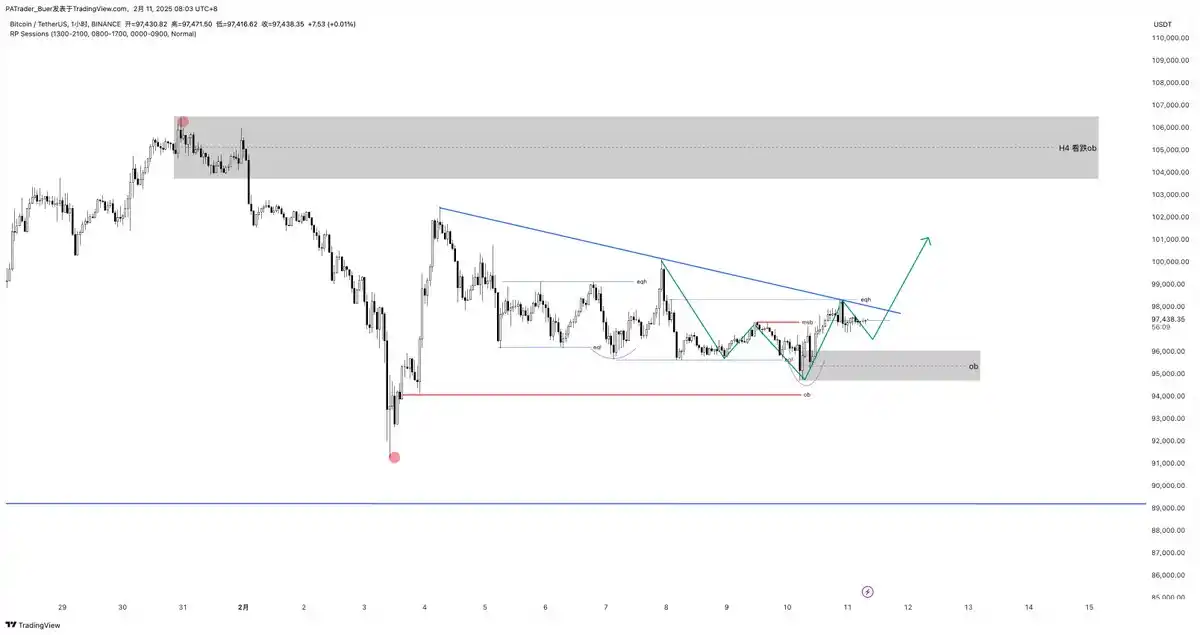
@Murphy_Chen
In BTC history, after a weekly chart forms a high-cross death, the rebound generally ranges around 15%-20%. If calculated based on the current $97,000, a maximum rebound of 20% would be up to $116,400.
It happens to fall just above the orange line and below the red line.
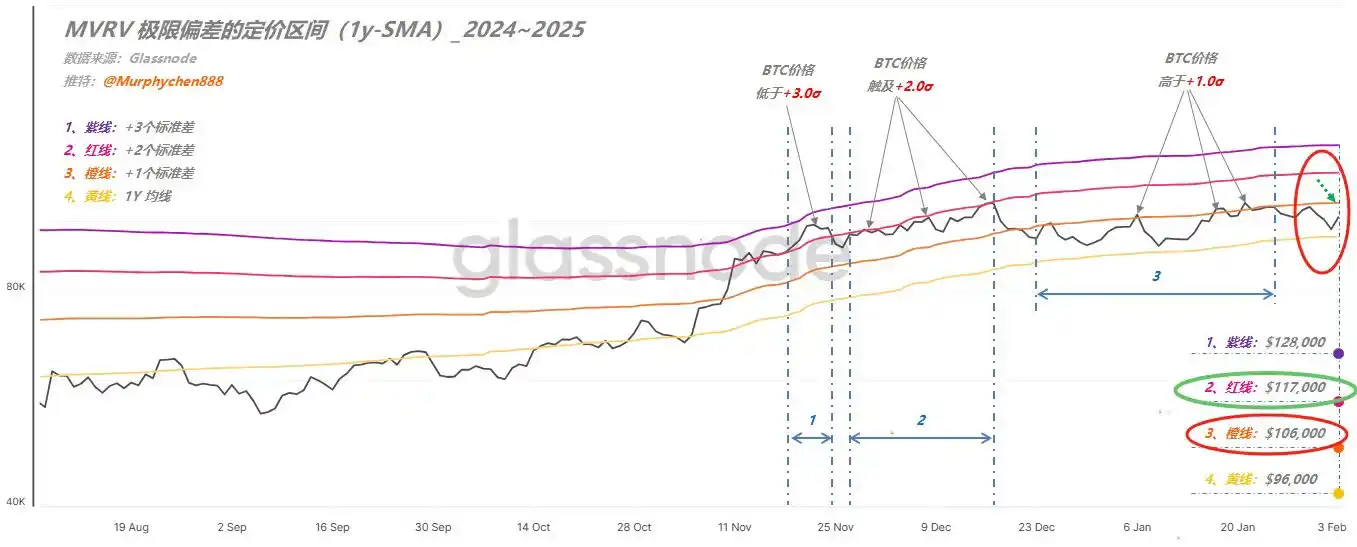
According to the data speculated in my previous article "Observing a Trend's Pricing Range Using Extreme Deviation Bands," this may be the limit position of this round of trend rebound.
In simple terms, within the context of "trend attenuation," there will be a rebound, but it may not necessarily reach the extreme limit. I don't know if this is a coincidence, the on-chain data and candlestick technology mutually confirming each other.
Macro Analysis
@Maoshu_CN
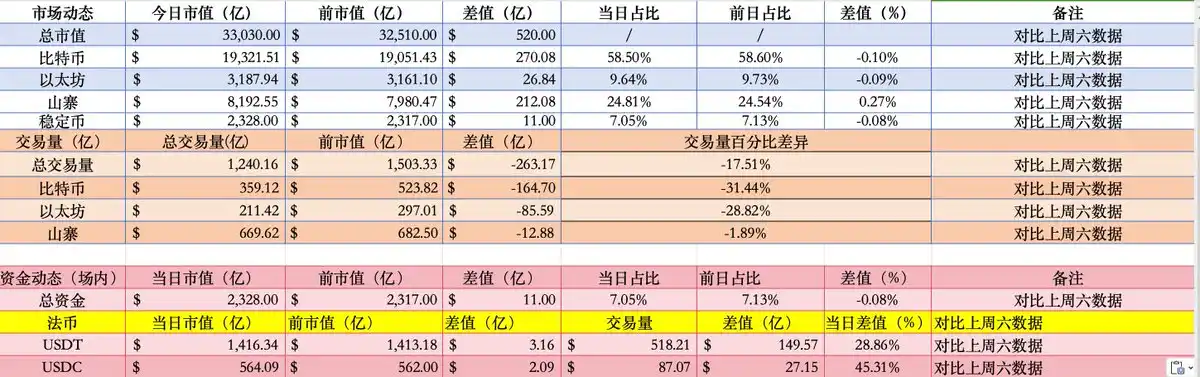
February 10th Data Recording Discrepancy: Funds saw a slight outflow in the Asia-Europe region, while funds continued to flow into the US region, and market activity gradually recovered.
As Monday progressed, market heat gradually picked up, market capitalization saw a slight increase, the share of altcoins increased slightly, BTC's share decreased slightly, and ETH continued to weaken, with its share following suit.
In terms of trading volume, compared to last Saturday, there was still a decline. The Asia-Europe market was quiet on Monday, only waiting for the formal opening of the US market tonight to activate the market.
Funds continued to flow into the market, with on-exchange funds increasing by another $1.1 billion, bringing the total to $232.8 billion.
USDT: Official website data shows $141.618 billion. Compared to last Saturday, there was a slight outflow of funds in the Asia-Europe market. Fund activity increased, with some funds exiting after trading, indicating that confidence in the Asia-Europe market was temporarily lacking on Monday.
USDC: Data sources show an increase of $209 million in funds, with increased activity. Funds from the US region continue to flow in.
As the US stock market opened, tech stocks and large metal companies led the market higher, with the four major indices following pre-market trends, maintaining their upward trajectory!
Gold prices continued to rise, and the 10-year US Treasury bond yield experienced a short-term decline, causing bond prices to rise and yields to fall.
Still on the same "theme" as last week—tariffs—however, the reactions and trends are quite different. As we mentioned earlier today, the risk market is becoming "desensitized" to tariff issues, but risk liquidity is still being significantly diverted. In the short term, gold, long-term bonds, and US stocks have all diverted risk liquidity, with the cryptocurrency market showing an expected short-term "split."
@Phyrex_Ni
The momentum of the rise in the US stock market after the opening is quite good, especially NVIDIA, which seems to have emerged from the shadow of DeepSeek, achieving a five-day winning streak, striving to fill the price gap below.
Trump mentioned that so far, prices have not helped AI and cryptocurrency, but this is ultimately a long-term matter. It won't rise today just because of something said today; it also requires the cooperation and support of various departments. Many states in the US have started strategic reserve layouts thanks to this. Many policies that are starting to adjust are also benefiting from this, and even the strategic reserve has not been truly implemented yet.
So I think AI is like a mirror. Through the mirror of AI, you can see the future of cryptocurrency. Both of these tracks are currently supported by the US government, and both the Democratic and Republican parties are in support. I really can't think of any bearish news that can fight against the government machinery other than an economic recession. But at least BTC has not collapsed, and investors still maintain enough patience.
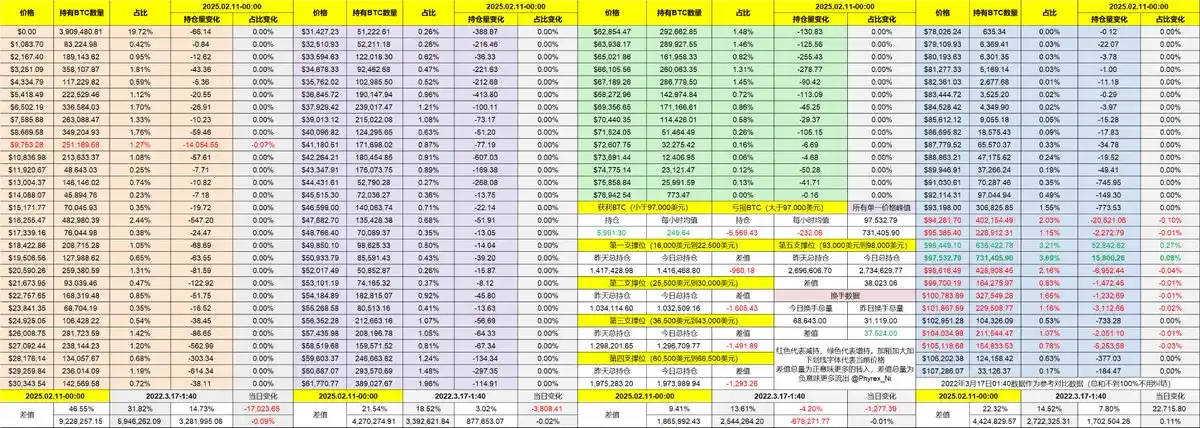
Looking back at the current data, starting from Monday, BTC's turnover is still very low, and a large number of investors are still in a wait-and-see mode. This state is increasingly resembling the two junk times that have occurred before. The definition of junk time is that neither buying nor selling is desired, and everyone is waiting for a better opportunity. However, as long as the current support level is not broken for BTC, investor sentiment will still be intact.
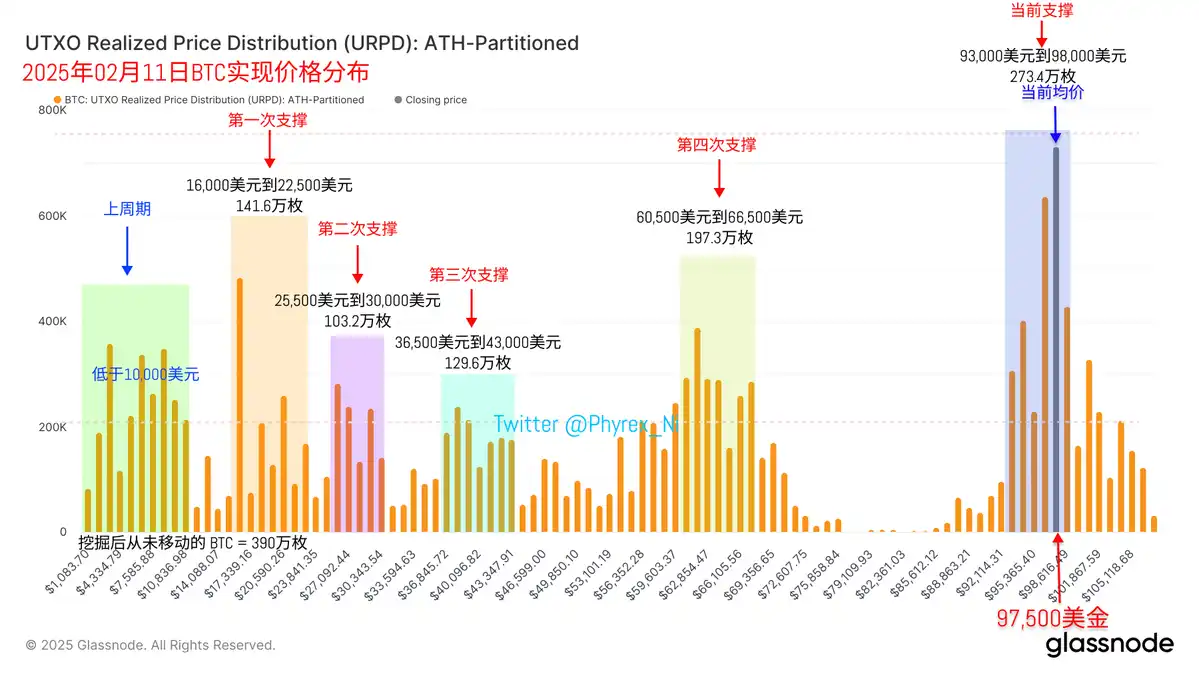
Currently, the support between $93,000 and $98,000 is still strong, and there are no signs of trouble yet. Moreover, BTC has been oscillating around $97,000 recently, which may not necessarily be a bad thing. After shaking off the weak hands, it will be more beneficial for the future market outlook.
Data Analysis
@Xbt886
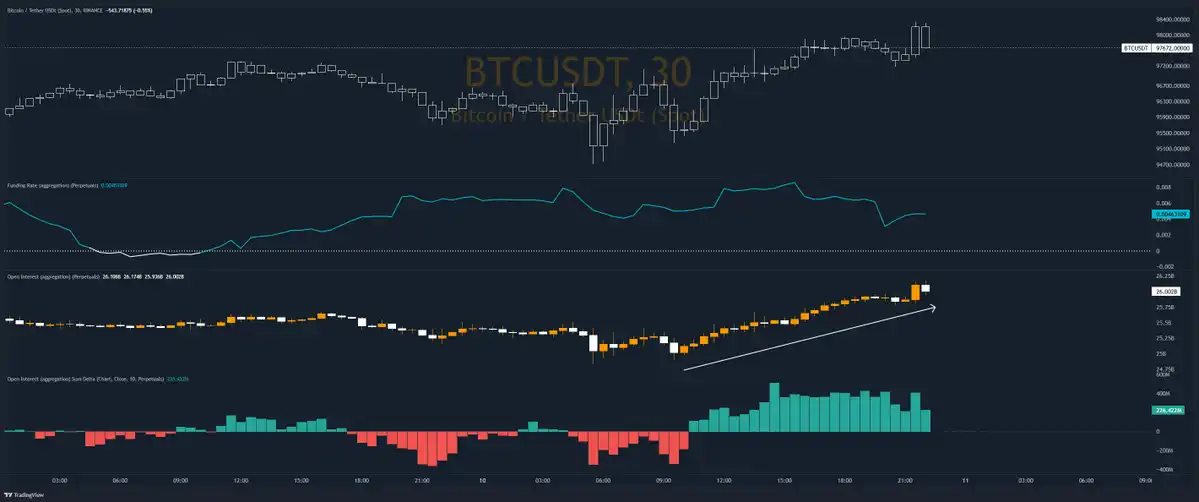
Futures longs chasing the price to open positions often lead to unsustainable price increases driven by futures.
@Phyrex_Ni
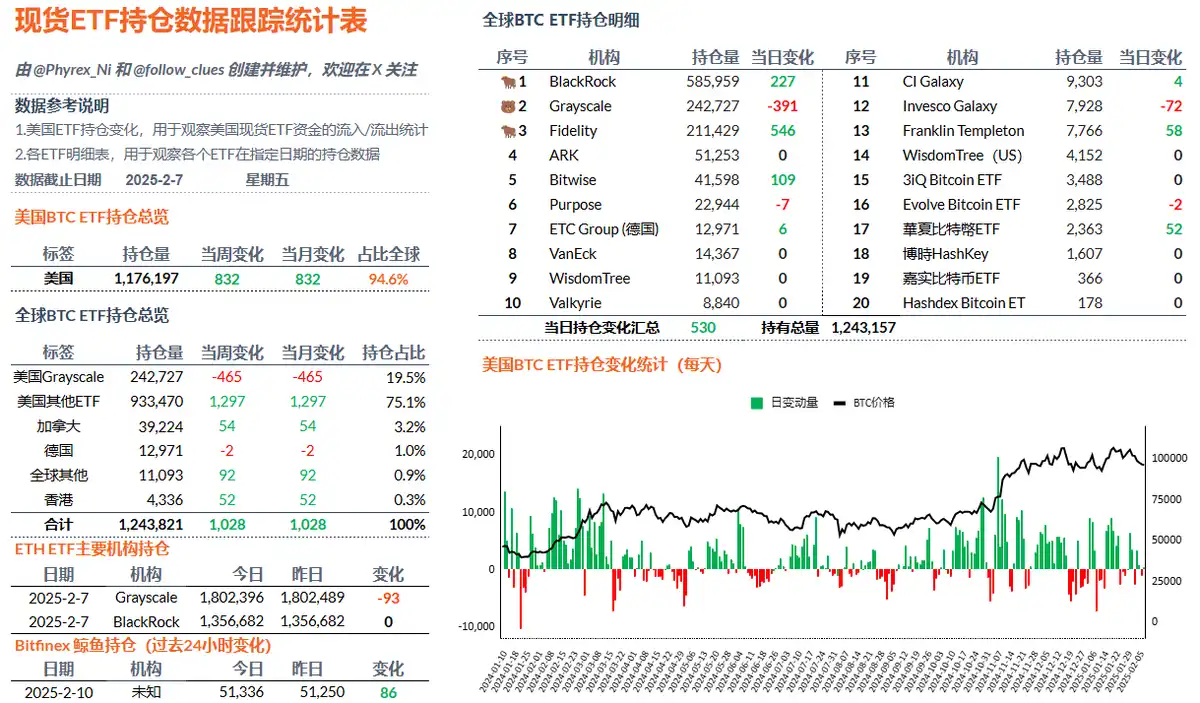
Although ETH's data is not very promising, BTC's data is slightly more optimistic. At least BTC is still maintaining a net inflow status. Both BlackRock and Fidelity have had small-scale inflows, showing that investor sentiment towards BTC is still stronger than towards ETH. The sell-off is only from Grayscale's GBTC and JPMorgan Chase, totaling 516 BTC, which is not a significant amount.
From the current situation, whether it's BTC or ETH, the buying power is not strong without new positive catalysts. The buyer's market can only maintain a very scattered presence. When there is positive news, although the temporary buy-side data looks good, user sentiment quickly deteriorates, making it difficult to sustain a continuous bullish trend. It seems that the current issue is mainly poor liquidity.
The data for BTC's spot ETF in the 56th week is not favorable, as compared to the 55th week, U.S. investors' net buying power has decreased by 62% to only 38%. This decline from the 55th week to the 54th week is also evident. Therefore, it is clear that in the past three weeks, investor sentiment has not reached the FOMO state, naturally providing less support for the price.
However, it is still noticeable that more investors are still expecting BTC to have a better upward trend. After all, the new U.S. government is quite supportive of cryptocurrency.
You may also like

6MV Founder: In 2026, the "landmark turning point" for crypto investment has arrived

Abraxas Capital Mints $2.89 Billion USDT: Liquidity Boost or Just More Stablecoin Arbitrage?
Abraxas Capital just received $2.89 billion in freshly minted USDT from Tether. Is this a bullish liquidity injection for crypto markets, or is it business as usual for a stablecoin arbitrage giant? We analyze the data and the likely impact on Bitcoin, altcoins, and DeFi.
A VC from the Crypto world said AI is too crazy, and they are very conservative
The Evolutionary History of Contract Algorithms: A Decade of Perpetual Contracts, the Curtain Has Yet to Fall

Kicked out by PayPal, Musk aims to make a comeback in the cryptocurrency market

Solana ETF News: What Is a Solana ETF and Why Is Goldman Sachs Betting $108 Million on SOL?
Solana ETF news today shows Goldman Sachs disclosed a $108M position while total SOL ETF inflows reached $1.45B. Analysts now expect up to $6B in institutional demand as Solana trades 71% below its all-time high.

Bitcoin ETF News Today: $2.1B Inflows Signal Strong Institutional Demand for BTC
Bitcoin ETFs news recorded $2.1B inflows over 8 consecutive days, marking one of the strongest recent accumulation streaks. Here’s what the latest Bitcoin ETF news means for BTC price and whether the $80K breakout level is next.
Michael Saylor: Winter is Over – Is He Right? 5 Key Data Points (2026)
Michael Saylor tweeted yesterday “Winter‘s Over.” It is short. It is bold. And it has the crypto world talking.
But is he right? Or is this just another CEO pumping his bags?
Let us look at the data. Let us be neutral. Let us see if the ice has really melted.

WEEX Bubbles App Now Live Visualizes the Crypto Market at a Glance
WEEX Bubbles is a standalone app designed to help users quickly understand complex crypto market movements through an intuitive bubble visualization.

Polygon co-founder Sandeep: Writing after the chain bridge chain explosion

Major Upgrade on Web: 10+ Advanced Chart Styles for Deeper Market Insights
To deliver more powerful and professional analysis tools, WEEX has rolled out a major upgrade to its web trading charts—now supporting up to 14 advanced chart styles.

Morning Report | Aethir secures a $260 million enterprise contract with Axe Compute; New Fire Technology acquires Avenir Group's trading team; Polymarket's trading volume surpassed by Kalshi

Why a Million-Follower Crypto KOL Chooses WEEX VIP?
Discover why top crypto KOL Carl Moon partnered with WEEX. Explore the WEEX VIP ecosystem, 1,000 BTC protection fund, and exclusive rewards for serious traders.

CoinEx Founder: The Crypto Endgame in My Eyes

Spark Coin (SPK): Explodes 73% as Aave Bleeds $15B, A Good Investment Now?
Spark coin (SPK) surged 73% as $15 billion fled Aave after the KelpDAO hack. This article explains what Spark is, why it’s pumping, and whether it is a good investment right now.

As Aave's building collapses, Spark's high-rise is rising

RootData: Q1 2026 Cryptocurrency Exchange Transparency Research Report

What Is Memecoin Trading? A Beginner's Guide to How It Works, the Risks, and 2026's Hottest Tokens
Memecoins surged 30%+ at the start of 2026 while Bitcoin was flat. RAVE spiked 4,500% then crashed 90% in days. MAGA jumped 350% overnight. This guide explains exactly how memecoin trading works — and how to not blow up your account doing it.
6MV Founder: In 2026, the "landmark turning point" for crypto investment has arrived
Abraxas Capital Mints $2.89 Billion USDT: Liquidity Boost or Just More Stablecoin Arbitrage?
Abraxas Capital just received $2.89 billion in freshly minted USDT from Tether. Is this a bullish liquidity injection for crypto markets, or is it business as usual for a stablecoin arbitrage giant? We analyze the data and the likely impact on Bitcoin, altcoins, and DeFi.
A VC from the Crypto world said AI is too crazy, and they are very conservative
The Evolutionary History of Contract Algorithms: A Decade of Perpetual Contracts, the Curtain Has Yet to Fall
Kicked out by PayPal, Musk aims to make a comeback in the cryptocurrency market
Solana ETF News: What Is a Solana ETF and Why Is Goldman Sachs Betting $108 Million on SOL?
Solana ETF news today shows Goldman Sachs disclosed a $108M position while total SOL ETF inflows reached $1.45B. Analysts now expect up to $6B in institutional demand as Solana trades 71% below its all-time high.


 App
App