
 Buy Crypto
- Markets
 Futures
- Spot
- Copy Trade
- Earn
- More
DeFi's Comeback Secret Weapon: Buyback, Fee Switch, and Dividend Future Vision




Original Article Title: DeFi's Growing Focus on Token Value Accrual
Original Article Author: @ManoppoMarco, primitivecrypto Investor
Original Article Translation: zhouzhou, BlockBeats
Editor's Note: DeFi protocols are accelerating the accumulation of value for token holders, with protocols such as Aave, Ethena, Hyperliquid, and Jupiter implementing buyback plans, fee switches, and new incentive structures. Ethena plans to enable a fee switch to share revenue with stakers and is currently achieving key milestones. Other protocols are also enhancing token value through buybacks, fee distribution, and governance optimization.
The following is the original content (reorganized for better readability):
If you've spent 8-9 figures on growth but haven't seen at least linear revenue growth, buybacks may not be a bad thing. DeFi protocols are facing increasing pressure to distribute some of the revenue to token holders. Major projects like Aave, Ethena, and Hyperliquid are exploring how to introduce a value accrual mechanism for their native tokens.
The key driving force behind this trend? Donald Trump's election, which has brought a more favorable regulatory environment for DeFi. Here are the latest updates on the tokenomics of Aave, Athena, Jupiter, and Hyperliquid, including their buyback plans and fee adjustments.
AAVE
Aave has just introduced a significant tokenomics reform focusing on buybacks, fee distribution, and providing better incentives for token holders. According to Marc Zeller, founder of the Aave Chan Initiative (ACI), this is one of the most important proposals in Aave's history.
Buyback & Fee Adjustment
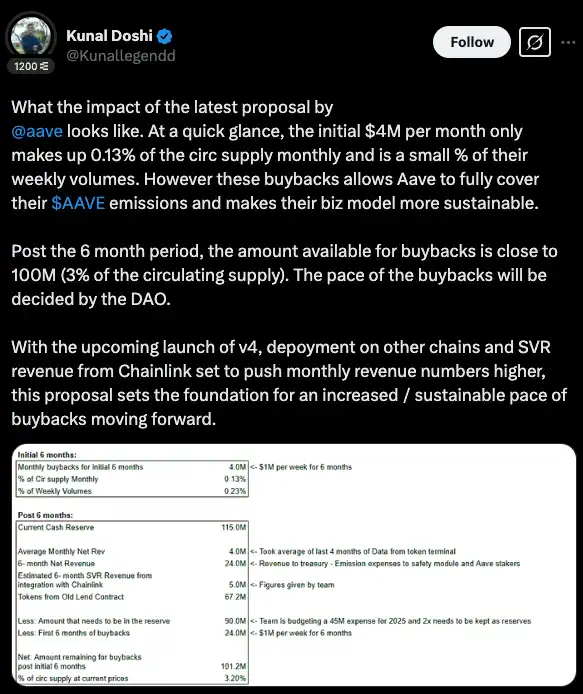
Aave has launched a six-month buyback plan, committing $1 million weekly (approximately $4 million monthly) to cover AAVE token emissions and enhance protocol sustainability. After six months, the buyback treasury could reach $100 million (roughly 3% of the circulating supply), and the specific deployment pace will be determined by the DAO.
What is the goal? To control token emissions while enhancing Aave's treasury strength.
New Financial & Governance Initiatives
Aave is establishing the Aave Financial Committee (AFC), dedicated to treasury fund management and liquidity strategy. Additionally, Aave is completing the transition from the LEND token, reclaiming 320,000 AAVE tokens (approximately $65 million) for future use.
Umbrella: Aave's New Risk Management System:
Aave spends $27 million annually on liquidity costs, so the Umbrella system has been introduced to optimize capital efficiency and reduce risk. This system will be integrated across multiple blockchains, including Ethereum, Avalanche, Arbitrum, Gnosis, and Base.
Anti-GHO: A New Incentive Mechanism for Stablecoin Holders:
Anti-GHO, as a brand-new incentive mechanism, will replace the old discount model for GHO holders. Held tokens can be burned at a 1:1 ratio to offset GHO debt or converted to StkGHO, aligning the incentive mechanism directly with Aave's revenue. This mechanism is still in development and may be introduced as part of a future "Aavenomics Part Two" update.
What's Next?
With the release of Aave v4, more on-chain deployments, and additional income from Chainlink SVR, this update sets the foundation for a larger-scale, more sustainable buyback in the future.
Jupiter
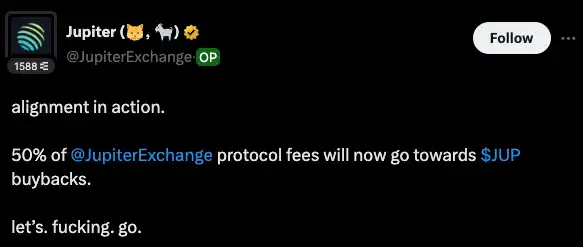
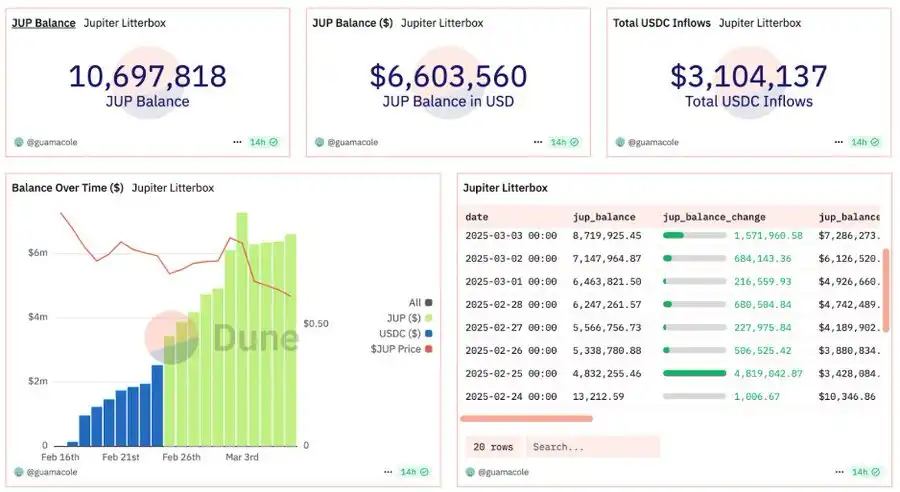
Since February 17, 2025, Jupiter has started allocating 50% of protocol fees to buy back and lock up JUP tokens for three years. This initiative aims to reduce circulating supply, enhance long-term stability, and promote user participation in the Solana ecosystem. In February of this year, Jupiter completed its first buyback, purchasing 48,800 JUP tokens for $3.33 million. Currently, Jupiter's Litterbox Trust buyback program has accumulated repurchases of over 10 million JUP tokens (approximately $6 million).
What's Next?
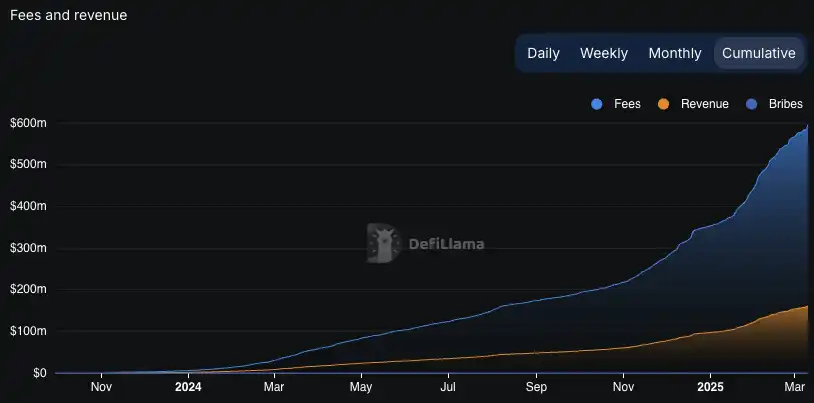
On an annual basis, Jupiter's $3.33 million buyback size is equivalent to an annual buyback amount exceeding $35 million. If we take a more aggressive estimate, with Jupiter's 2024 revenue projected at $102 million, this implies that the buyback size could exceed $50 million.
Hyperliquid
Token Distribution
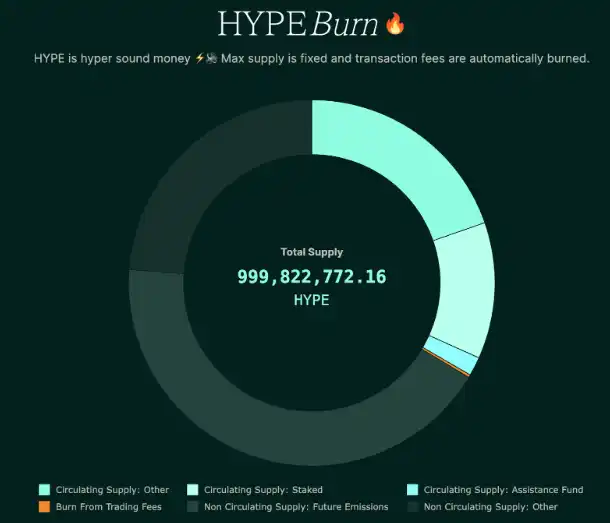
Hyperliquid's native token HYPE has a total supply of 1 billion, with no fundraising and no investor allocation. The specific distribution is as follows:
· 31.0%: Airdropped to early users (fully circulating)
· 38.888%: Reserved for future emission and community rewards
· 23.8%: Team allocation, locked for 1 year, with most unlocking in 2027-2028
· 6.0%: Hyper Foundation
· 0.3%: Community grants
· 0.012%: HIP-2
The team-to-community token ratio is 3:7, with the largest non-team holder being the Assistance Fund (AF), holding 1.16% of the total supply, accounting for 3.74% of the circulating supply.
Revenue Model & Buyback Mechanism
Hyperliquid's main sources of revenue include transaction fees (spot + derivatives) and HIP-1 auction fees. As Hyperliquid L1 currently does not charge Gas fees, Gas-related revenue is not included for now.
Revenue Distribution
· 46% of perpetual contract trading fees allocated to HLP holders (supply-side rewards)
· 54% used to buy back HYPE via the Assistance Fund (AF)
In addition, HIP-1 auction fees and the spot trading fees (USDC portion) are currently all used for HYPE token buybacks.
Dual Deflation Mechanism
· Buyback: AF uses a portion of revenue to buy back HYPE tokens, which are not burned but held by the AF
·Burn:
1. All HYPE-denominated spot trading fees (such as the HYPE-USDC pair) will be directly burned
2. After the HyperEVM mainnet launch, all Gas fees will also be paid in HYPE and burned
Buyback Impact & Staking Mechanism
Based on publicly available Hyperliquid transaction fee data, estimated as of March 2025, AF will initiate a buyback using 54% of perpetual contract revenue, expecting to repurchase approximately 2.5 million HYPE tokens monthly, worth around $35 million. HYPE staking was launched on December 30, 2024, utilizing a PoS reward mechanism (similar to Ethereum), with a current annual return rate of about 2.5%. Currently, 30 million HYPE tokens have been staked (excluding the 3 billion tokens held by the team/foundation).

Future Outlook
Hyperliquid may introduce a fee-sharing model to allocate a portion of on-chain transaction fees directly to HYPE holders to create a more sustainable incentive system. However, some believe that the current model can generate a stronger flywheel effect in market fluctuations.
Hyperliquid's revenue mainly comes from transaction fees and HIP-1 auction fees and may also expand to include revenue sources such as HyperEVM transactions in the future. Currently, apart from being used for buybacks and incentives, a portion of the transaction fees can also:
· Be distributed based on holdings or staking amounts to HYPE holders.
· Reward long-term stakers to drive deeper community participation.
· Be deposited into a community treasury for governance-determined purposes.
Possible Distribution Models:
· Direct Fee Sharing:
A portion of the transaction fees converted to USDC or HYPE, regularly distributed to token holders (similar to dividends).
· Staking Enhancement Rewards:
Only users staking HYPE will receive a share to incentivize long-term holding.
·Hybrid Mode:
Combining Fee Sharing + HYPE Buyback, balancing price support with holding incentives.
Ethena
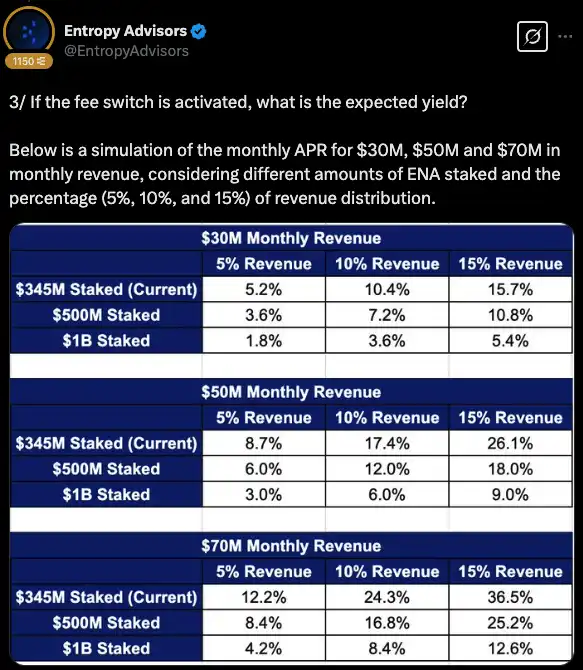
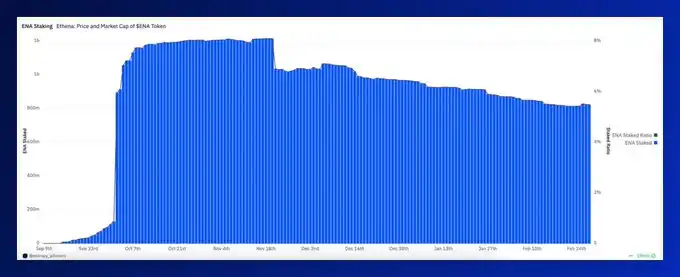
Ethena Labs has now entered the top five DeFi protocols by TVL, with annual revenue exceeding 300 million USD. As the protocol grows, Wintermute's fee-sharing proposal has been approved by the Ethena Risk Committee. Currently, 824 million ENA tokens (worth 324 million USD) are staked, accounting for 5.5% of the total supply, but stakers can only receive governance rewards and unclaimed ENA airdrops, without benefiting from Ethena's generated revenue sharing.
Ethena Fee Switch and Future Plans:
The activation of the fee switch will provide stakers with a direct revenue-sharing opportunity and enhance DAO governance effectiveness through alignment with ENA holders' incentives. Ethena's revenue primarily comes from perpetual contract market funding rates. Currently, 100% of the revenue is distributed to USDe stakers and the reserve fund. In the past three months, the average monthly revenue has been 50 million USD.
Preparation before Enabling Fee Switch: The Risk Committee has set five key metrics to ensure Ethena is in a stable position before sharing revenue.
Current Metrics Progress:
·USDe Supply Target: 6B – Target gap is now only 9%.
·Cumulative Revenue: 250M+ – Reached 330 million USD in January, exceeding the target.
·Exchange Integration: Binance/OKX – No schedule yet, but Binance currently holds 4 million USDe.
·Reserve Fund Share ≥ 1% of USDe Supply – A 61 million USD reserve supports 6.1 billion USDe.
·sUSDe vs. sUSDS APY Spread ≥ 5% – Due to market downturn, the spread has narrowed, but it may widen again in the future.
Future Outlook
Ethena is nearing its target, but the fee switch will remain paused until all metrics are met. During this time, the team will focus on USDe supply growth, ensuring more exchange integrations, and monitoring the market situation.
Once all conditions are met, ENA stakers will be able to start enjoying revenue sharing.
Summary
Key DeFi protocols are accelerating the transition towards token holder value accrual, with Aave, Ethena, Hyperliquid, and Jupiter implementing buyback programs, fee switches, and new incentive structures to make their tokens more valuable beyond speculation.
This trend reflects the industry's overall shift towards sustainable tokenomics, with projects placing more emphasis on real revenue distribution rather than inflationary incentives.
Aave leverages its deep reserves to support buybacks and governance improvements, Ethena is committed to providing direct revenue sharing to stakers, Hyperliquid optimizes its buyback and fee distribution model, and Jupiter locks up buyback tokens to stabilize the supply.
With the gradual improvement of the regulatory environment and the maturation of DeFi, protocols that succeed in aligning with community incentives will experience significant growth.
You may also like

Tom Lee's Ethereum Thesis: Why the Man Who Called the Last Cycle Is Doubling Down on Bitmine
Tom Lee is emerging as one of Ethereum’s most influential supporters. From Fundstrat to Bitmine, his Ethereum thesis combines staking yield, treasury accumulation, and long-term network value. Here is why “Tom Lee Ethereum” has become one of crypto’s most watched narratives.

Naval personally takes the stage: The historic collision between ordinary people and venture capital

a16z Crypto: 9 Charts to Understand the Evolution Trends of Stablecoins

Refutation of Yang Haipo's "The End of Cryptocurrency"

Can a hairdryer earn $34,000? Interpreting the reflexivity paradox of prediction markets

6MV Founder: In 2026, the "landmark turning point" for crypto investment has arrived

Abraxas Capital Mints $2.89 Billion USDT: Liquidity Boost or Just More Stablecoin Arbitrage?
Abraxas Capital just received $2.89 billion in freshly minted USDT from Tether. Is this a bullish liquidity injection for crypto markets, or is it business as usual for a stablecoin arbitrage giant? We analyze the data and the likely impact on Bitcoin, altcoins, and DeFi.
A VC from the Crypto world said AI is too crazy, and they are very conservative
The Evolutionary History of Contract Algorithms: A Decade of Perpetual Contracts, the Curtain Has Yet to Fall

Kicked out by PayPal, Musk aims to make a comeback in the cryptocurrency market

Solana ETF News: What Is a Solana ETF and Why Is Goldman Sachs Betting $108 Million on SOL?
Solana ETF news today shows Goldman Sachs disclosed a $108M position while total SOL ETF inflows reached $1.45B. Analysts now expect up to $6B in institutional demand as Solana trades 71% below its all-time high.

Bitcoin ETF News Today: $2.1B Inflows Signal Strong Institutional Demand for BTC
Bitcoin ETFs news recorded $2.1B inflows over 8 consecutive days, marking one of the strongest recent accumulation streaks. Here’s what the latest Bitcoin ETF news means for BTC price and whether the $80K breakout level is next.
Michael Saylor: Winter is Over – Is He Right? 5 Key Data Points (2026)
Michael Saylor tweeted yesterday “Winter‘s Over.” It is short. It is bold. And it has the crypto world talking.
But is he right? Or is this just another CEO pumping his bags?
Let us look at the data. Let us be neutral. Let us see if the ice has really melted.

WEEX Bubbles App Now Live Visualizes the Crypto Market at a Glance
WEEX Bubbles is a standalone app designed to help users quickly understand complex crypto market movements through an intuitive bubble visualization.

Polygon co-founder Sandeep: Writing after the chain bridge chain explosion

Major Upgrade on Web: 10+ Advanced Chart Styles for Deeper Market Insights
To deliver more powerful and professional analysis tools, WEEX has rolled out a major upgrade to its web trading charts—now supporting up to 14 advanced chart styles.
Morning Report | Aethir secures a $260 million enterprise contract with Axe Compute; New Fire Technology acquires Avenir Group's trading team; Polymarket's trading volume surpassed by Kalshi

Why a Million-Follower Crypto KOL Chooses WEEX VIP?
Discover why top crypto KOL Carl Moon partnered with WEEX. Explore the WEEX VIP ecosystem, 1,000 BTC protection fund, and exclusive rewards for serious traders.
Tom Lee's Ethereum Thesis: Why the Man Who Called the Last Cycle Is Doubling Down on Bitmine
Tom Lee is emerging as one of Ethereum’s most influential supporters. From Fundstrat to Bitmine, his Ethereum thesis combines staking yield, treasury accumulation, and long-term network value. Here is why “Tom Lee Ethereum” has become one of crypto’s most watched narratives.





 App
App