
 Buy Crypto
- Markets
 Futures
- Spot
- Copy Trade
- Earn
- More
Evaporate $2 Trillion, U.S. Stocks See Worst Start in 4 Years, Why is the Market Bearish?


At the close of the U.S. stock market last weekend, seven stocks saw all their year-to-date gains wiped out, with none spared. According to Yahoo Finance data, Tesla is down 26.4% YTD, Microsoft down 15%, Meta down 15.2%, NVIDIA down 10%, Amazon down 9.5%, Google down 9%, Apple down 2%. Looking at broad market data, the S&P 500 has seen five consecutive weeks of decline, hitting a seven-month low, with a YTD cumulative decrease of 5.1%. The Dow Jones entered a pullback territory on that day. This marks the longest losing streak of 2022 so far.
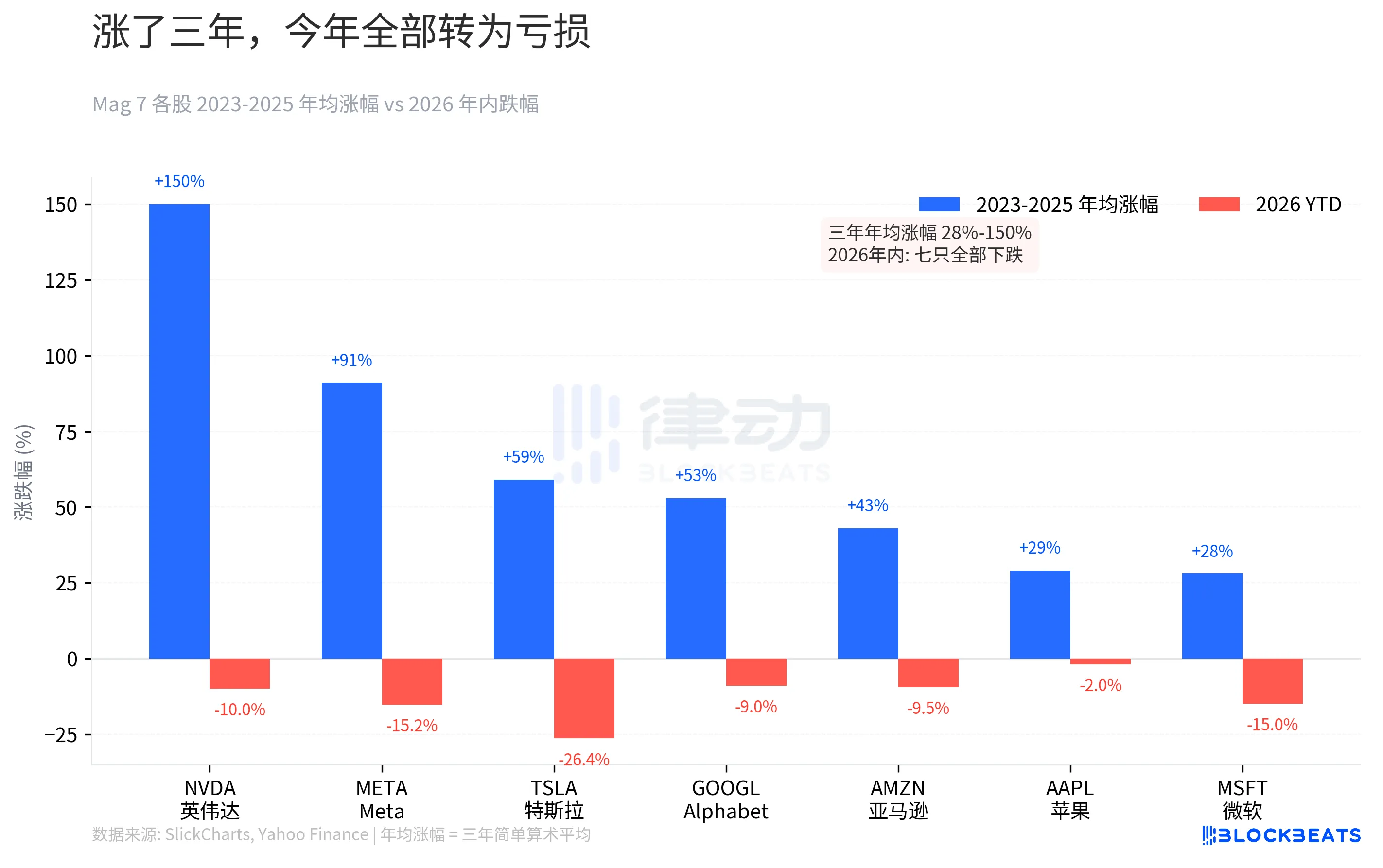
NVIDIA, which was up 239% in 2023, is now down 10% YTD. While this may seem mild, if you bought at the peak in October 2025, you would actually be down 21.2%. Meta, up 194% in 2023, is now down 15.2% from its peak. The faith accumulated during the three-year bull market has been gradually eroded in three months.
The returns in 2024 and 2025 have decelerated, from 107% to 64% to 23%. Growth has slowed, but valuations have not adjusted accordingly. When the music stopped, the risk premium ignored over the past three years came back all at once.
Rate Hike Expectation Reversal: From Single Digits to 52% in Just Three Months
The stock price decline is just a consequence. The real reversal is in interest rate expectations.
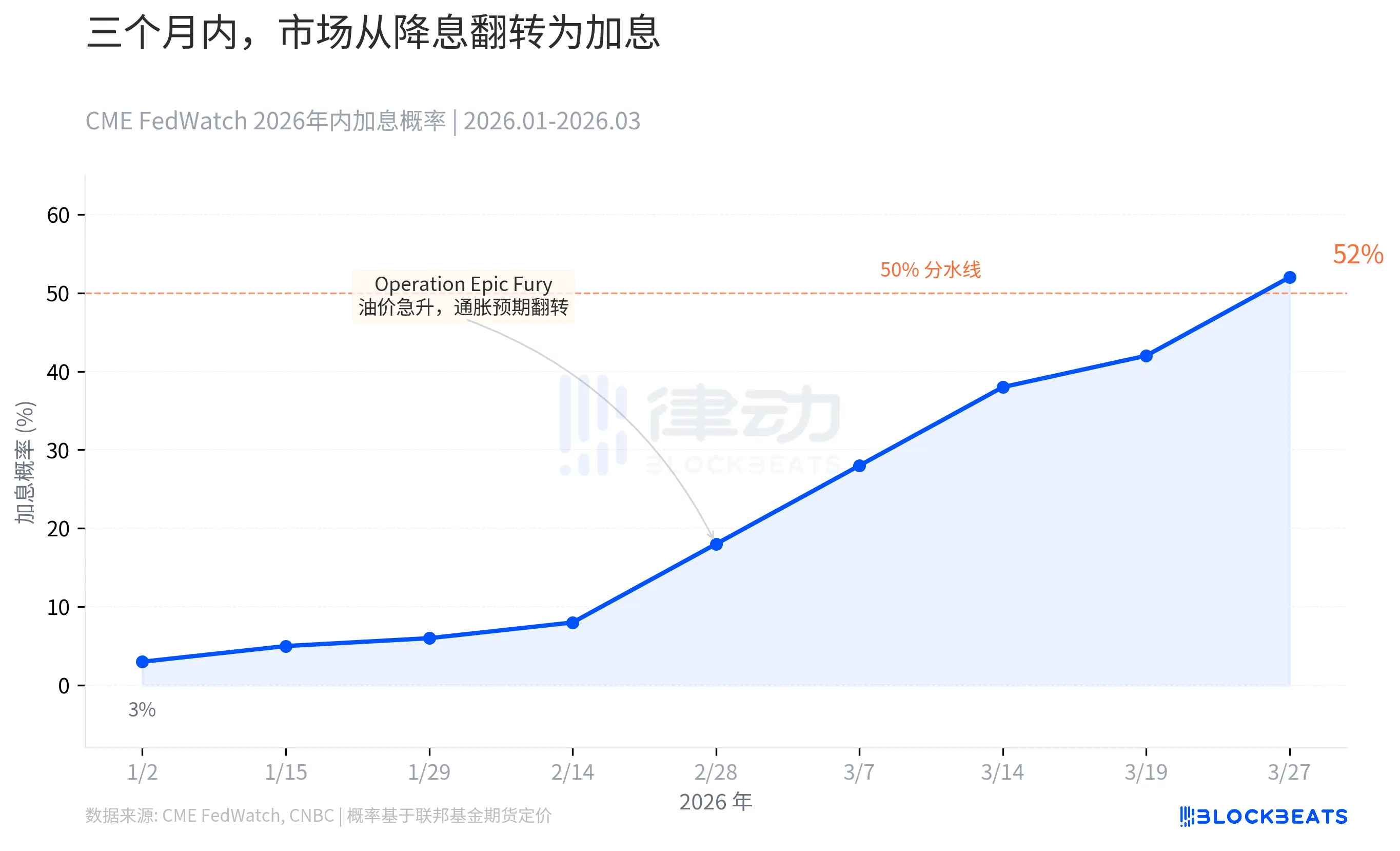
According to CME FedWatch data, in early January 2026, the market was still pricing in rate cuts, with the probability of a rate hike YTD at less than 3%. The consensus at the end of 2025 was that the Fed would continue cutting rates in 2026.
The turning point began on February 28th. The "Operation Epic Fury" triggered an escalation in the situation in the Strait of Hormuz, a chokepoint that carries 20% of global oil shipments, came under direct threat. Brent crude closed at $112.57 on March 27th, up 45% YTD. Rising oil prices fueled inflation expectations, which in turn directly reshaped rate pricing.
On March 27th, the CME futures market priced in a YTD rate hike probability exceeding 50%, reaching 52%. This marks the first time since early 2023 that the market has shifted from an "rate cut expectation" to a "rate hike expectation." According to the Atlanta Fed's Market Probability Tracker data, the probability of a 25 basis point rate hike has reached 19.8%.
From nearly zero to over half in less than three months. At the beginning of the year, there was still discussion about cutting interest rates several times, but now the discussion is about whether to raise rates.
Microsoft Drops the Most, Not Tesla
Your intuition would tell you that Tesla should be the hardest hit in the Mag 7. It has the biggest fluctuations and the most controversies. But the data presents a different reality.
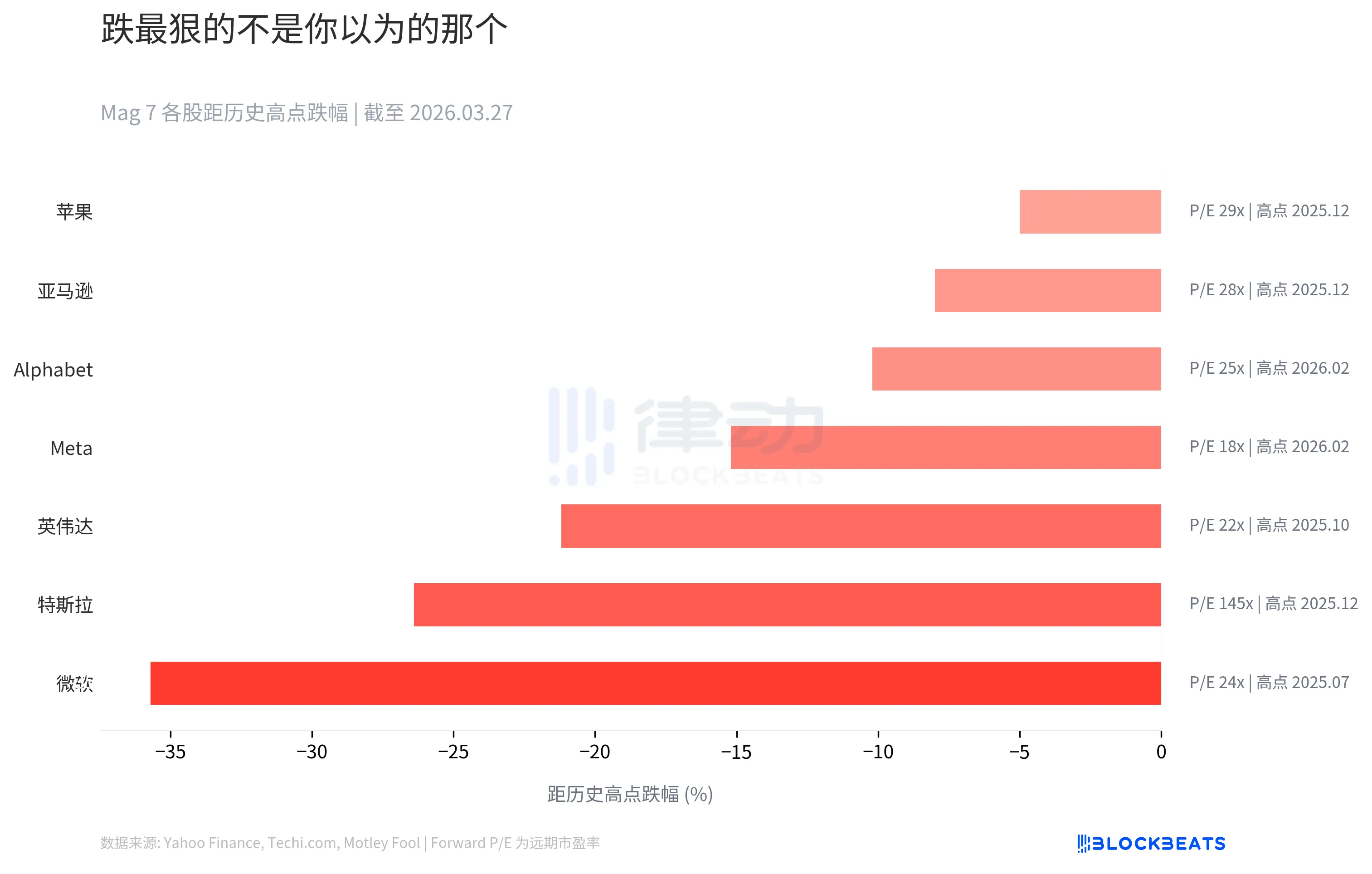
According to data from Techi.com and Motley Fool, Microsoft has dropped by 35.7% from its July 2025 peak (around $534), making it the largest percentage drop among the Mag 7 from their historical highs. Tesla ranks second with 26.4%, and Nvidia ranks third with 21.2%.
Looking at the Forward P/E column on the right, the story becomes more complex. Tesla's forward P/E is 145 times, while Microsoft's is only 24 times. Microsoft dropped more because the market priced in its expectations more rigidly. When the overall environment deteriorates, the "certainty premium" actually contracts the most.
Apple is the most resistant to decline among the seven, only falling 5% from its peak. But with a Forward P/E of 29 times, this "safety" is not cheap.
$650 Billion AI Capital Expenditure: Burning Money Is Not the Issue, It's Return Expectations
In 2026, the Mag 7 wrote themselves an unprecedented check.
According to the Q4 2025 financial guidance of each company and data compiled by Bloomberg, the 2026 AI capital expenditure budgets of the four companies Amazon, Google, Microsoft, and Meta total approximately $650 billion, a 67% increase from 2025's $381 billion. Each company's budget this year is close to or exceeds the sum of the past three years.
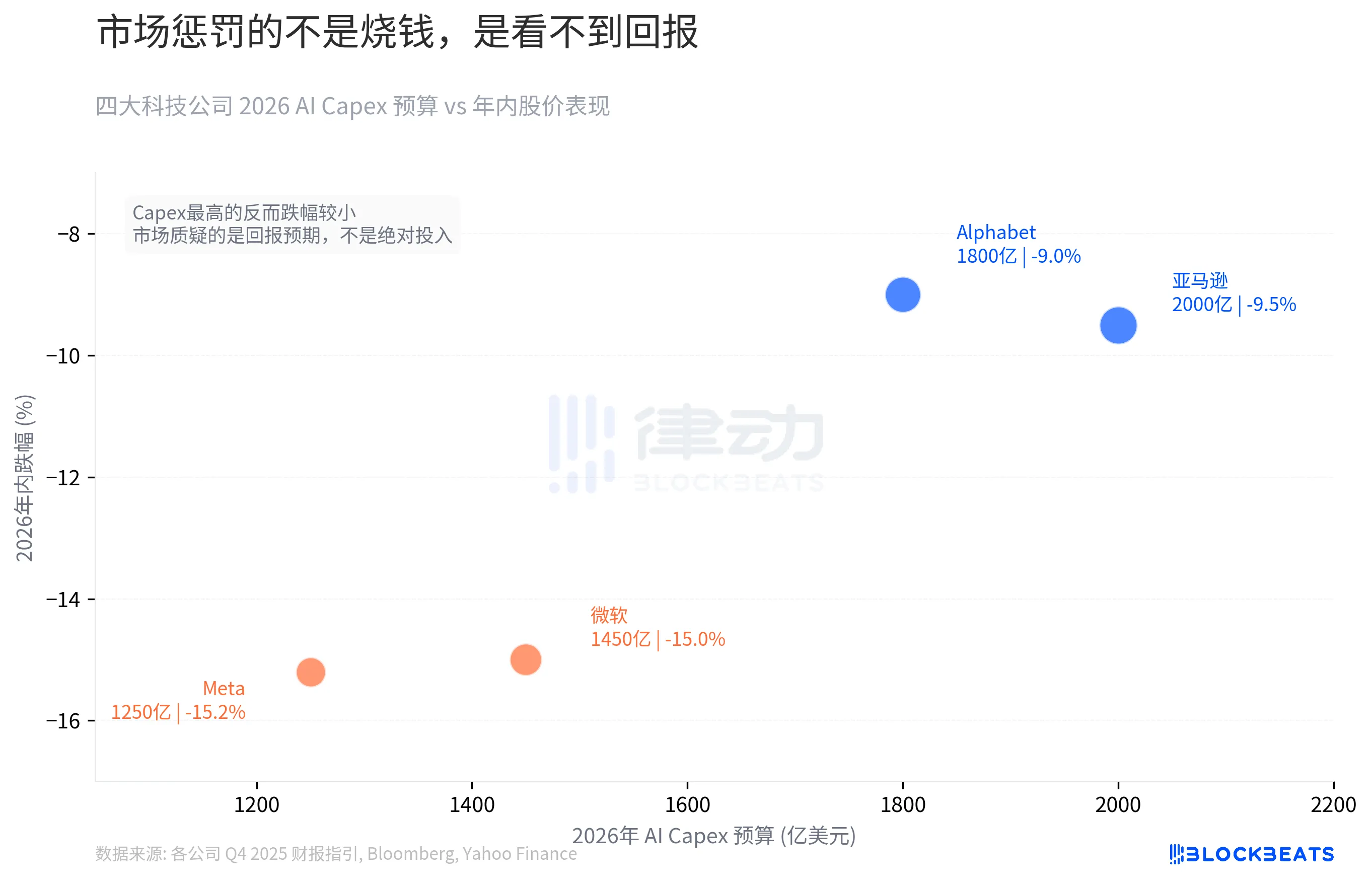
Amazon, with the largest Capex of $200 billion, and Google, with $180 billion, only dropped by 9.5% and 9% during the year. On the other hand, Microsoft with $145 billion and Meta with $125 billion in Capex saw drops of 15% and 15.2%, despite lower Capex. Spending more results in less drop.
The market's punishment is not based on the absolute scale of investment but on the visibility of returns. Amazon's AI investment directly serves its cash flow engine, AWS, and Google's investment has a clear monetization path through search advertising. Where Microsoft's and Meta's AI expenditures land is still a guessing game for investors. From Copilot's enterprise penetration to the metaverse's strategic shift to AI agents, none of these have yet materialized into numbers. The interest rate hike cycle doesn't wait for the story to unfold.
The Money Has Spoken by Walking
According to State Street Global Advisors' monthly fund flow data, year-to-date 2026, ETF net inflows into cyclical sectors such as Energy, Materials, and Industrials have reached $19 billion, accounting for 65% of all sector ETF inflows, far exceeding these sectors' 47% market weight. According to Morningstar data, Natural Resources funds saw $7.5 billion in inflows in January, marking a sector's monthly historical high.
According to ETF Trends data, cyclical sectors have seen an average year-to-date gain of +20%, while the Technology sector is down 6% year-to-date, and the S&P 500 as a whole is up only +0.5%. The Aerospace & Defense ETF (SHLD) saw over $10 billion in net inflows in January, with a year-to-date gain of +20%. The Technology sector is not entirely bleeding out, with $6 billion in inflows in February, but the returns significantly lag behind cyclical sectors.
With interest rate expectations flipped, the $650 billion in AI spending has become the most prominent line on the balance sheet. Institutional money has started to move, heading towards Energy and Defense.
EY-Parthenon Chief Economist Gregory Daco has referred to the current situation as "multidimensional disruption." He puts the probability of a U.S. recession at 40%. Goldman Sachs at 30%, while Moody's Chief Economist Mark Zandi's number is close to 50%.
Three years of exuberance, three months of reversal, and $650 billion hanging in the balance of a tightening cycle. Was the $2 trillion market cap evaporation of Mag 7 a single day panic, or is the market repricing for a cycle that has already concluded?
You may also like

Why a Million-Follower Crypto KOL Chooses WEEX VIP?
Discover why top crypto KOL Carl Moon partnered with WEEX. Explore the WEEX VIP ecosystem, 1,000 BTC protection fund, and exclusive rewards for serious traders.

CoinEx Founder: The Crypto Endgame in My Eyes

Spark Coin (SPK): Explodes 73% as Aave Bleeds $15B, A Good Investment Now?
Spark coin (SPK) surged 73% as $15 billion fled Aave after the KelpDAO hack. This article explains what Spark is, why it’s pumping, and whether it is a good investment right now.

As Aave's building collapses, Spark's high-rise is rising

RootData: Q1 2026 Cryptocurrency Exchange Transparency Research Report

What Is Memecoin Trading? A Beginner's Guide to How It Works, the Risks, and 2026's Hottest Tokens
Memecoins surged 30%+ at the start of 2026 while Bitcoin was flat. RAVE spiked 4,500% then crashed 90% in days. MAGA jumped 350% overnight. This guide explains exactly how memecoin trading works — and how to not blow up your account doing it.

Trump Extends Ceasefire: Bitcoin Hits $79K — What Crypto Traders Need to Know Right Now
Bitcoin surged past $79,000 after Trump extended the ceasefire indefinitely. We break down exactly what happened, how every major crypto reacted, and what traders should watch next — including the one level that could unlock an $85,000 BTC rally.

CHIP Crypto Price Prediction 2026: Can USD.AI's GPU Lending Token Reach $1?
CHIP's 24-hour trading volume hit $1.87 billion on a $236 million market cap — an 8x ratio that almost never happens on legitimate tokens. We explain what's driving it, what USD.AI actually does for GPU tokenization, and whether CHIP belongs in your AI crypto portfolio.

RootData: Q1 2026 Web3 Industry Investment Research Report

USDC is the only AI token

The voice of a senior Polymarket user: In fact, we have already been surpassed by our competitors

Transcript of Dr. Han, founder of Gate, speaking at the University of Hong Kong: Breaking the Matthew Effect and Winning in Asymmetric Competition

Who will replace AAVE as the new king?
Fu Peng 2026 First Public Speech: What Exactly Are Crypto Assets? Why Did I Join the Crypto Asset Industry?

Lattice Capital Founder: Crypto VC, Seeing is Believing Because of Faith

The Pitch Is Set. So Is the Trade: CHZ, SportFi, and the UCL Window That Won't Wait
CHZ is gaining momentum as SportFi narratives accelerate alongside the UEFA Champions League(UCL) and global football cycles. This article explores how CHZ, fan tokens, and the broader SportFi ecosystem are driven by real-world events, market narratives, and capital flows—offering insights into why SportFi is emerging as one of the most dynamic sectors in crypto.
Morning Report | SpaceX acquires Cursor for $60 billion; Kalshi and Polymarket launch perpetual contract trading; NeoCognition completes $40 million financing
IMF | The Future of Stablecoins and Payments: Evidence from Financial Markets
Why a Million-Follower Crypto KOL Chooses WEEX VIP?
Discover why top crypto KOL Carl Moon partnered with WEEX. Explore the WEEX VIP ecosystem, 1,000 BTC protection fund, and exclusive rewards for serious traders.
CoinEx Founder: The Crypto Endgame in My Eyes
Spark Coin (SPK): Explodes 73% as Aave Bleeds $15B, A Good Investment Now?
Spark coin (SPK) surged 73% as $15 billion fled Aave after the KelpDAO hack. This article explains what Spark is, why it’s pumping, and whether it is a good investment right now.
As Aave's building collapses, Spark's high-rise is rising
RootData: Q1 2026 Cryptocurrency Exchange Transparency Research Report
What Is Memecoin Trading? A Beginner's Guide to How It Works, the Risks, and 2026's Hottest Tokens
Memecoins surged 30%+ at the start of 2026 while Bitcoin was flat. RAVE spiked 4,500% then crashed 90% in days. MAGA jumped 350% overnight. This guide explains exactly how memecoin trading works — and how to not blow up your account doing it.







 App
App