
 Buy Crypto
- Markets
 Futures
- Spot
- Copy Trade
- Earn
- More
Hyperbeat, to launch a "bank" on Hyperliquid

Original Title: "Hyperbeat: The Person Behind the 'Bank' on Hyperliquid"
Original Author: Sanqing, Foresight News
On April 8, the Hyperliquid native protocol Hyperbeat launched Liquid Banking, deploying a self-managed "bank" on HyperEVM, integrating stablecoin deposits, VISA card spending, perpetual contract trading, and multi-currency fiat transactions into a single on-chain smart wallet.
Image Source: Hyperbeat Tweet
The Hyperbeat team transitioned from the Hyperliquid testnet's initial validators, starting with only 5 members and self-raising around $200,000 to kick off. The two co-founders, Kilian Boshoff (@Fundi_Crypto) and 800.HL (@degennQuant), have kept a low profile, with the former having a background from Stellenbosch University in South Africa, and the company registered in the Cayman Islands.
In August 2025, they completed a $5.2 million seed round, led by ether.fi Ventures and Electric Capital, with participation from Coinbase Ventures, Maelstrom, Anchorage Digital, among others, valuing the company at around $40 million.
Morpho Powers the Engine, Creating a 'Bank' in Ten Months
The core selling point of Liquid Banking is Credit Mode.
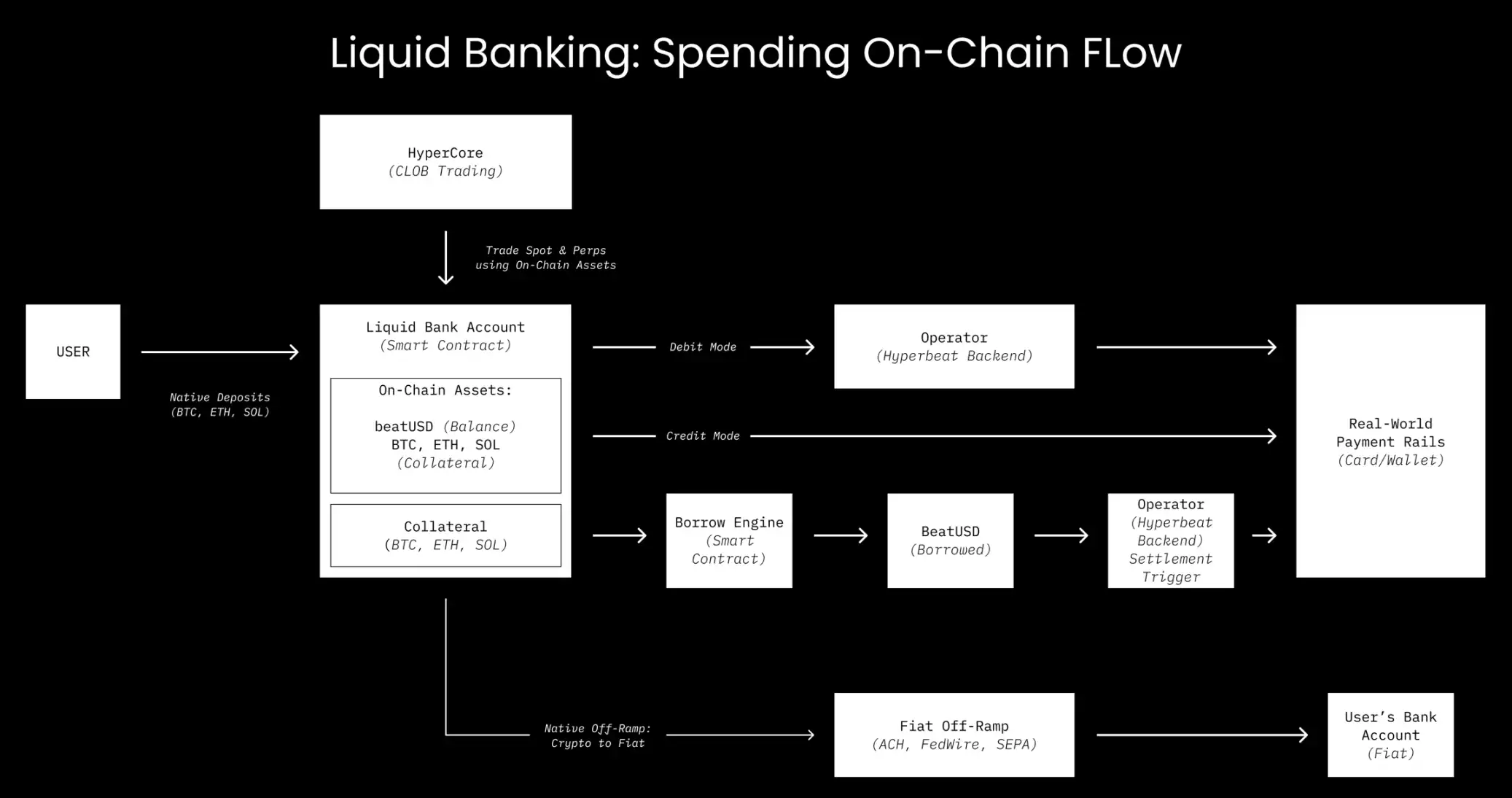
CREDIT Mode | Image Source: Hyperbeat Docs
Users deposit assets such as BTC, ETH, HYPE as collateral, and when they swipe their VISA card, the system instantly borrows stablecoins through the Morpho Blue market to complete the payment, while the collateral remains on-chain to continue earning rewards. Users never interact with a lending interface throughout the process, as the act of swiping the card itself constitutes an on-chain loan.
The underlying lending engine comes from Morpho. Hyperbeat integrates Morpho into users' smart wallets through an on-chain whitelist mechanism. Currently, Credit Mode is running on six isolated markets, with collateral including HYPE, UBTC, UETH, USOL, and even the gold token XAUT.
Hyperbeat does not touch the core lending logic, and Morpho does not touch the user interface. The former creates the "bank frontend," while the latter provides the "credit engine."
The stablecoin deposits in Liquid Banking are centered around the native stablecoin beatUSD issued in collaboration with Paxos Labs. Paxos provides the stablecoin infrastructure (based on USDG0), with reserve earnings flowing directly back into Hyperbeat's reward program and ultimately distributed to users, rather than remaining with the issuer.
The USD+ Treasury on the deposit side automatically allocates user funds to Morpho and protocols like Hypuur, Hyperlend, Felix, offering an annual percentage yield of 3%-8%.
The earnings come from real lending interest from Credit Mode consumers. The more the consumption, the higher the deposit yield. However, whether this cycle can be sustained depends on the actual consumption volume.
Non-selling coin consumption, but card swiping accrues interest
The fiat deposits and withdrawals in Liquid Banking are provided by Noah, supporting USD (ACH, FedWire) and Euro (SEPA) deposits, with each account linked to a unique IBAN.
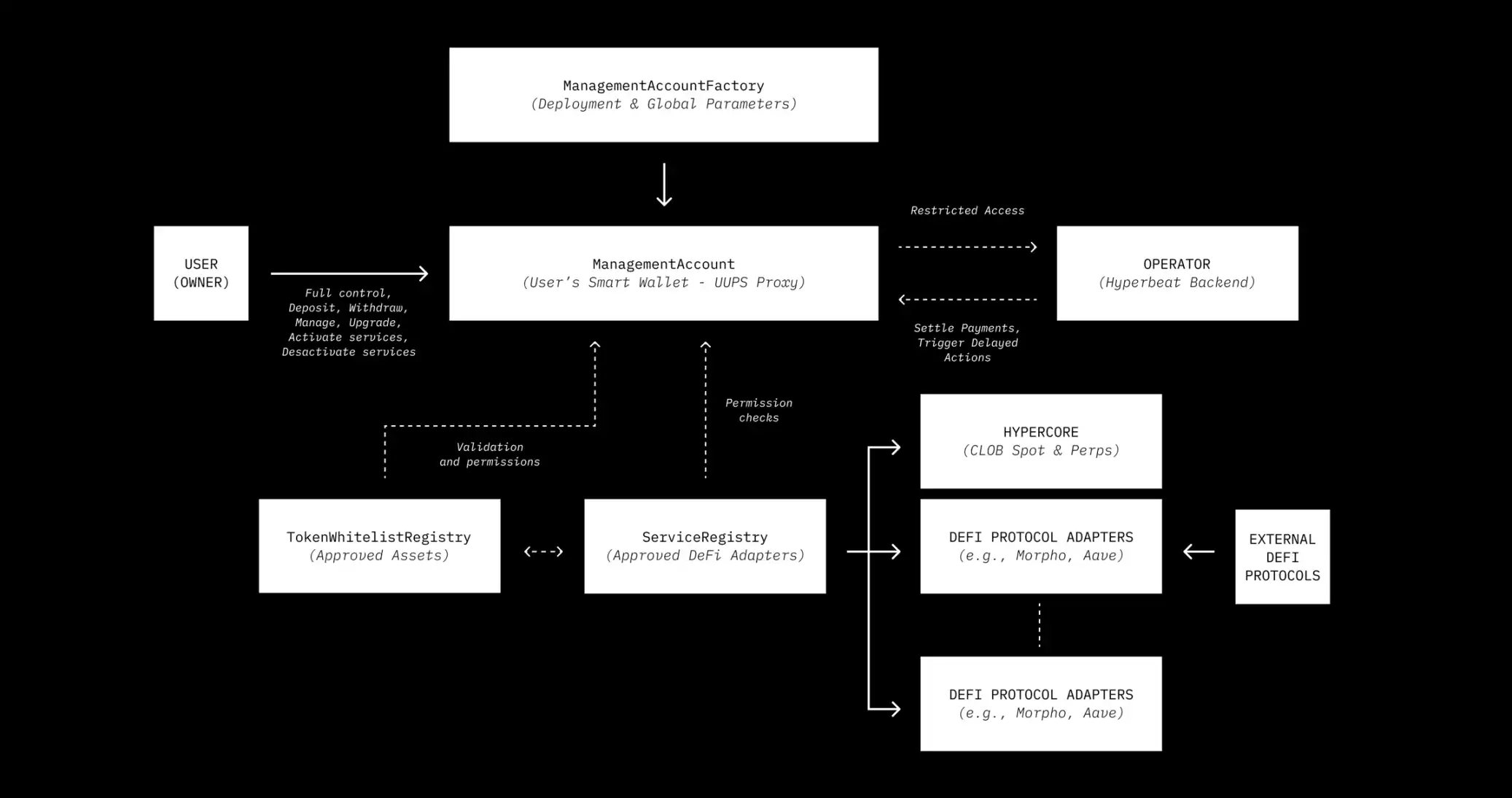
Liquid Banking Architecture | Source: Hyperbeat Docs
In March 2026, direct deposits and withdrawals for the Vietnamese Dong and Malaysian Ringgit will be further enabled, with withdrawals also covering currencies like Pound Sterling, Dirham, Baht, among a dozen others.
The VISA card is issued by Third National, with the underlying infrastructure provided by Rain, a Visa Principal Member. By early January 2026, its funding valuation had reached $1.95 billion, with an annualized processing volume exceeding $30 billion, covering over a hundred countries.
The card is classified as Visa Signature, with benefits such as airport lounge access. Foreign exchange transactions incur a 1% FX fee (based on Visa's official rate), no annual fee, no swipe fees; ATM withdrawals cost $1 + 0.65%; default monthly spending limit of $100,000.
The Credit Mode's lending interest rate fluctuates with the Morpho market utilization rate, but there is no interest-free period; interest on each "HODL & Borrow" transaction starts accruing from the moment of the transaction.
The Hyperbeat official "no hidden fees" refers to the transparency of the yield strategy, not the card fee pricing. The Credit Mode lending interest rate is dynamically determined by the Morpho market, without an interest-free period, meaning that the real-time cost of "HODL & Borrow" convenience exists and is not low.
Self-Custody Comes with a One-Day Cooling-Off Period
Unlike all centralized crypto cards, user assets always stay in their self-controlled ManagementAccount smart wallet. The Hyperbeat backend only has a limited Operator role, which can only settle within the user-set limits and cannot transfer assets to unauthorized addresses.
However, self-custody must address one issue: what if users front-run withdrawals after swiping their card? Hyperbeat has introduced an on-chain time-lock mechanism.
Settlement token withdrawals require a cooling-off period and confirmation process, collateral withdrawals require Operator approval to prevent defaults, and mode switches also have delays. The contract has been audited by Zellic and Nethermind, and key management is provided by Turnkey.
These frictions are not bugs but features. It acknowledges the speed difference between on-chain settlement and offline consumption, filling the gap with contract rules instead of "trust us." However, users must monitor their health factor themselves, as there is no customer service to help undo operational errors.
You may also like

a16z New Post: Predicting the Market, Entering the Fast Forward Phase

Arthur Hayes New Post: It's Now "No Trade" Time
a16z New Article: Predictive Markets Entering Fast-Forward Phase

a16z founder: In the age of Agents, what truly matters has changed

The President of Kyrgyzstan meets with Sun Yuchen, and TRON collaborates with Kyrgyzstan to build a new pattern of digital economy in Central Asia
46 minutes, $292 million stolen, DeFi faces development dilemma again

How to Earn Free USDT in 2026: No High Volume Required (WEEX Poker Party Guide)
Is Joker Crypto legit in 2026 or just another memecoin? Can You Really Earn Passive Income with Joker Crypto in 2026? Learn how Joker staking rewards work, how to earn NFT bonuses, expected APY ranges, gas-fee rebates, and how to avoid crypto scams before joining.

How to Get Free USDT Welcome Bonus in 2026: Earn Up to 700 USDT on WEEX
Legit Free Welcome Bonus 2026: Learn how to earn up to 700 USDT on WEEX with Auto Earn Boost Fest. Increase your balance, activate Auto Earn, and qualify automatically.

AI Agent Payments Just Got Real: Utexo × x402 Brings 50ms USDT Transactions to Internet Scale
Utexo integrates USDT into the x402 protocol, enabling 50ms instant payments embedded natively in HTTP requests. Explore how this breakthrough is rewriting the rules for AI agent payments, API monetization, and the machine-to-machine economy.

DWF Deep Report: AI in DeFi Outperforms Humans in Yield Optimization, but Complex Trades Still Lag Behind by 5 Times

What Separates Smart Money from the Crowd in Crypto? Insights from Freedom of Money
Most crypto traders lose money not because of bad luck, but because they misunderstand how the market really works. From Freedom of Money to the rise and fall of Sam Bankman-Fried, they highlight a key divide in crypto: those who build the market and those who chase it. This reading guide explores essential books that reveal how narrative, regulation, capital, and psychology shape long-term success in the crypto industry.

The Risk Management Core Team has just been ousted, and Aave is now facing a $200 million default.

The $293 million bug wasn't in the code; so, what's the deal with the "DVN Configuration Bug," which led to the largest hack of 2026?

a16z on Recruitment: How to Choose Between Crypto-Native and Traditional Talent?
The biggest DeFi heist of 2026, hackers easily took advantage of Aave

Will Robots Replace Humans? He Says No!
Binance Coin's Price Skyrockets 15x to All-Time High, Saved by Three Bull Market Lifelines




 App
App