
 Buy Crypto
- Markets
 Futures
- Spot
- Copy Trade
- Earn
- More
In just 70 days, Polymarket easily raked in tens of millions in fees


Original Title: "In Just 70 Days, Polymarket Easily Takes Away Millions of Dollars in Fees"
Original Author: Azuma, Odaily Planet Daily
On January 6th this year, Polymarket officially bid farewell to the "zero fee" model, starting to charge transaction fees from the "15-minute cryptocurrency price change" market. The specific fee rate will vary with real-time market odds— the closer the odds are to 0% or 100%, the lower the fee; conversely, the closer the odds are to 50%, the higher the fee, reaching a maximum of 1.56%.
Later, on January 28th, about three weeks after the fee implementation, we published an article titled "Data Calculation: Polymarket's Annual Revenue Easily Exceeds $100 Million, Assuming...". The article made a static estimate based on Polymarket's trading volume and trading activity structure at the time: in the most conservative scenario, assuming the fee-charging market remains the same, it is estimated that Polymarket could generate approximately $38 million in revenue per year; and in the most aggressive scenario, if Polymarket expands fees to all markets, an estimated annual fee income of $418 million.
In our previous revenue estimate for Polymarket, we were frustrated by the short observation period and too few calculable samples. Now, two months later, we have re-estimated Polymarket's revenue expectations with richer data. The results show that the so-called "conservative" estimate is indeed too conservative, and the so-called "aggressive" expectation is not overly exaggerated.
Revenue Data Changes
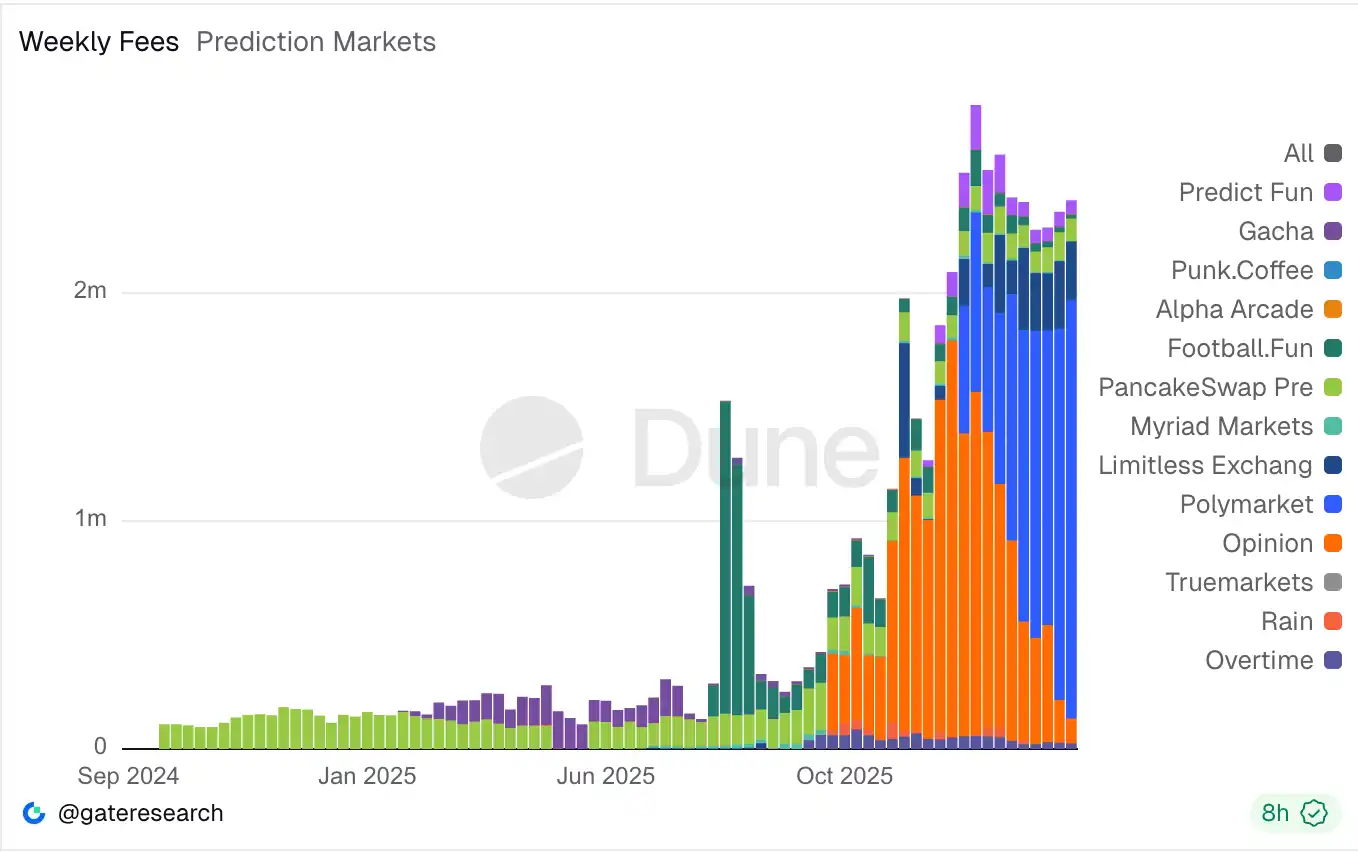
According to data compiled by Gate Research on Dune, since the introduction of transaction fees on January 6th, Polymarket has accumulated over $11.2 million in fee revenue.
By once again making a static estimate in the most conservative manner, assuming that market trading volume and activity structure remain unchanged, it is projected that Polymarket could generate approximately $58.4 million in revenue annually.
However, this estimation method does not accurately reflect Polymarket's revenue capabilities.
The reason is that Polymarket's revenue data is visibly growing— in the past 10 weeks, the platform's fee revenue has been $560,000, $786,000, $633,000, $749,000, $1.08 million, $1.28 million, $1.35 million, $1.29 million, $1.63 million, $1.84 million... almost showing significant growth every week.
Reasons for Revenue Growth
The growth in Polymarket's fee revenue can be attributed to two main factors. First, Polymarket has expanded the scope of fee-charging markets. Second, both Polymarket's overall trading volume and fee-charging market volume have continued to grow.
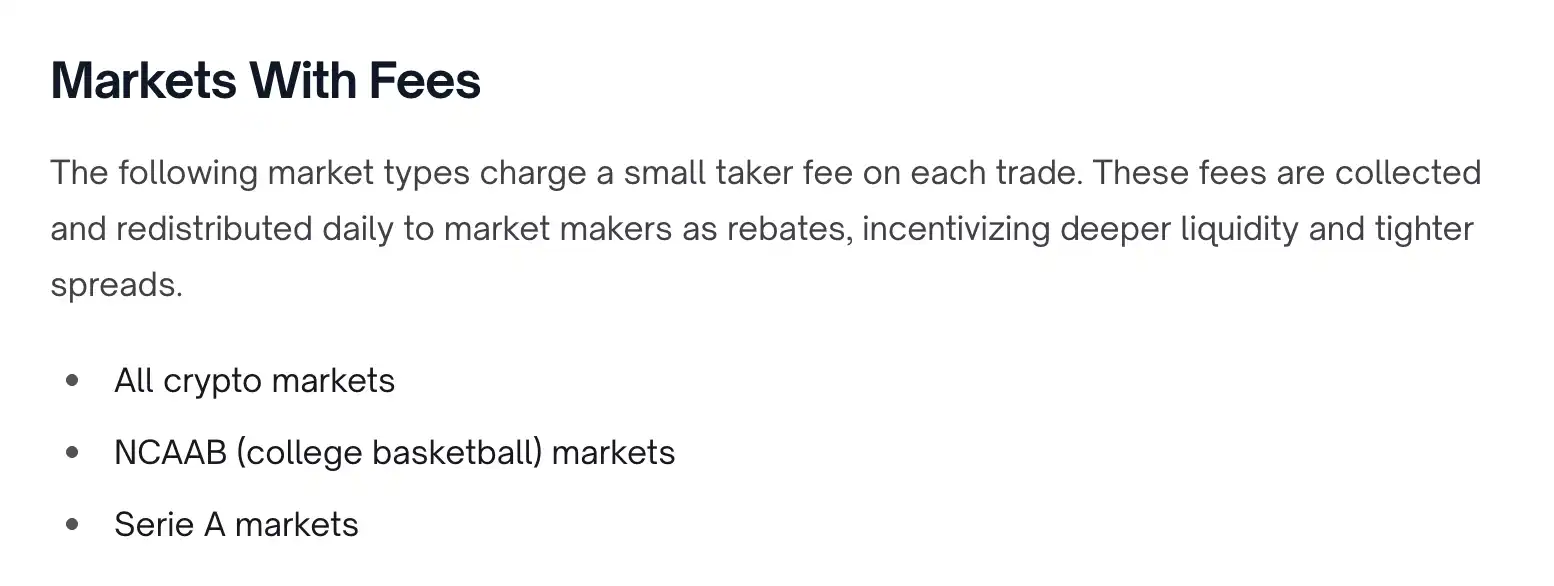
Regarding the scope of fee-charging markets, on March 6, Polymarket expanded its fee mechanism to all cryptocurrency-related markets. Additionally, earlier trials of fee collection were conducted in sports markets such as NCAA and Serie A, but the former (cryptocurrency-related markets) currently remains the main source of fee revenue.
With respect to trading volume, the data dashboard below, created by Data Dashboards on Dune, shows that Polymarket's overall weekly trading volume, including the cryptocurrency market (bottommost purple bar), has been steadily increasing.
Future Revenue Forecast
The last time we estimated Polymarket's revenue, we had to manually calculate the percentage of "15-Minute Cryptocurrency Price Change" related markets as a share of all cryptocurrency-related market volume. However, Polymarket has now expanded fees to all cryptocurrency-related markets as of March 6, making this estimation much more convenient. As for NCAA and Serie A, either because the former has not yet entered the "March Madness" formal tournament stage or the latter does not attract much attention in American culture, the trading volume of related markets is significantly lower compared to cryptocurrency, so we will temporarily ignore them.
Using the data from the first complete week after March 6 (3.9-3.15), the share of cryptocurrency-related event trading volume in Polymarket's total platform volume was 26.7% for that week. In the same week, Polymarket's fee revenue was approximately $1.84 million. Based on this static proportion, at the current level of trading volume and transaction structure, if Polymarket introduces a similar fee model to all markets, it is estimated that this platform could generate $360 million in annual revenue.
The Money Printer Is Running
It is worth noting that as a key initiative to enhance liquidity on Polymarket, the platform has distributed a total of $13.41 million in subsidies to liquidity providers (LPs) to date. As a comparison, if the data for the remaining days of March maintains the performance of the first half of the month, the fee revenue from Polymarket this month would be sufficient to cover the total expenditure on liquidity subsidies.

Polymarket has already essentially proven the revenue potential of this new format of prediction markets, and future revenue growth will largely depend on two variables - how much further trading volume can grow, and whether fees can be further extended to more markets.
If these two variables continue to rise, prediction markets could perhaps become the simplest, most straightforward “money printer” in the cryptocurrency industry.
You may also like

a16z Crypto: 9 Charts to Understand the Evolution Trends of Stablecoins

Refutation of Yang Haipo's "The End of Cryptocurrency"

Can a hairdryer earn $34,000? Interpreting the reflexivity paradox of prediction markets

6MV Founder: In 2026, the "landmark turning point" for crypto investment has arrived

Abraxas Capital Mints $2.89 Billion USDT: Liquidity Boost or Just More Stablecoin Arbitrage?
Abraxas Capital just received $2.89 billion in freshly minted USDT from Tether. Is this a bullish liquidity injection for crypto markets, or is it business as usual for a stablecoin arbitrage giant? We analyze the data and the likely impact on Bitcoin, altcoins, and DeFi.
A VC from the Crypto world said AI is too crazy, and they are very conservative
The Evolutionary History of Contract Algorithms: A Decade of Perpetual Contracts, the Curtain Has Yet to Fall

Kicked out by PayPal, Musk aims to make a comeback in the cryptocurrency market

Solana ETF News: What Is a Solana ETF and Why Is Goldman Sachs Betting $108 Million on SOL?
Solana ETF news today shows Goldman Sachs disclosed a $108M position while total SOL ETF inflows reached $1.45B. Analysts now expect up to $6B in institutional demand as Solana trades 71% below its all-time high.

Bitcoin ETF News Today: $2.1B Inflows Signal Strong Institutional Demand for BTC
Bitcoin ETFs news recorded $2.1B inflows over 8 consecutive days, marking one of the strongest recent accumulation streaks. Here’s what the latest Bitcoin ETF news means for BTC price and whether the $80K breakout level is next.
Michael Saylor: Winter is Over – Is He Right? 5 Key Data Points (2026)
Michael Saylor tweeted yesterday “Winter‘s Over.” It is short. It is bold. And it has the crypto world talking.
But is he right? Or is this just another CEO pumping his bags?
Let us look at the data. Let us be neutral. Let us see if the ice has really melted.

WEEX Bubbles App Now Live Visualizes the Crypto Market at a Glance
WEEX Bubbles is a standalone app designed to help users quickly understand complex crypto market movements through an intuitive bubble visualization.

Polygon co-founder Sandeep: Writing after the chain bridge chain explosion

Major Upgrade on Web: 10+ Advanced Chart Styles for Deeper Market Insights
To deliver more powerful and professional analysis tools, WEEX has rolled out a major upgrade to its web trading charts—now supporting up to 14 advanced chart styles.

Morning Report | Aethir secures a $260 million enterprise contract with Axe Compute; New Fire Technology acquires Avenir Group's trading team; Polymarket's trading volume surpassed by Kalshi

Why a Million-Follower Crypto KOL Chooses WEEX VIP?
Discover why top crypto KOL Carl Moon partnered with WEEX. Explore the WEEX VIP ecosystem, 1,000 BTC protection fund, and exclusive rewards for serious traders.

CoinEx Founder: The Crypto Endgame in My Eyes

Spark Coin (SPK): Explodes 73% as Aave Bleeds $15B, A Good Investment Now?
Spark coin (SPK) surged 73% as $15 billion fled Aave after the KelpDAO hack. This article explains what Spark is, why it’s pumping, and whether it is a good investment right now.
a16z Crypto: 9 Charts to Understand the Evolution Trends of Stablecoins
Refutation of Yang Haipo's "The End of Cryptocurrency"
Can a hairdryer earn $34,000? Interpreting the reflexivity paradox of prediction markets
6MV Founder: In 2026, the "landmark turning point" for crypto investment has arrived
Abraxas Capital Mints $2.89 Billion USDT: Liquidity Boost or Just More Stablecoin Arbitrage?
Abraxas Capital just received $2.89 billion in freshly minted USDT from Tether. Is this a bullish liquidity injection for crypto markets, or is it business as usual for a stablecoin arbitrage giant? We analyze the data and the likely impact on Bitcoin, altcoins, and DeFi.


 App
App