
 Buy Crypto
- Markets
 Futures
- Spot
- Copy Trade
- Earn
- More
Is Nasdaq About to Reach a New High, Is the Bull Market Back?


The war is not over yet, but the market seems to have already started pricing it in.
Almost All Assets Are Rising
Starting from March 27, the S&P 500 Index has rebounded by nearly 10%, on track for a third consecutive week of gains. The Nasdaq 100 has seen a larger increase, rising by about 12%, closing positively for the tenth straight trading day, marking the longest winning streak in 2021.
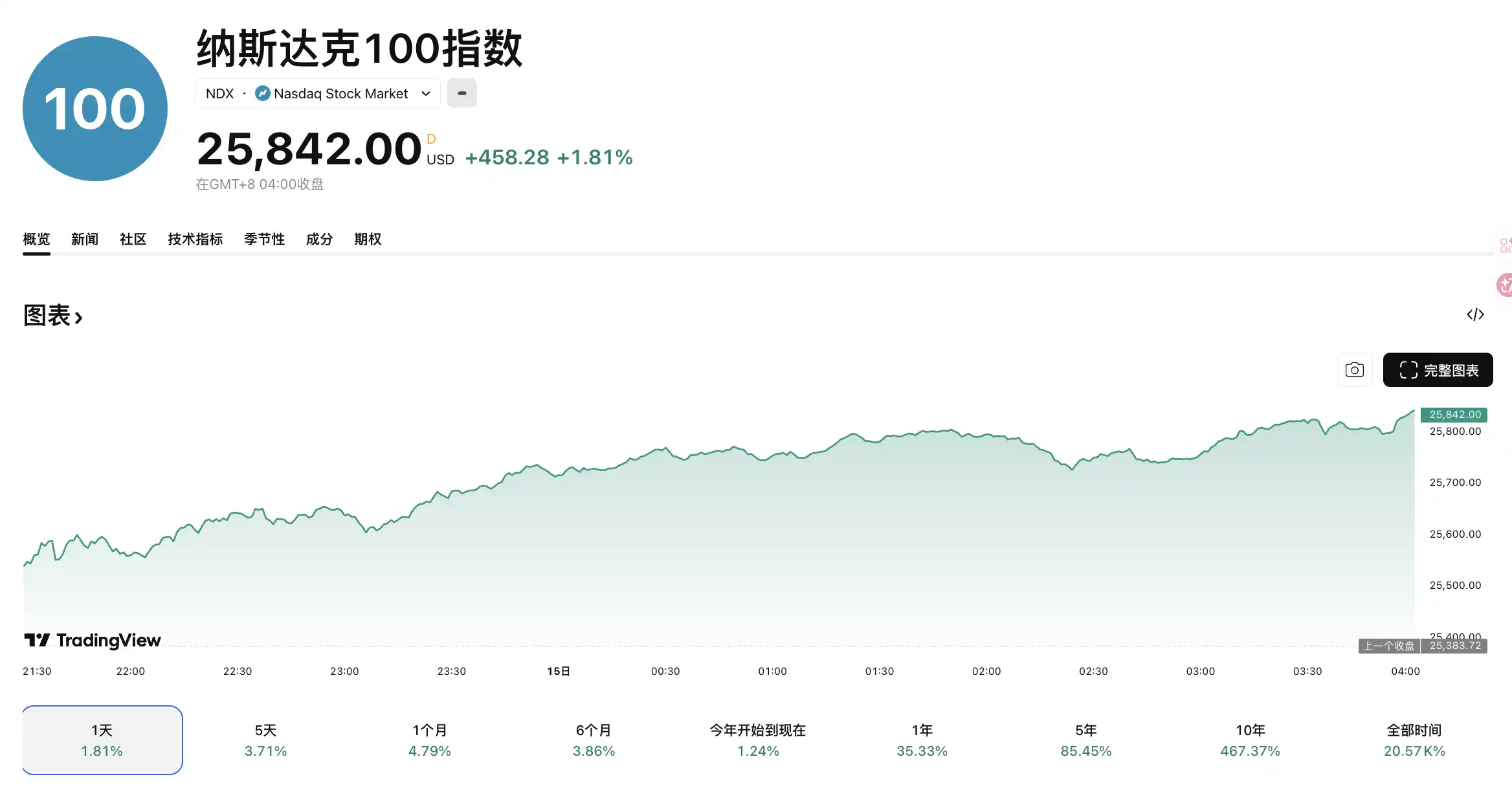
U.S. market close: Dow rose by 0.66%, S&P rose by 1.18%, Nasdaq rose by 1.96%. Crypto-related stocks surged across the board: Robinhood jumped over 10% in a single day, Circle rose by nearly 7%, Coinbase went up by 5.65%, and Riot followed with a 4.32% increase. The Japanese and Korean markets are also following suit. The Nikkei 225 opened with a 0.71% increase, breaking through 58,000 points for the first time since March. The KOSPI in South Korea opened 2.98% higher at 6145.62 points.
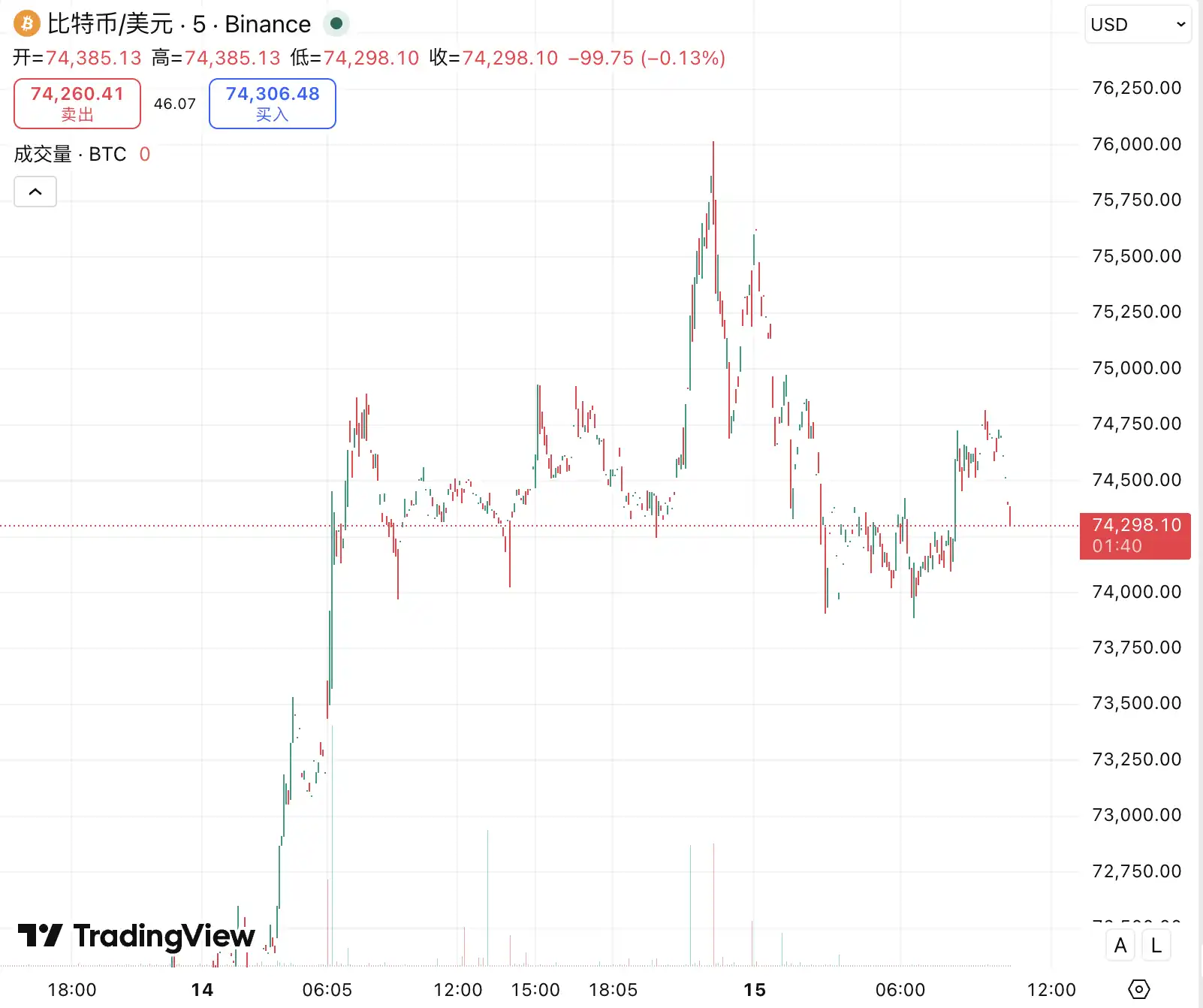
As for Bitcoin, it reached a high of $76,120 on Tuesday, hitting a new high since February 6, successfully reclaiming the key support zone at $75,000. Analyst CryptoBlockto pointed out that Bitcoin has broken through the upper bound of the ascending triangle at $73,000, with the daily RSI rising to 63. The next target is set at $80,000, with a measured target of $89,050, approximately 18% higher than the current price.
Bitcoin's on-chain data is also worth noting. Since 2026, the average daily transaction count of Bitcoin has increased by 62%, reaching 765,130 transactions on April 5, hitting a 17-month high. Analyst CW8900 put it plainly: "The current daily transaction count of Bitcoin is higher than when the BTC price was at $120,000, signaling bullish network behavior."
Of course, it's not all optimism. The cryptocurrency market funding rates show that both BTC and ETH have negative funding rates on major platforms like Binance, where shorts are paying fees to longs to maintain their positions. From a sentiment perspective, bearish signals have not completely subsided.
But the market seems to be rising due to the "expectation of the war's end."
Rich Privorotky, Head of Delta One trading at Goldman Sachs, puts it well: "The market seems to have declared victory in the war with Iran, even though the conflict itself has not truly ended."
Tom Lee's interpretation is more direct. Speaking to CNBC, he stated that current defense spending is around $30 billion per month and could potentially double to $60 billion, providing a significant boost to the economy. A $20 increase in oil prices would only add about $12 billion in monthly burden to households. "Overall, the war is actually helping corporate profits."
He referenced the precedent of World War II: the US stock market bottomed in May 1942, only five months after the US entered the war, when not a single soldier had set foot on the European or Pacific battlefields yet. "The market is good at anticipating outcomes in advance. The current stock market rally indicates that the market is pricing in a favorable outcome."
The Second Round of Negotiations is Coming
What may have triggered all of this is a geopolitical easing.
On April 14, President Trump reiterated in an interview with Fox News, "The Iran conflict is nearing its end." He added, "I think Iran wants to make a deal right now." He also revealed to the New York Post that a new round of US-Iran negotiations "could take place in the next two days" in Pakistan.
This follows on from last Saturday's "lengthy but unproductive" Islamabad talks. The US and Iran announced a two-week ceasefire on April 8, with the deadline set for April 22. According to Russian sources citing Arab diplomatic sources, discussions to extend the ceasefire are currently ongoing.
Who will represent the US? Trump has not specified, but confirmed that he will not attend. According to CNN sources, if a new round of face-to-face talks can be achieved before the ceasefire expires, Vice President Pence is expected to lead the second round of negotiations. Pence has stated that he will continue to strive for the "big deal" Trump hopes to reach with Iran.
After the news broke, WTI crude oil plummeted by 4% during Wednesday's Asian session. Meanwhile, commercial shipping in the Strait of Hormuz is improving.
According to the WSJ, over the past 24 hours, more than 20 cargo ships, container ships, and oil tankers have crossed the strait, although this is only a small fraction of pre-war levels.

Doug Peta, Chief US Investment Strategist at BCA Research, said, "As earnings season kicks off, fundamentals are more forcefully driving stock prices compared to the headlines of the Iran situation."
The noise of war persists. But the market has chosen to look ahead.
You may also like

AI Agent Payments Just Got Real: Utexo × x402 Brings 50ms USDT Transactions to Internet Scale
Utexo integrates USDT into the x402 protocol, enabling 50ms instant payments embedded natively in HTTP requests. Explore how this breakthrough is rewriting the rules for AI agent payments, API monetization, and the machine-to-machine economy.

DWF Deep Report: AI in DeFi Outperforms Humans in Yield Optimization, but Complex Trades Still Lag Behind by 5 Times

What Separates Smart Money from the Crowd in Crypto? Insights from Freedom of Money
Most crypto traders lose money not because of bad luck, but because they misunderstand how the market really works. From Freedom of Money to the rise and fall of Sam Bankman-Fried, they highlight a key divide in crypto: those who build the market and those who chase it. This reading guide explores essential books that reveal how narrative, regulation, capital, and psychology shape long-term success in the crypto industry.

The Risk Management Core Team has just been ousted, and Aave is now facing a $200 million default.

The $293 million bug wasn't in the code; so, what's the deal with the "DVN Configuration Bug," which led to the largest hack of 2026?

a16z on Recruitment: How to Choose Between Crypto-Native and Traditional Talent?

The biggest DeFi heist of 2026, hackers easily took advantage of Aave

Will Robots Replace Humans? He Says No!

Binance Coin's Price Skyrockets 15x to All-Time High, Saved by Three Bull Market Lifelines

The organization has accessed the prediction market, but is stuck at the third stage

Head of crypto VC collective shrinks: a16z crypto fund management scale plummets by 40%, Multicoin cut in half

Arthur Hayes New Post: It's "No Trade" Time Now
Claude Opus 4.7 Review: Is It Worthy of the Title of Strongest Model?

DWF In-Depth Report: AI Outperforms Humans in Yield Farming Optimization in DeFi, But Complex Transactions Still Lag Behind 5x
The financial tricks of the crypto giant Kraken

When proactive market makers start to take initiative

Massive Whale Movement: Unstaking $84.96 Million in HYPE Tokens
Key Takeaways A crypto whale, known as TechnoRevenant, has unstaked approximately $84.96 million in HYPE tokens. The tokens…

ListaDAO Addresses Third-Party Contract Vulnerability Concerns
Key Takeaways GoPlus Security revealed a vulnerability in a contract resembling those of ListaDAO. ListaDAO confirmed that their…
AI Agent Payments Just Got Real: Utexo × x402 Brings 50ms USDT Transactions to Internet Scale
Utexo integrates USDT into the x402 protocol, enabling 50ms instant payments embedded natively in HTTP requests. Explore how this breakthrough is rewriting the rules for AI agent payments, API monetization, and the machine-to-machine economy.
DWF Deep Report: AI in DeFi Outperforms Humans in Yield Optimization, but Complex Trades Still Lag Behind by 5 Times
What Separates Smart Money from the Crowd in Crypto? Insights from Freedom of Money
Most crypto traders lose money not because of bad luck, but because they misunderstand how the market really works. From Freedom of Money to the rise and fall of Sam Bankman-Fried, they highlight a key divide in crypto: those who build the market and those who chase it. This reading guide explores essential books that reveal how narrative, regulation, capital, and psychology shape long-term success in the crypto industry.




 App
App