
 Buy Crypto
- Markets
 Futures
- Spot
- Copy Trade
- Earn
- More
Key Members Depart to Establish "Forked EF": How Much Longer Can the Ethereum Foundation Endure?

On January 21st, Ethereum's well-known core developer Eric Conner announced his departure from the Ethereum Foundation on social media, citing a series of issues within the Ethereum Foundation, including lack of transparency, disconnect from the community, and resistance to change.
The criticism of the Ethereum Foundation (EF) has been ongoing, and in recent months, Ethereum's lackluster performance has further fueled community dissatisfaction. Many prominent investors and developers have expressed their opinions and frustrations with the EF. However, the departure of a veteran developer indicates that internal disagreements within the EF have reached an irreconcilable point, pushing the EF into a crisis.
Amid escalating public opinion and the community's unresolved anger, a grassroots movement has quietly formed the Second Foundation.
With Ethereum facing internal and external challenges, reform is urgently needed.
Who is Eric?
Ethereum's renowned core developer Eric Conner has left the ecosystem community after nearly 11 years of collaboration with Ethereum, citing Vitalik's rejection of a leadership restructuring proposal.
Eric is a co-author of EIP-1559, a significant network upgrade that changes the way Ethereum transaction fees operate. He was not formally employed by Ethereum but has been providing guidance, investment, and has been one of the key figures driving ecosystem development since the early days.
On January 21st, Ethereum core developer Eric Conner posted on social media, saying, "I am no longer `.eth.` Maybe one day someone in leadership will realign with the community, but for now, I'm out. Deep down I sincerely hope Ethereum succeeds. Good luck."
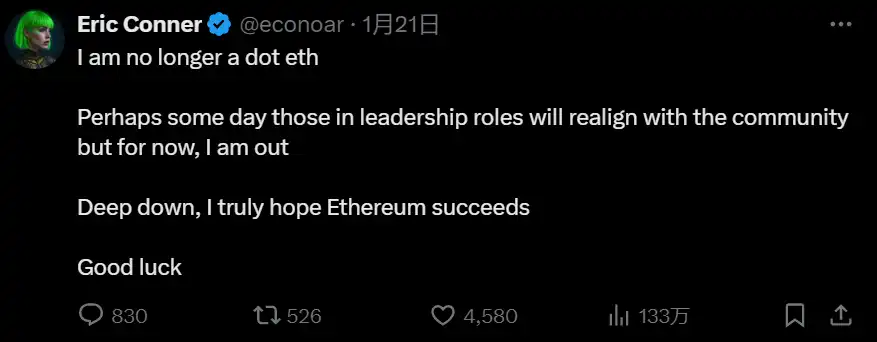
He later posted about why he entered Ethereum and why he chose to leave. Eric first encountered Bitcoin in 2012 and after the Mt. Gox incident, he witnessed many friends suffer heavy losses due to reliance on centralized exchanges. Eric and a few friends attempted to develop the first decentralized exchange (DEX) on Ethereum—EtherEx. Although the project failed due to premature timing, it immersed him in the Ethereum community.
Previously, Eric had expressed that the Ethereum Foundation's lack of transparency and growing sense of disconnect from the community were becoming stronger. The Foundation could have cut 80% of its budget, allowing Ethereum to operate and grow smoothly. The issue is that the current Foundation does not report to stakeholders, is gradually sinking into a quagmire, and is resistant to change. The Foundation currently exhibits a "counter-victory and competitive mindset," leading many community members to question whether to continue to stay.
A Frozen Path, Not a Day's Cold
Since last year's EDCON in Montenegro, the industry's dissatisfaction with the Ethereum Foundation has begun to surface. L2, as a solution to improve Ethereum's scalability, has been shackled with the "Ethereum alignment" shackle from day one, accepting and executing the will of the EF. Everyone is expressing loyalty to Ethereum, aiming to create the most EVM-compatible L2 solution. For a long time, rather than focusing on the product and technology itself, how to gain EF's approval has been the primary concern for project teams, leading to the distortion of the Ethereum ecosystem under EF's pressure.

Related Read: "EF Has No Dreams"
The intricate vested interests within the EF, the EF's constraints on a project's "orthodoxy" in terms of ideology, and the gradual departure of major protocols from Ethereum leading to betrayal, have seemingly plunged this organization into a midlife crisis, facing difficulties in structure, efficiency, and culture. As the meme trend drives Solana's resurgence, Ethereum's weak performance during several Bitcoin ATH breakthroughs, and the recent issuance of coins by Trump on Solana driving SOL to a new high, Ethereum's decline is evident, intensifying the community's dissatisfaction with Ethereum. Under public pressure, on the 18th, Vitalik himself responded to the doubts in a post, indicating a large-scale restructuring of the EF leadership and the specific objectives of the reform.
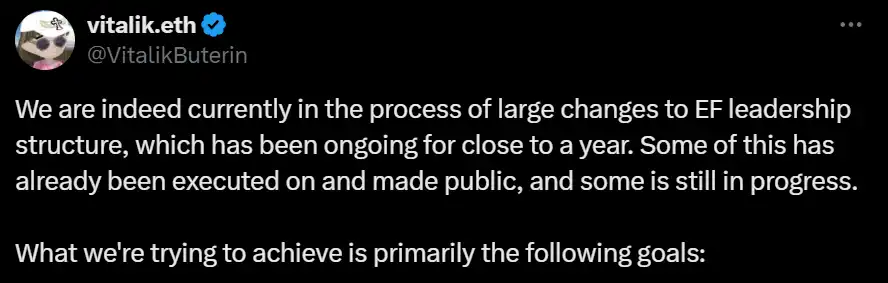
A stone has caused a thousand-layer wave, and a crusade against the EF has followed.
On the 20th, Synthetix and Infinex founder Kain Warwick first expressed his dissatisfaction with L2: "If I were to operate the EF, I would definitely put pressure on Layer 2 to demand they use sequencers' revenue to burn ETH. Ethereum has a significant advantage in this negotiation...".
At the same time, Aave founder Stani Kulechov also stated that after reading the Ethereum 2024 budget report, he believed that there are 12 areas for improvement to ensure the EF's sustainable development, including slowing down the burn rate, reducing the number of employees, and establishing a sustainable revenue model. However, on the 21st, Stani Kulechov posted again, saying: "I don't advocate for dissolving the EF, but rather recommend a better, faster, stronger, and more extensive EF path... We should focus less on internal politics or neutrality and focus more on advancing technological progress as quickly as possible."
During the evening, Evgeny Gaevoy, Founder and CEO of the top market-making institution Wintermute, also shared his views on Ethereum, mentioning the current risk of Ethereum being caught in a "death spiral": "If there is no casino, the only use of ETH is to send stuff in Zazulu, then the price will be low and the security will be low. As the ETH price drops, fewer and fewer dapps believe it is secure and will escape to other chains, which could form a very (deadly) spiral, further lowering the price."
Facing sudden community backlash, the Ethereum Foundation (EF) apparently did not have a well-prepared plan to calm the situation, and even went against the grain by selling off ETH in response to the community's staking proposal. The next day, Vitalik announced in a post that the Ethereum Foundation's financial update, indicating that the Ethereum Foundation had set up a new 3-of-5 multi-signature wallet, which EF will use to participate in the DeFi ecosystem and has conducted test transactions on Aave.
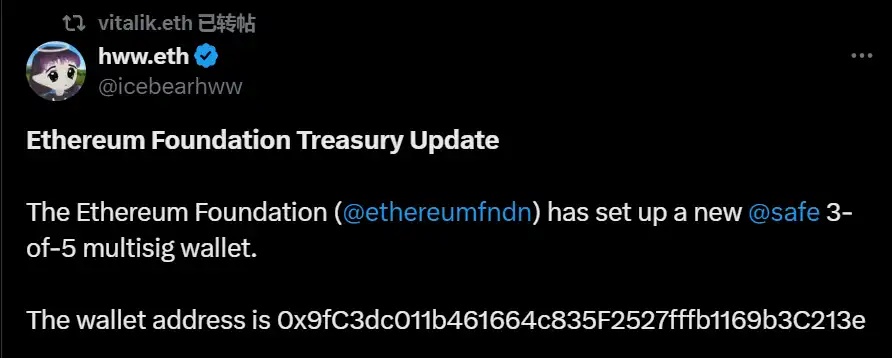
However, the community does not seem convinced and mocked, asking if they were ready to sell again. In this EF criticism battle, the community's anger has not subsided, and the smoke is still lingering.
Even a Second Foundation Emerges, Which Way Now?
On January 22, there were market rumors that Lido founder Konstantin Lomashuk had established the Ethereum Second Foundation. Currently, the Second Foundation's official Twitter account (@2nd_foundation_) is live, and Konstantin Lomashuk quickly retweeted its first tweet.
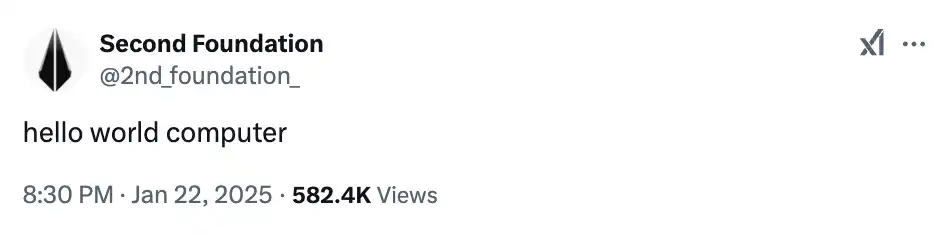
On January 23, Lido founder Konstantin Lomashuk posted again, saying that the tweet was just an idea, and the "Second Foundation" has not been formally established.
He stated that Ethereum is the ultimate world computer, and every member of the Ethereum community can contribute to its growth, development, and success. If a Second Foundation is truly established in the future, it must have a clear goal to complement the tremendous work done by current contributors. "Thank you for your support; I also believe that Ethereum needs more organizations to collectively drive development. I will share more thoughts after further discussions with those who reach out to me."
Although this plan is not currently being executed, the combination of Eric Conner's departure has sparked intense debate within the Ethereum community about the internal and external challenges facing Ethereum.
Regardless of how the domestic and international communities debate, one consensus is that the Ethereum Foundation needs to make a choice because there is a natural difference between left and right, and one cannot be both left-wing and right-wing. During industry difficulties, idealism of the left is needed, and during industry development, accelerationism of the right is needed. A netizen commented, "If Ethereum follows the path of a networked nation, political diversity will inevitably exist. If multiple foundations can ensure confrontation and cooperation, it will lead Ethereum towards a greater future."
Second Foundation currently seems like a troublemaker, but some also question why not look forward to having more control departments in decentralized organizations, as Vitalik stated in an article on January 21 that the future of the Ethereum blockchain is decentralized, and the Ethereum Foundation is just a part of it. He further noted, "EF should not 'overreach'; it should confidently represent the part of Ethereum it can effectively represent while deliberately creating and nurturing open spaces for other organizations to represent other aspects of Ethereum. Some of these aspects may even be better suited to exist in a for-profit form."
You may also like

Abraxas Capital Mints $2.89 Billion USDT: Liquidity Boost or Just More Stablecoin Arbitrage?
Abraxas Capital just received $2.89 billion in freshly minted USDT from Tether. Is this a bullish liquidity injection for crypto markets, or is it business as usual for a stablecoin arbitrage giant? We analyze the data and the likely impact on Bitcoin, altcoins, and DeFi.

A VC from the Crypto world said AI is too crazy, and they are very conservative
The Evolutionary History of Contract Algorithms: A Decade of Perpetual Contracts, the Curtain Has Yet to Fall

Kicked out by PayPal, Musk aims to make a comeback in the cryptocurrency market

Solana ETF News: What Is a Solana ETF and Why Is Goldman Sachs Betting $108 Million on SOL?
Solana ETF news today shows Goldman Sachs disclosed a $108M position while total SOL ETF inflows reached $1.45B. Analysts now expect up to $6B in institutional demand as Solana trades 71% below its all-time high.

Bitcoin ETF News Today: $2.1B Inflows Signal Strong Institutional Demand for BTC
Bitcoin ETFs news recorded $2.1B inflows over 8 consecutive days, marking one of the strongest recent accumulation streaks. Here’s what the latest Bitcoin ETF news means for BTC price and whether the $80K breakout level is next.
Michael Saylor: Winter is Over – Is He Right? 5 Key Data Points (2026)
Michael Saylor tweeted yesterday “Winter‘s Over.” It is short. It is bold. And it has the crypto world talking.
But is he right? Or is this just another CEO pumping his bags?
Let us look at the data. Let us be neutral. Let us see if the ice has really melted.

WEEX Bubbles App Now Live Visualizes the Crypto Market at a Glance
WEEX Bubbles is a standalone app designed to help users quickly understand complex crypto market movements through an intuitive bubble visualization.

Polygon co-founder Sandeep: Writing after the chain bridge chain explosion

Major Upgrade on Web: 10+ Advanced Chart Styles for Deeper Market Insights
To deliver more powerful and professional analysis tools, WEEX has rolled out a major upgrade to its web trading charts—now supporting up to 14 advanced chart styles.

Morning Report | Aethir secures a $260 million enterprise contract with Axe Compute; New Fire Technology acquires Avenir Group's trading team; Polymarket's trading volume surpassed by Kalshi

Why a Million-Follower Crypto KOL Chooses WEEX VIP?
Discover why top crypto KOL Carl Moon partnered with WEEX. Explore the WEEX VIP ecosystem, 1,000 BTC protection fund, and exclusive rewards for serious traders.

CoinEx Founder: The Crypto Endgame in My Eyes

Spark Coin (SPK): Explodes 73% as Aave Bleeds $15B, A Good Investment Now?
Spark coin (SPK) surged 73% as $15 billion fled Aave after the KelpDAO hack. This article explains what Spark is, why it’s pumping, and whether it is a good investment right now.

As Aave's building collapses, Spark's high-rise is rising

RootData: Q1 2026 Cryptocurrency Exchange Transparency Research Report

What Is Memecoin Trading? A Beginner's Guide to How It Works, the Risks, and 2026's Hottest Tokens
Memecoins surged 30%+ at the start of 2026 while Bitcoin was flat. RAVE spiked 4,500% then crashed 90% in days. MAGA jumped 350% overnight. This guide explains exactly how memecoin trading works — and how to not blow up your account doing it.

Trump Extends Ceasefire: Bitcoin Hits $79K — What Crypto Traders Need to Know Right Now
Bitcoin surged past $79,000 after Trump extended the ceasefire indefinitely. We break down exactly what happened, how every major crypto reacted, and what traders should watch next — including the one level that could unlock an $85,000 BTC rally.
Abraxas Capital Mints $2.89 Billion USDT: Liquidity Boost or Just More Stablecoin Arbitrage?
Abraxas Capital just received $2.89 billion in freshly minted USDT from Tether. Is this a bullish liquidity injection for crypto markets, or is it business as usual for a stablecoin arbitrage giant? We analyze the data and the likely impact on Bitcoin, altcoins, and DeFi.
A VC from the Crypto world said AI is too crazy, and they are very conservative
The Evolutionary History of Contract Algorithms: A Decade of Perpetual Contracts, the Curtain Has Yet to Fall
Kicked out by PayPal, Musk aims to make a comeback in the cryptocurrency market
Solana ETF News: What Is a Solana ETF and Why Is Goldman Sachs Betting $108 Million on SOL?
Solana ETF news today shows Goldman Sachs disclosed a $108M position while total SOL ETF inflows reached $1.45B. Analysts now expect up to $6B in institutional demand as Solana trades 71% below its all-time high.
Bitcoin ETF News Today: $2.1B Inflows Signal Strong Institutional Demand for BTC
Bitcoin ETFs news recorded $2.1B inflows over 8 consecutive days, marking one of the strongest recent accumulation streaks. Here’s what the latest Bitcoin ETF news means for BTC price and whether the $80K breakout level is next.


 App
App