
 Buy Crypto
- Markets
 Futures
- Spot
- Copy Trade
- Earn
- More
Kyle Samani Returns to Crypto? Post Discusses How to Efficiently Weed Out CEX

Original Author: Kyle Samani, Co-founder of Multicoin
Original Translator: Azuma, Odaily Planet Daily
Editor's Note: The man known for his shilling of Solana, Multicoin Capital's former co-founder Kyle Samani, who recently made a high-profile return after stepping back, is back at it again!
Yesterday evening, Kyle Samani posted a lengthy thread on his personal X account. In the post, Kyle Samani once again employed his continued shilling (not meant negatively) rhetoric, using "efficiency" as a breakthrough point in the decentralized narrative, elaborating on how the current Solana ecosystem's flagship PropAMM will match or even outperform traditional centralized models in terms of efficiency. He argued that PropAMM is one of the most important innovations in market microstructure in recent years or even decades.
· Related articles: "Kyle Samani's Exit from the Scene, Is There Another Story?", "Kyle Samani's Turnaround, The Person Who Believed Most in Web3 Also Exits the Scene"
Below is the original content by Kyle Samani, translated by Odaily Planet Daily.
Original Content:
PropAMM is one of the most important innovations in market microstructure in recent years, and may even be one of the most important innovations in decades.
To help everyone understand this conclusion, let's first take a look at how Market Makers (MM) quote on traditional centralized exchanges (CEX).
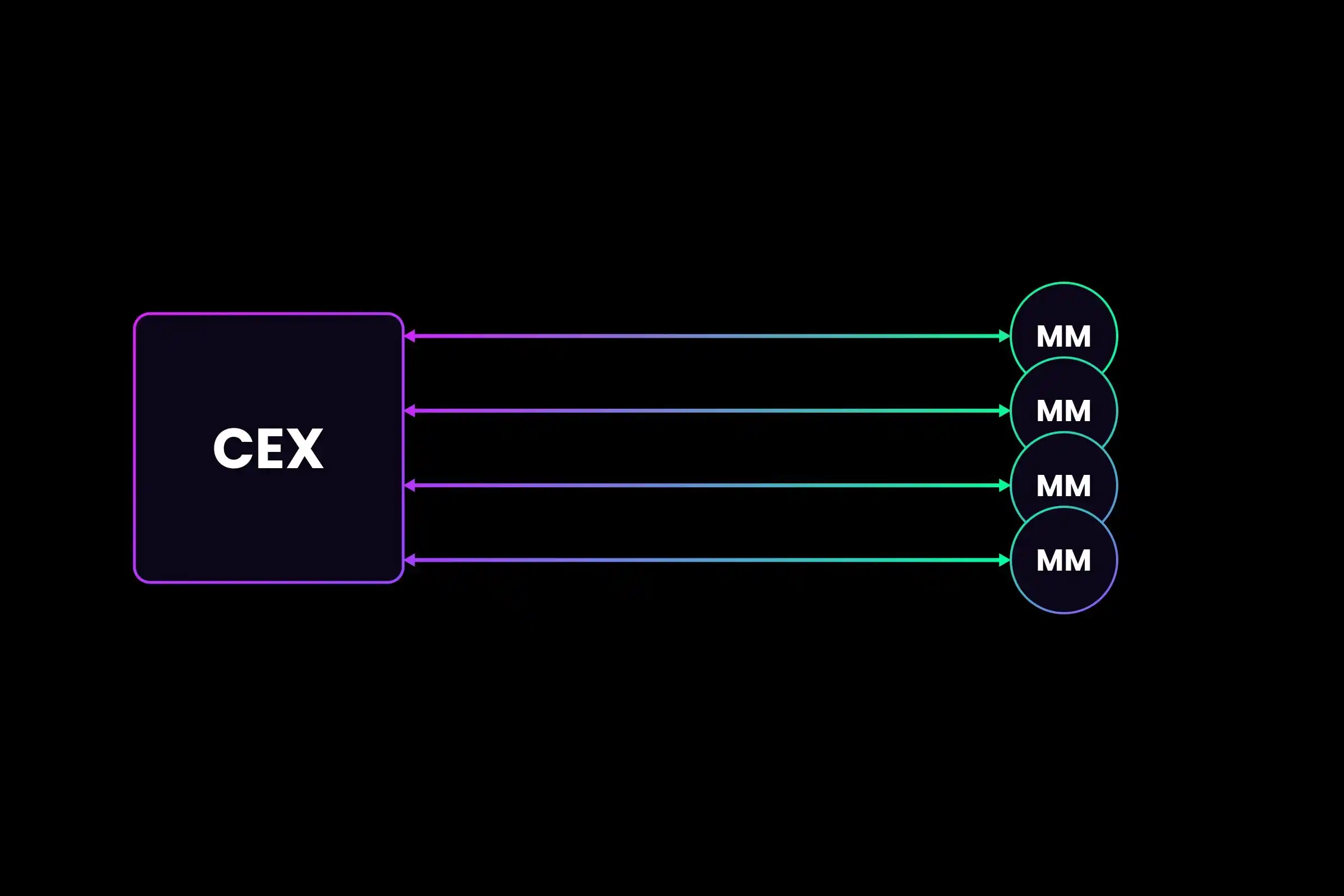
Market Makers typically engage in physical co-location with the exchange. Each Market Maker runs algorithms on a server and is connected to another server through a standardized length of network cable (e.g., 50 meters), where the exchange's system is running.
There is a constant back-and-forth data flow between market makers and trading platforms. Every time a market maker sends an order to the trading platform—whether it's a limit order, cancel order, or market order—the trading platform needs to broadcast this information to all other market makers; then, other market makers will resend their orders based on the new information; and so the cycle repeats, indefinitely.
Below is a simple schematic.
Now let's take a look at how PropAMM works on the Solana mainnet.
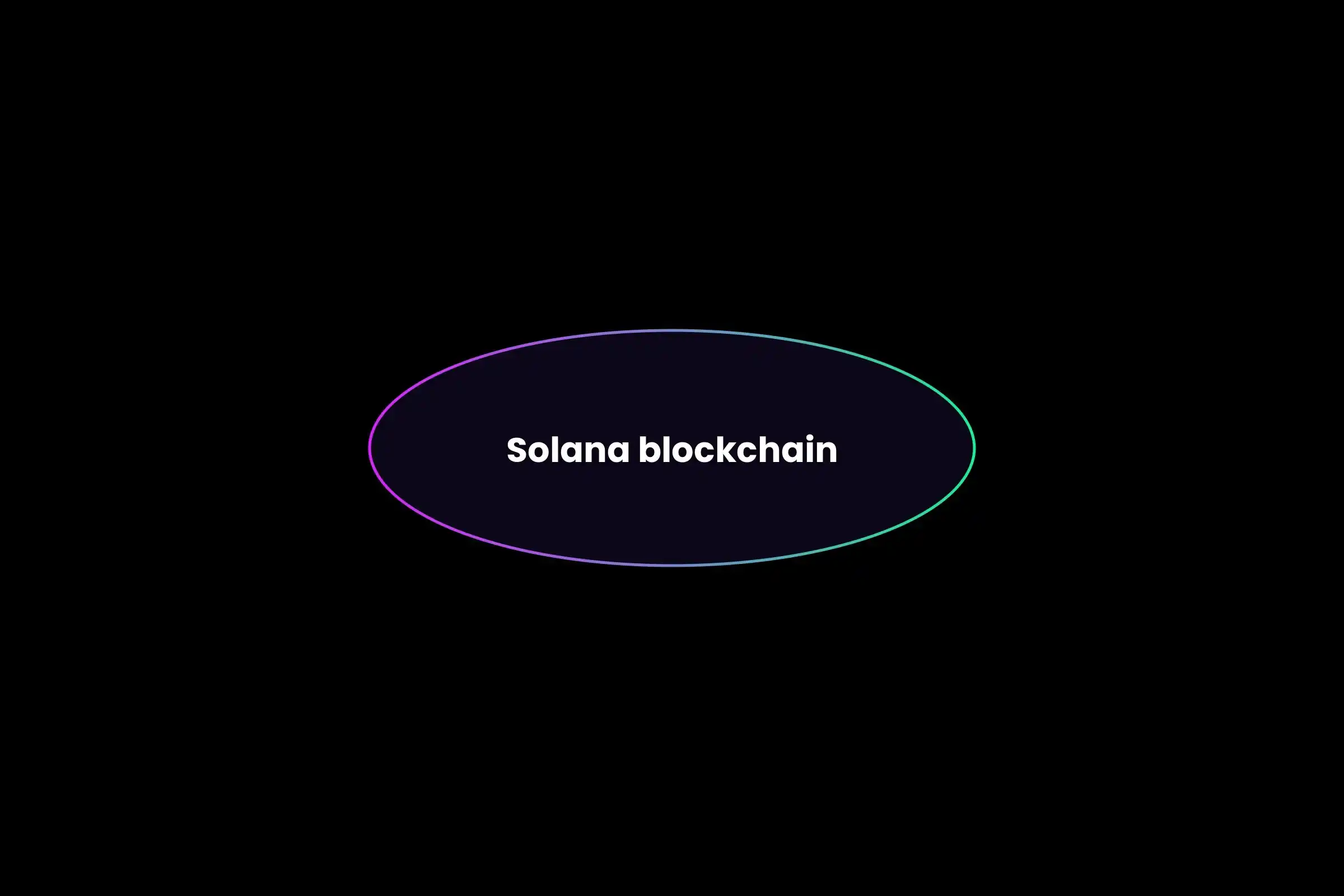
The beauty of PropAMM on Solana is that the blockchain itself directly "hosts" the market maker algorithm. This means the system no longer needs to shuttle billions of messages back and forth between market makers and trading platforms; the market maker algorithm will run directly on the same physical machine as the trading platform.
The new schematic is as follows. (Yes, only the Solana blockchain is needed!)
In the cryptocurrency industry, there has always been a perennial view that, because decentralized systems need to communicate between global nodes, they will surely be slower (have higher latency) than centralized systems.
But if you look at this problem in a different way, on-chain hosted algorithms may actually have lower latency than traditional centralized trading platforms in finance.
Why is this so? The reason is the latency required for PropAMM to update prices only involves electrons moving within the same block of physical silicon. For example, if a previous market order caused a price change for SOL-USD, this information is immediately visible to all PropAMM and used for pricing the next market order. Everything happens within the same block of silicon, eliminating the need for bidirectional communication between servers.
It is worth noting that PropAMM does require frequent oracle updates, but this is not a problem and does not change the overall fact as I described above.
The most critical point remains that when a trading platform—in the case above, the Solana blockchain—directly hosts the PropAMM algorithm, market maker pricing changes in real-time within the same block of physical silicon.
PropAMM has become the dominant mechanism for the SOL-USDC spot price on Solana, with a spread tighter than all major CEXs. I expect this market structure to become the dominant mode of on-chain trading this year, including spot, perpetuals, and even prediction markets.
The biggest challenge for PropAMM is that there is currently no way to guarantee that a taker will always receive the best execution, due to:
· All PropAMM algorithms are not public (which is actually reasonable, as traditional market-making algorithms are also private);
· The outcome of trading routing across multiple PropAMMs is non-deterministic.
However, this issue is solvable. I expect all relevant aggregator teams to introduce solutions this year, such as Jupiter and dFlow on the spot side, and Phoenix on the derivatives side.
Current PropAMMs are still not fully optimized and are subject to various limitations of the Solana blockchain itself. This year, Solana will roll out a series of major upgrades that will significantly improve PropAMM performance, including:
1. Higher CU (Computational Unit) limits per trade and larger trade sizes;
2. Higher CU limits per block;
3. Alpenglow: reducing slot time from 400ms to 100–150ms;
4. DoubleZero: reducing global network latency;
5. Application-controlled execution;
6. Multiple concurrent leaders.
If on the Solana mainnet, PropAMMs are already able to provide quotes tighter than all CEXs without these upgrades, it is conceivable that as these upgrades are gradually rolled out, their performance will become even more powerful.
You may also like

Naval personally takes the stage: The historic collision between ordinary people and venture capital

a16z Crypto: 9 Charts to Understand the Evolution Trends of Stablecoins

Refutation of Yang Haipo's "The End of Cryptocurrency"

Can a hairdryer earn $34,000? Interpreting the reflexivity paradox of prediction markets

6MV Founder: In 2026, the "landmark turning point" for crypto investment has arrived

Abraxas Capital Mints $2.89 Billion USDT: Liquidity Boost or Just More Stablecoin Arbitrage?
Abraxas Capital just received $2.89 billion in freshly minted USDT from Tether. Is this a bullish liquidity injection for crypto markets, or is it business as usual for a stablecoin arbitrage giant? We analyze the data and the likely impact on Bitcoin, altcoins, and DeFi.
A VC from the Crypto world said AI is too crazy, and they are very conservative
The Evolutionary History of Contract Algorithms: A Decade of Perpetual Contracts, the Curtain Has Yet to Fall

Kicked out by PayPal, Musk aims to make a comeback in the cryptocurrency market

Solana ETF News: What Is a Solana ETF and Why Is Goldman Sachs Betting $108 Million on SOL?
Solana ETF news today shows Goldman Sachs disclosed a $108M position while total SOL ETF inflows reached $1.45B. Analysts now expect up to $6B in institutional demand as Solana trades 71% below its all-time high.

Bitcoin ETF News Today: $2.1B Inflows Signal Strong Institutional Demand for BTC
Bitcoin ETFs news recorded $2.1B inflows over 8 consecutive days, marking one of the strongest recent accumulation streaks. Here’s what the latest Bitcoin ETF news means for BTC price and whether the $80K breakout level is next.
Michael Saylor: Winter is Over – Is He Right? 5 Key Data Points (2026)
Michael Saylor tweeted yesterday “Winter‘s Over.” It is short. It is bold. And it has the crypto world talking.
But is he right? Or is this just another CEO pumping his bags?
Let us look at the data. Let us be neutral. Let us see if the ice has really melted.

WEEX Bubbles App Now Live Visualizes the Crypto Market at a Glance
WEEX Bubbles is a standalone app designed to help users quickly understand complex crypto market movements through an intuitive bubble visualization.

Polygon co-founder Sandeep: Writing after the chain bridge chain explosion

Major Upgrade on Web: 10+ Advanced Chart Styles for Deeper Market Insights
To deliver more powerful and professional analysis tools, WEEX has rolled out a major upgrade to its web trading charts—now supporting up to 14 advanced chart styles.
Morning Report | Aethir secures a $260 million enterprise contract with Axe Compute; New Fire Technology acquires Avenir Group's trading team; Polymarket's trading volume surpassed by Kalshi

Why a Million-Follower Crypto KOL Chooses WEEX VIP?
Discover why top crypto KOL Carl Moon partnered with WEEX. Explore the WEEX VIP ecosystem, 1,000 BTC protection fund, and exclusive rewards for serious traders.

CoinEx Founder: The Crypto Endgame in My Eyes
Naval personally takes the stage: The historic collision between ordinary people and venture capital
a16z Crypto: 9 Charts to Understand the Evolution Trends of Stablecoins
Refutation of Yang Haipo's "The End of Cryptocurrency"
Can a hairdryer earn $34,000? Interpreting the reflexivity paradox of prediction markets
6MV Founder: In 2026, the "landmark turning point" for crypto investment has arrived
Abraxas Capital Mints $2.89 Billion USDT: Liquidity Boost or Just More Stablecoin Arbitrage?
Abraxas Capital just received $2.89 billion in freshly minted USDT from Tether. Is this a bullish liquidity injection for crypto markets, or is it business as usual for a stablecoin arbitrage giant? We analyze the data and the likely impact on Bitcoin, altcoins, and DeFi.


 App
App