

meme Coin Crashes 50% Across the Board, Did Binance Pull an April Fools' Day Prank on the Market?

On April 1st, Binance had a rough April Fools' Day, and the market fell victim to a costly joke. First, $GUN was suspected by the community to be engaging in rug pulling or whale dumping, but this matter has yet to be conclusively resolved. Following one announcement, a more serious chain reaction crash occurred later that night. What kind of joke did Binance play on us this April Fools' Day?
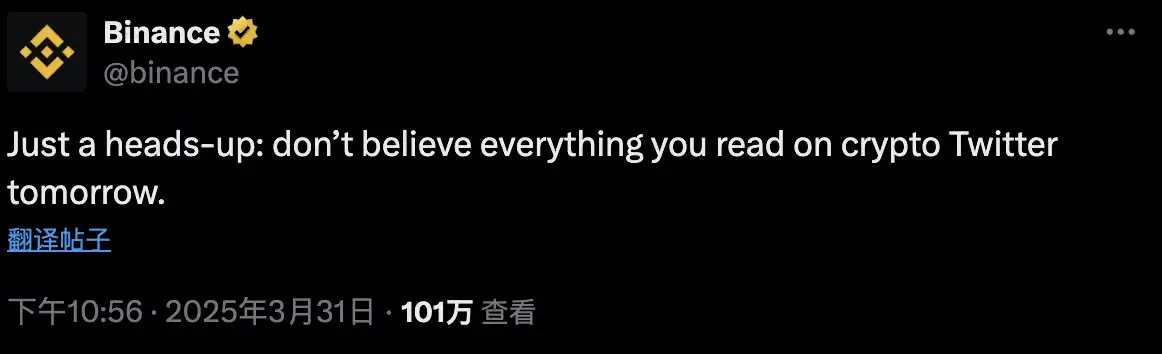
Announcement Turmoil
Initial Announcement
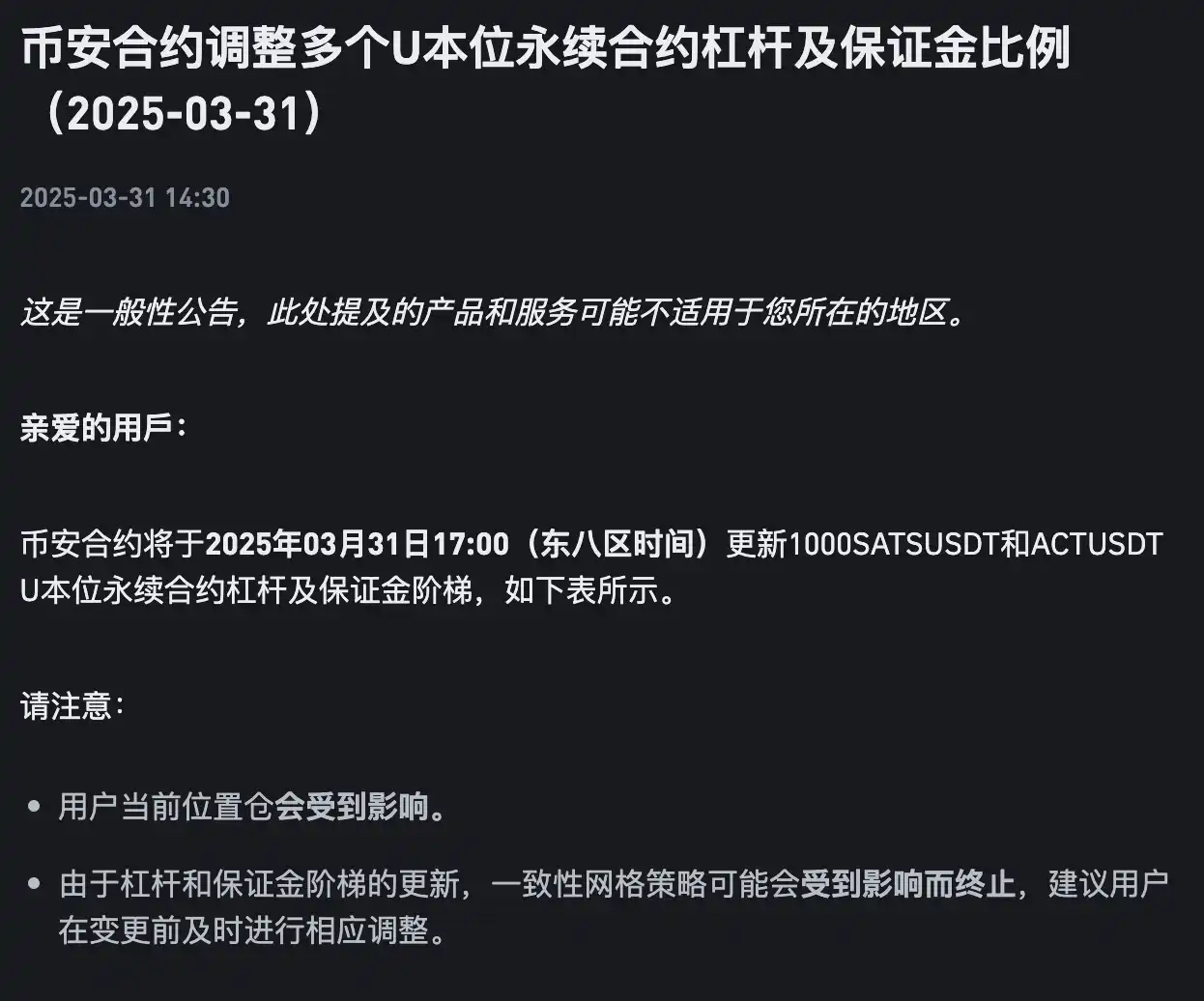
The genesis of this plummet can be traced back to an announcement made yesterday. On March 31st at 14:30, Binance released the announcement "Binance Futures will update 1000SATSUSDT and ACTUSDT U perpetual contract leverage and margin tier at 17:00 on the same day," warning users that their current position might be affected and that due to the leverage and margin tier update, the consistency grid strategy may be terminated. Users were advised to make necessary adjustments promptly before the change.
Subsequent Amendment Announcement
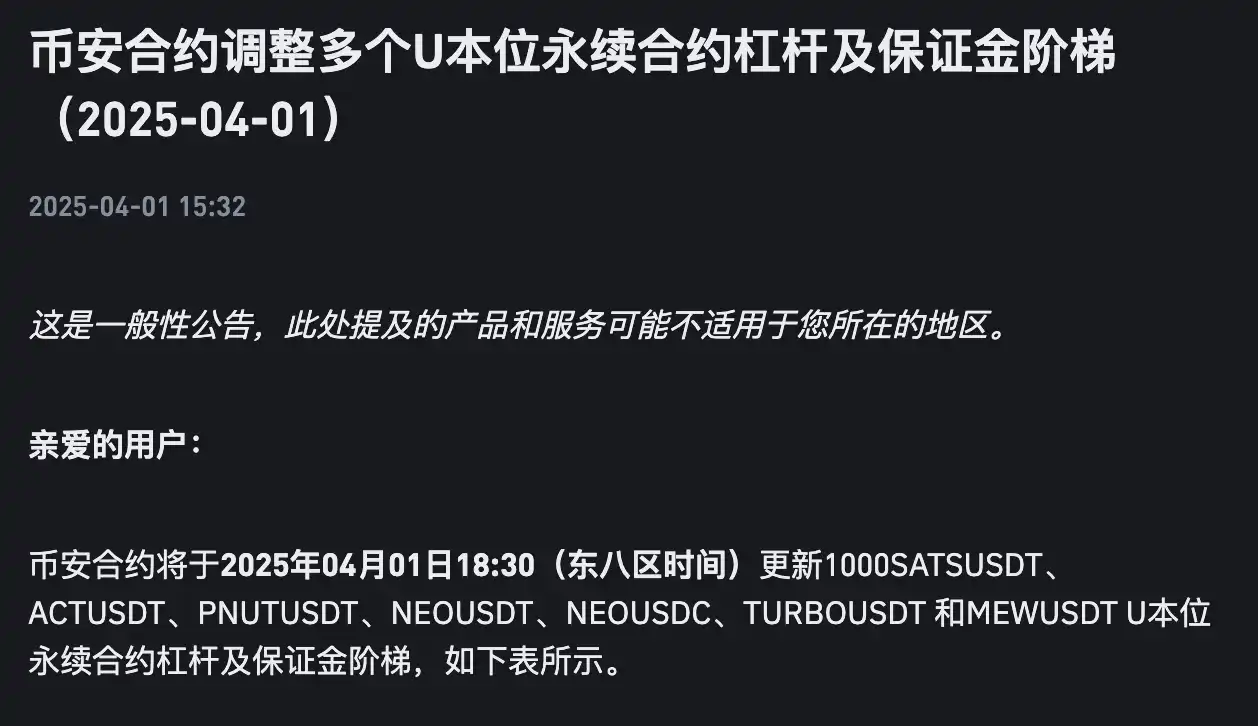
Just one day later, on April 1st at 15:32, Binance once again issued an announcement stating, "Binance Futures will update 1000SATSUSDT, ACTUSDT, PNUTUSDT, NEOUSDT, NEOUSDC, TURBOUSDT, and MEWUSDT U perpetual contract leverage and margin tier on April 1, 2025, at 18:30". This announcement not only further modified the previous day's newly updated $ACT position limit "by further reducing the lower leverage position limit by 50%," but also gave users less than a 3-hour reaction time.
Marketwide Meltdown
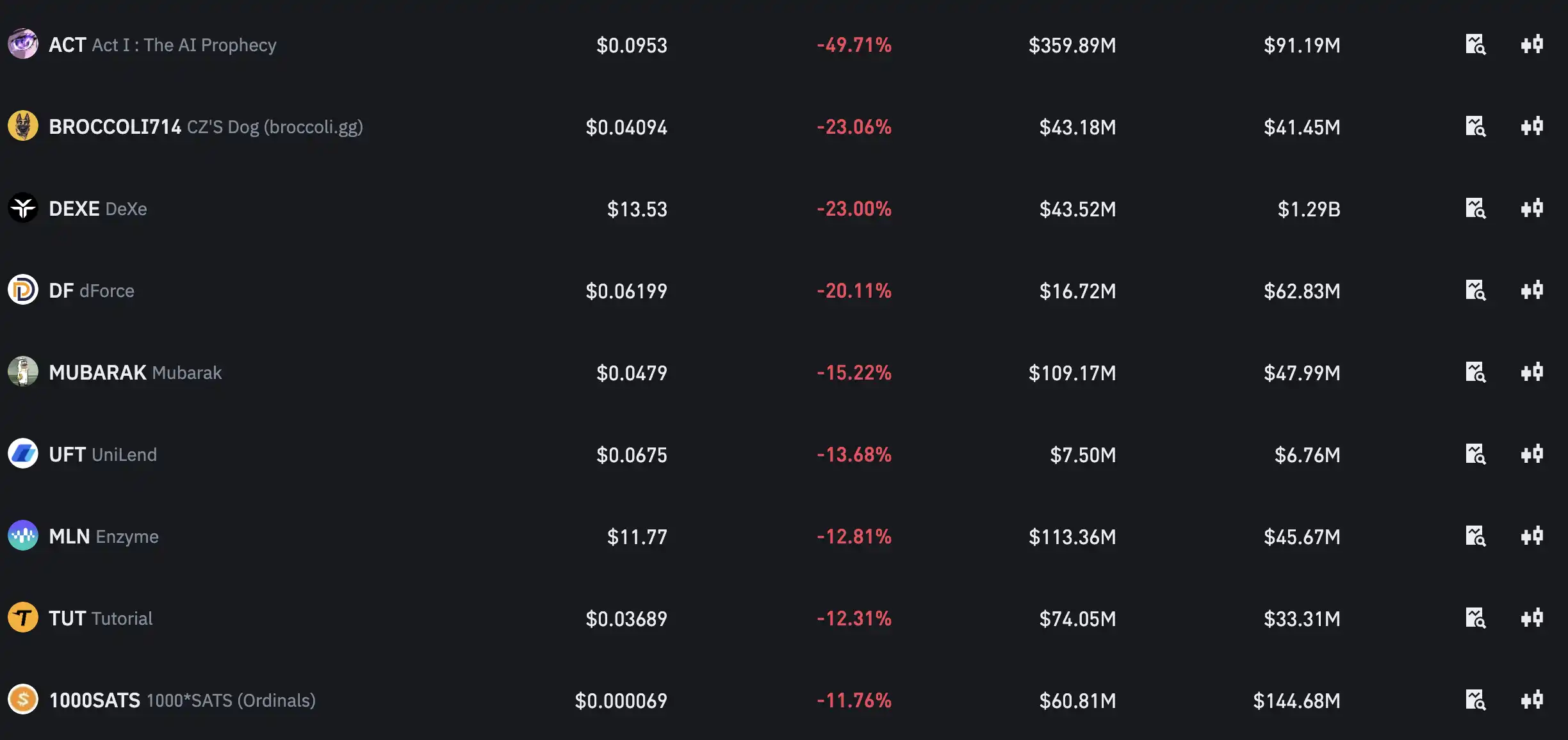
Several tokens such as ACT, DEXE, HIPPO, BANANAS31, TST, PNUT, and others experienced nearly simultaneous drops of up to 50%. Within a span of just 5 minutes from 18:30 to 18:35, the total value of ACT contract holdings on the Binance platform plummeted by 76.53%, dropping from $94.1286 million to $22.0932 million. This instantly ignited the community, clearly indicating that the impact of Binance's rule changes far exceeded everyone's expectations, leading to widespread speculation about the cause of the crash.
Liquidity Provider Suspicion
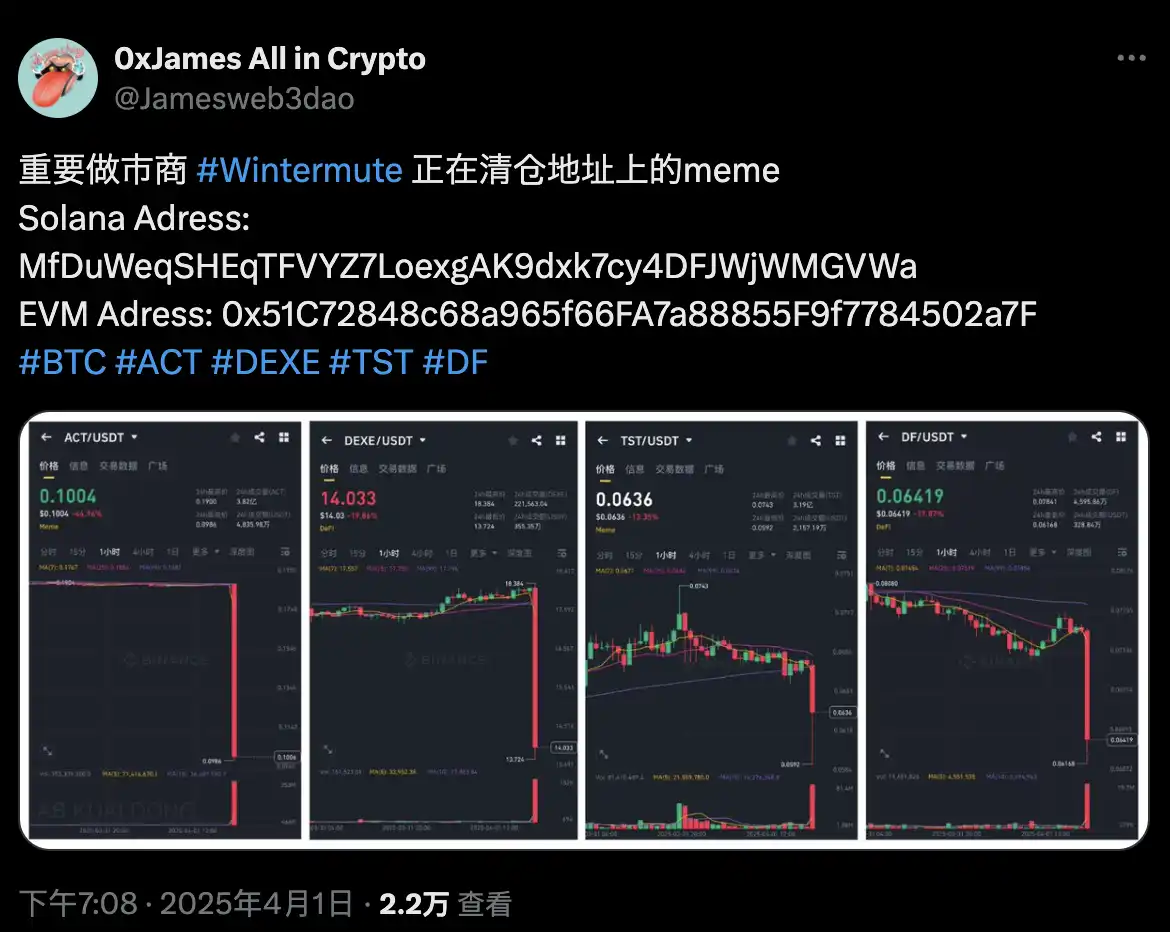
The first to be suspected was the liquidity provider, with WinterMute as the liquidity provider for the biggest loser $ACT and multiple MemeCoins thrust into the spotlight. Twitter KOL 0xJames observed addresses related to WinterMute were liquidating their Meme positions on-chain. Wintermute dumped approximately $250,000 worth of ACT tokens in half an hour through Raydium.
Liquidity Provider Clarification
However, some people, after analyzing the situation, don't believe this to be the case. A Web3 philosopher stated, "There is a clear time delay between CEX dumping and on-chain liquidation behavior. If WinterMute wanted to liquidate Meme, it would not align with the principle of maximizing profits."

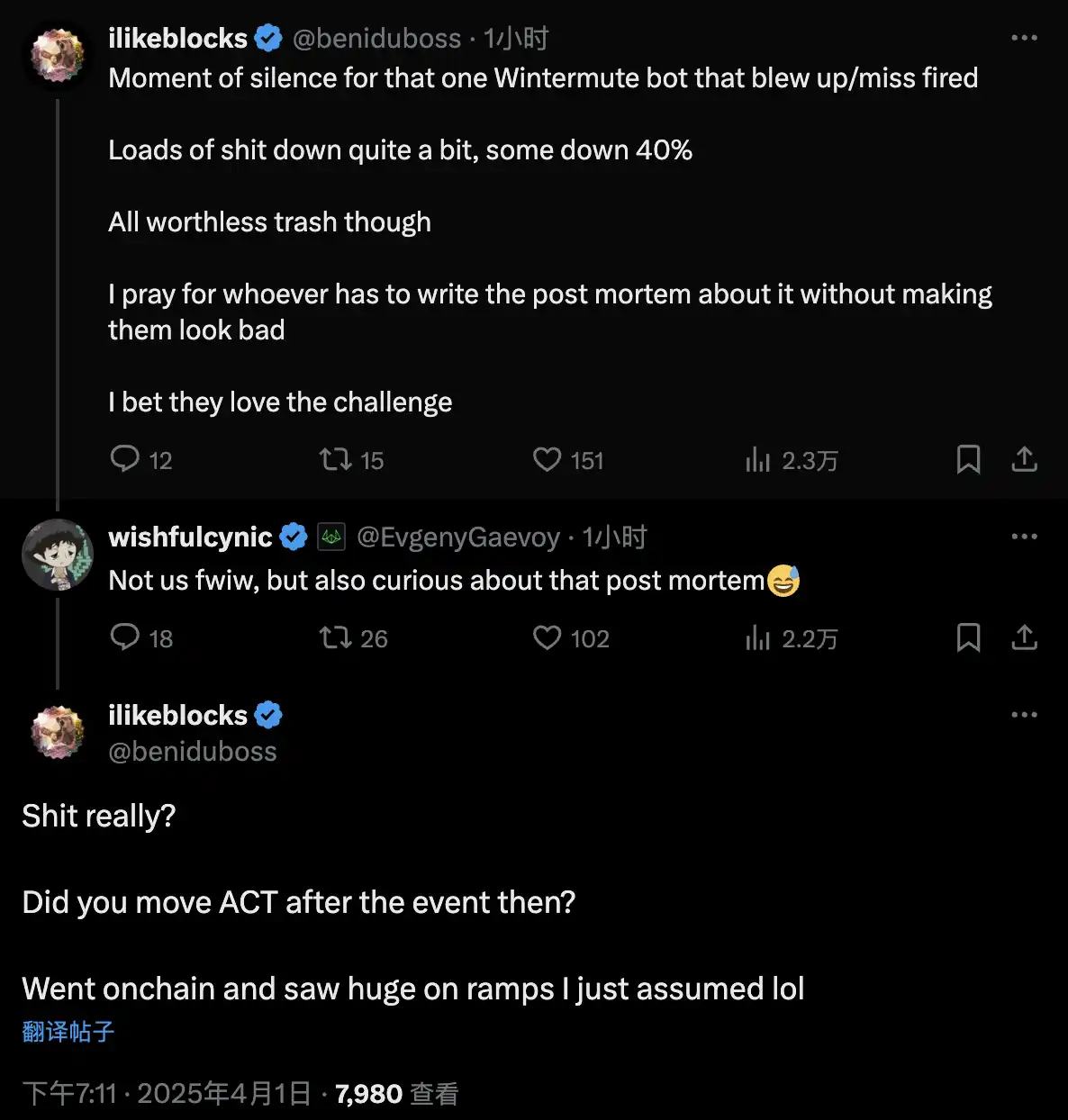
WinterMute's founder and CEO, Evgeny Gaevoy, later responded to a skeptic and left a remark saying, "It's not our thing, and we are also curious about the post-mortem analysis of what actually happened," indicating that the on-chain selling behavior was a reaction to drastic token price fluctuations and automated arbitrage in the AMM pool.
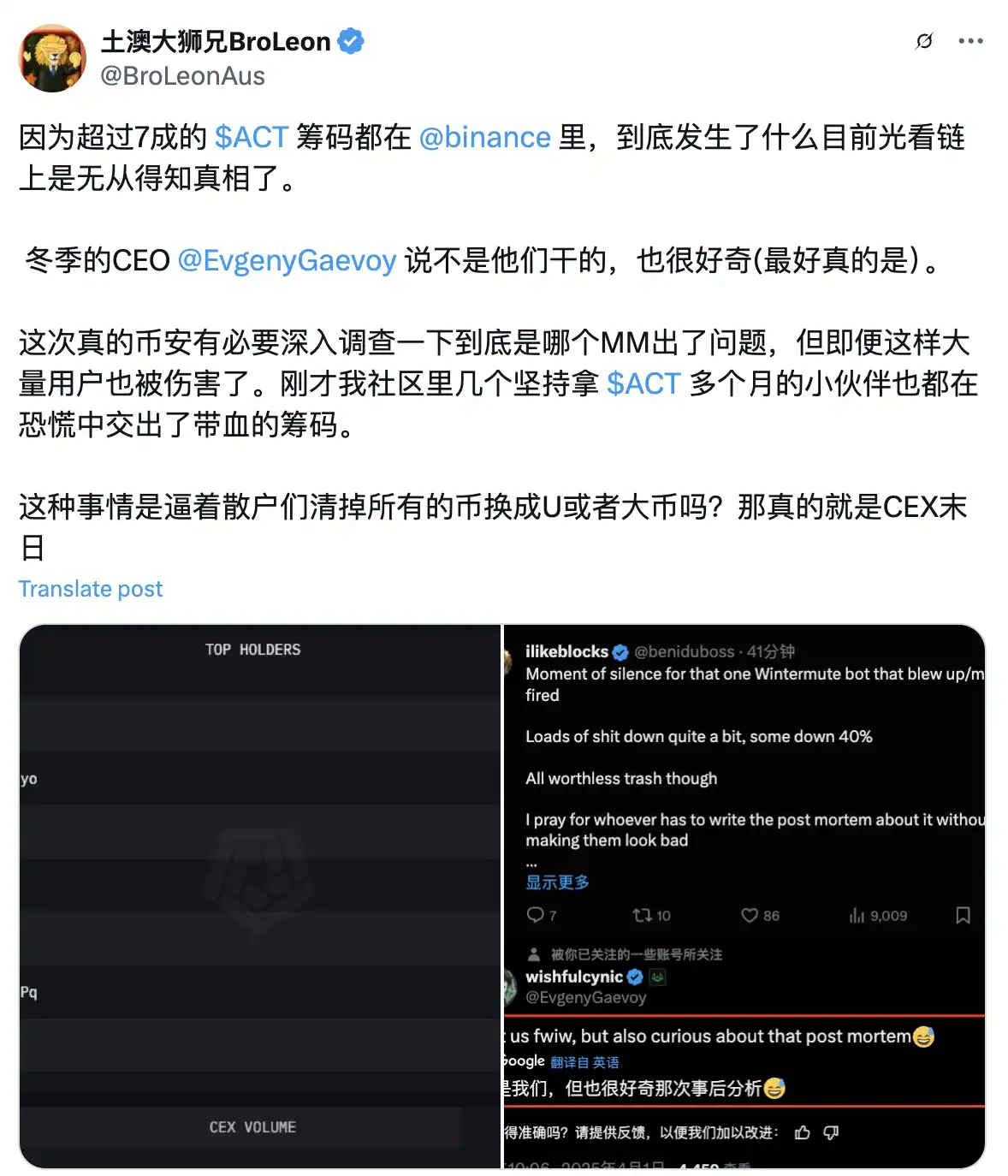
Australian lion BroLeon expressed skepticism towards Gaevoy's explanation, mentioning that 70% of $ACT chips are on exchanges, and the truth cannot be ascertained only from on-chain data. He hopes Binance can conduct a thorough investigation and provide a satisfactory answer; otherwise, it will have a highly negative impact on the market.
Binance Rule Change Factor
Of course, some also believe it was not a liquidity provider dumping but a change in Binance's rules. Firstly, the rule adjustment directly affected market liquidity. Binance adjusted the contract's position limit and leverage multiplier to reduce market risk. However, this had a significant impact on liquidity providers. The lowered position limit forced them to reduce their holdings, even leading to forced liquidation. The reduced leverage also compelled them to decrease leveraged positions. Liquidity providers typically hold spot and contract positions to hedge risks. If their holdings exceed the new limit or if funds are insufficient after leverage reduction, the system forcibly liquidates, selling in the contract market and reducing the contract price.
As the spot and contract price spreads continued to widen, coupled with arbitrage bots buying low in the contract market and selling high in the spot market, profiting from the narrowing spread, the bots sold extensively in the spot market, further depressing the spot price. As the liquidity providers were liquidated, causing the contract price to fall, coupled with arbitrage bots causing the spot price to drop, the overall market sentiment turned to panic, with retail investors following suit, leading to a chain reaction crash, resulting in a complete collapse of the Memecoin market.
Crypto KOL and former FTX Community Partner Benson Sun commented on this, saying, "Before Binance changes the rules, it should first assess how many positions will be liquidated. If the position of a market maker is large, they should also be notified in advance. As an industry leader, I hope Binance can handle this incident properly."
The Truth Remains a Mystery
After experiencing suspicions from the market regarding market makers, Binance rule mistakes, and even internal misconduct, KOL Zishi stated that none of this is related and only stated the facts. Meanwhile, He Yi commented with a sigh under this tweet, showing his helplessness.
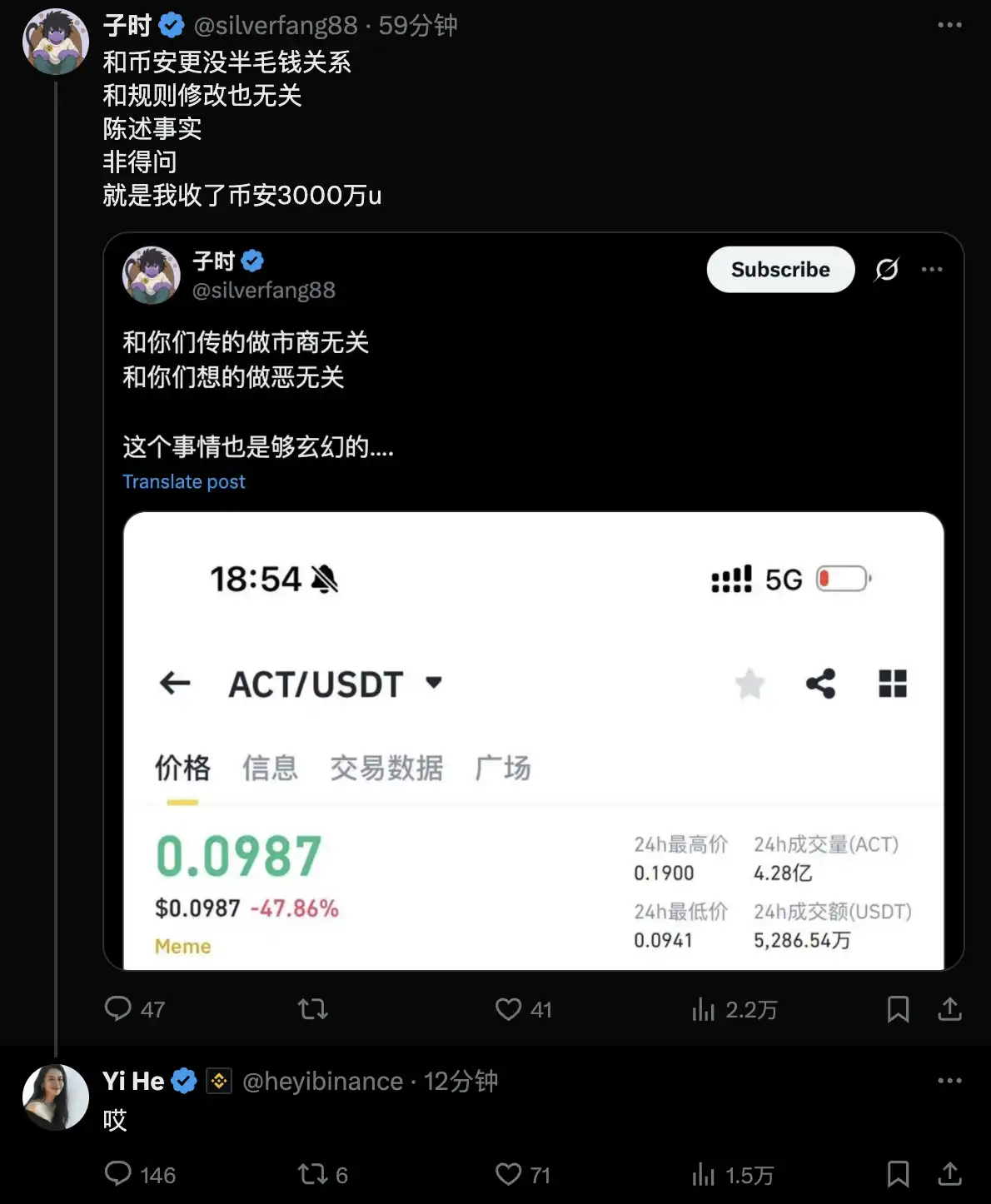
At the time of publication, He Yi tweeted that the corresponding team is preparing a detailed response, and it is still impossible to make a judgment at present. Recently, the beleaguered Binance has indeed encountered some issues that need to be addressed. BlockBeats will continue to follow this matter and report on it.
You may also like

Who authorized this? The gray area of x402

What is the background of 5(c) Capital, which has both Polymarket and Kalshi CEOs as investors?

This Week's Key News Preview | The Federal Reserve Announces Interest Rate Decision; MegaETH Conducts TGE

Lower the expectations for the next bull market of BTC

Morning News | Aave announces the establishment of a recovery fund; Michael Saylor releases Bitcoin Tracker information; Vietnam plans to launch a pilot project for crypto assets

Crypto ETF Weekly | Last week, the net inflow for Bitcoin spot ETFs in the U.S. was $823 million; the net inflow for Ethereum spot ETFs in the U.S. was $155 million

How to balance risk and return in DeFi yields?

Tom Lee's Ethereum Thesis: Why the Man Who Called the Last Cycle Is Doubling Down on Bitmine
Tom Lee is emerging as one of Ethereum’s most influential supporters. From Fundstrat to Bitmine, his Ethereum thesis combines staking yield, treasury accumulation, and long-term network value. Here is why “Tom Lee Ethereum” has become one of crypto’s most watched narratives.
Naval personally takes the stage: The historic collision between ordinary people and venture capital

a16z Crypto: 9 Charts to Understand the Evolution Trends of Stablecoins

Refutation of Yang Haipo's "The End of Cryptocurrency"

Can a hairdryer earn $34,000? Interpreting the reflexivity paradox of prediction markets

6MV Founder: In 2026, the "landmark turning point" for crypto investment has arrived

Abraxas Capital Mints $2.89 Billion USDT: Liquidity Boost or Just More Stablecoin Arbitrage?
Abraxas Capital just received $2.89 billion in freshly minted USDT from Tether. Is this a bullish liquidity injection for crypto markets, or is it business as usual for a stablecoin arbitrage giant? We analyze the data and the likely impact on Bitcoin, altcoins, and DeFi.
A VC from the Crypto world said AI is too crazy, and they are very conservative
The Evolutionary History of Contract Algorithms: A Decade of Perpetual Contracts, the Curtain Has Yet to Fall

Kicked out by PayPal, Musk aims to make a comeback in the cryptocurrency market

Solana ETF News: What Is a Solana ETF and Why Is Goldman Sachs Betting $108 Million on SOL?
Solana ETF news today shows Goldman Sachs disclosed a $108M position while total SOL ETF inflows reached $1.45B. Analysts now expect up to $6B in institutional demand as Solana trades 71% below its all-time high.
Who authorized this? The gray area of x402
What is the background of 5(c) Capital, which has both Polymarket and Kalshi CEOs as investors?
This Week's Key News Preview | The Federal Reserve Announces Interest Rate Decision; MegaETH Conducts TGE
Lower the expectations for the next bull market of BTC
Morning News | Aave announces the establishment of a recovery fund; Michael Saylor releases Bitcoin Tracker information; Vietnam plans to launch a pilot project for crypto assets
Crypto ETF Weekly | Last week, the net inflow for Bitcoin spot ETFs in the U.S. was $823 million; the net inflow for Ethereum spot ETFs in the U.S. was $155 million


