

Milestone AI-driven Layoff, a 50% Reduction in Force, Resulting in Unquestionable Capital Market Approval


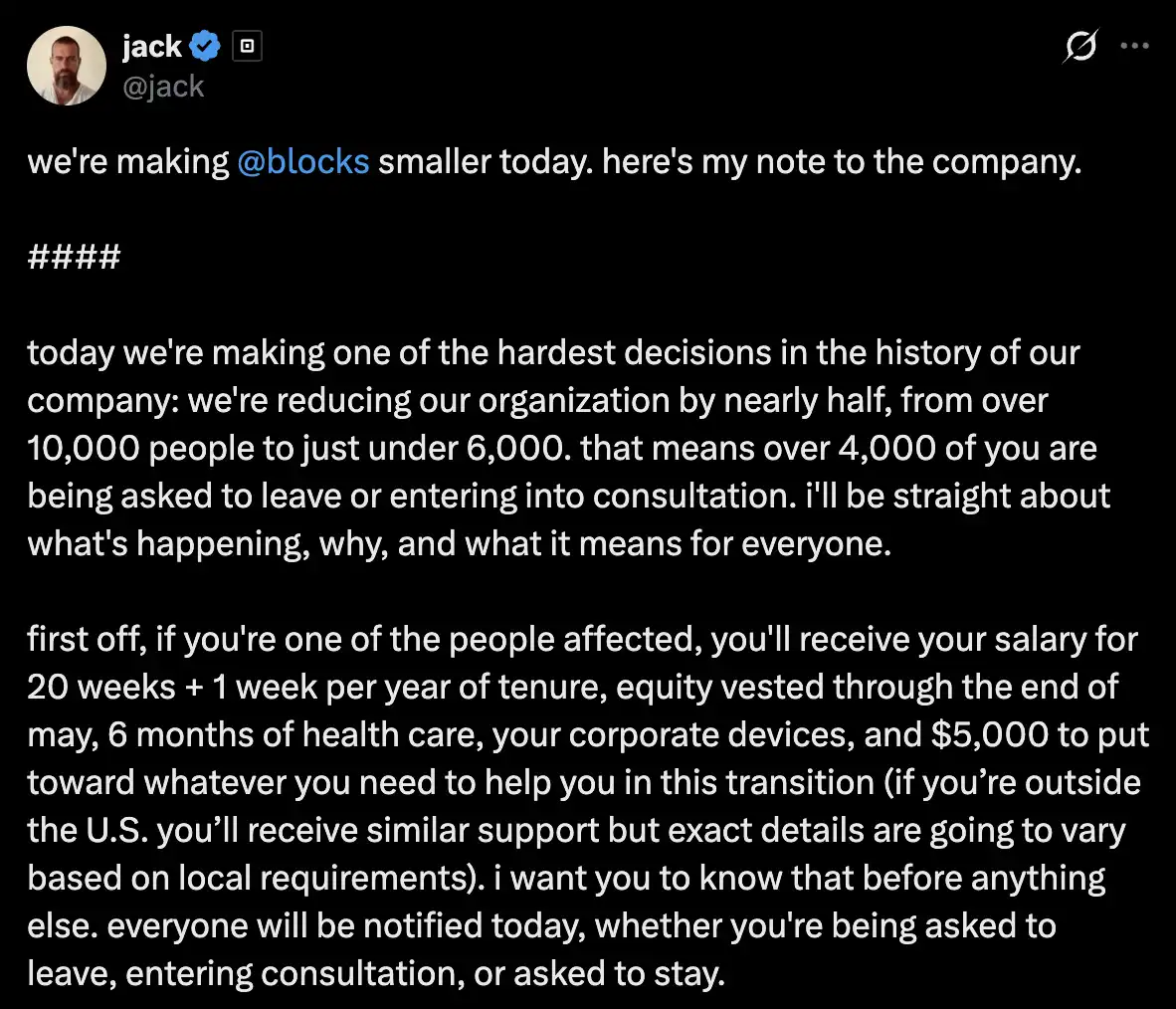
Last night, Jack Dorsey, the founder of the American payment company Block and also the original founder of Twitter acquired by Musk, released a company-wide email that shook Silicon Valley.
A 50% reduction in workforce, transforming a company of over ten thousand people into fewer than six thousand in an instant. However, unlike Musk's swift actions, Dorsey provided an extremely generous compensation package — starting with a 20-week salary, six months of health insurance, and even a $5000 "transition allowance."
He even requested that the Slack channel remain open until Thursday night so that departing employees could say goodbye gracefully.
However, the capital market never believes in tears, only in efficiency.
Almost at the same time as the company-wide email was released, Block's stock price soared. Wall Street's logic is simple yet ruthless, and the market's enthusiastic feedback told this former Twitter founder: you did something extremely right, yet extremely cruel.
The core of Block's layoffs is a internal AI tool they call "Goose."
If Klarna's layoffs in 2024 targeted customer service, and Dell's layoffs in 2025 targeted sales, then Block's earthquake in 2026 directly shattered the careers of engineers and project managers.
According to leaked technical details, Goose's "dimensionality reduction" impact on traditional corporate positions is reflected in three hardcore dimensions:
First, for coders, a traditional AI assistant could only write code snippets. But Goose has "global read-write access" to Block's massive legacy codebase.
In the past, modifying a cross-border payment interface required alignment among the payment, risk control, and clearing departments, with 5-8 engineers struggling for two weeks. With Goose, input natural language, Goose automatically scans all microservices, identifies dependency conflicts, and directly generates a Pull Request. Those mid-level engineers responsible for "interface alignment" instantly lost their value.
Next is operations. Block's payment business requires 24/7 uninterrupted service. Previously, this required a large-scale operations team working in shifts. Now, Goose can analyze logs 10 times faster than humans, autonomously perform rollbacks or scaling. It's basically the "unmanned" operations mentioned in Dorsey's email.
The most tragic impact was on project managers. Dorsey detests "communicating just for the sake of communicating." Those in intermediary roles translating between customer requirements and development tasks had their jobs taken over by Goose.
Block's recent layoff can essentially be defined as a milestone event for the AI industry in 2026.
Prior to this, people's perception of AI was still at the "tool" stage—enhancing personal efficiency, allowing one person to do the work of two. However, Block's case proves that AI truly changes a company's organizational structure. More cruelly, it provided tech giants with the perfect "fig leaf."
Turning back the clock to 2020 to 2022, amidst the frenzy of the zero interest rate era, Silicon Valley once fell into an irrational "hoarding talent race." At the end of 2019, Block's total number of employees was less than 4,000, but during the following three-year frenzy, this number skyrocketed to over 12,000, expanding threefold. While blindly expanding its workforce, Dorsey also defiantly spent nearly $300 million to acquire the streaming platform Tidal, which had no relevance to its core financial business.
As the tide receded, the bloated figure became the tech giants' heaviest shackle. How to cut off these historical burdens while not exposing a strategic failure in the capital market? The answer is to tell a cost-reduction and efficiency-improvement story with AI. The departure of these 4,000 employees not only once and for all bought out the "organizational debt" but also means that Block will directly save nearly $1 billion in annual operating expenses. After the big clean-up, the remaining 6,000 employees will support the company's massive annual revenue of over $22 billion, with annual revenue per employee soaring to over $3.5 million. This is a seductive model that even Wall Street cannot resist.
Packaging violent layoffs as an "AI-embracing organizational restructuring" not only conceals management's past oversight of blind expansion but also allows the company to naturally transform into a pioneer of the new era. Wall Street does not need to investigate what mistakes were made in the past; as long as they see that the saved $1 billion can directly translate into the next quarter's net profit expectations, that is enough to send the stock price soaring by 24%.
As Cobo's founder Fish God said: "What AI truly changes is not the enhancement of human skills but the transformation of a company's organizational structure."
From blind expansion and strategic redundancy during the pandemic to a small-scale test of marketing and customer service in early February, to now a "50% cut" in the core technical layer with the help of Goose, Block has completely undergone a power transition: from a "labor-intensive internet company" to a "native AI logic company," undergoing a brutal paradigm shift.
You may also like

Full text of the Federal Reserve's decision: Holding steady for the third consecutive time but increasing divisions

Dan Bin takes action, building a position in Circle

The Impossible Triangle of DeFi Lending

Bitcoin ETF News: Why Bitcoin Is Falling Even After $2.43B ETF Inflows in April
Bitcoin ETF news today shows $2.43B in April inflows as institutions absorbed thousands of BTC, yet the price dropped from $79K to $76K. Traders are now watching whether the $80K resistance breaks or triggers another pullback.

What Is RWA in Crypto? Real-World Assets Explained (2026 Guide)
What Is RWA in Crypto?RWA stands for Real-World Assets — traditional financial assets like bonds, real estate, gold, and private credit that have been converted into blockchain tokens.

Revisiting RWA: Nearly 50,000 people's first on-chain transaction was not Bitcoin, but stock indices and crude oil

Altcoin Price Outlook 2026: The Rotation Is Coming — Just Not the Way You Think
Bitcoin dominance at 58%, Fear & Greed at 39. If you think altcoin season is dead, you're reading the wrong signals. Here's what the data actually says about what comes next.

Oracle: The Second Battlefield Behind the Prediction Market War

a16z's key bet: Kalshi's weekly trading volume approaches $3 billion, transitioning from "prediction games" to financial infrastructure, the market begins to price "uncertainty."

Morning Report | Galaxy Digital announces Q1 2026 financial report; Liquid completes $18 million Series A financing; Polymarket plans to bring major exchanges to the U.S

From a banned economist to the new CEO of Xinhua: Fu Peng has figured out the second half of traffic

Why Private Credit Became the First True Bridge from TradFi to DeFi

Senior cryptocurrency investor: Blockchain is showing a siphoning effect on capital

When traditional crypto derivatives start to subtract: Insights from Hyper Trade's products

My view on blockchain has changed

Will AI Agents use bank cards? Why can't Agentic Payment avoid stablecoins and blockchain?

Deconstructing 80 mainstream payment institutions and wallets worldwide
The MiCA Fast Track for Cryptocurrency Licenses: Why OKX and BVNK Choose Malta
Full text of the Federal Reserve's decision: Holding steady for the third consecutive time but increasing divisions
Dan Bin takes action, building a position in Circle
The Impossible Triangle of DeFi Lending
Bitcoin ETF News: Why Bitcoin Is Falling Even After $2.43B ETF Inflows in April
Bitcoin ETF news today shows $2.43B in April inflows as institutions absorbed thousands of BTC, yet the price dropped from $79K to $76K. Traders are now watching whether the $80K resistance breaks or triggers another pullback.
What Is RWA in Crypto? Real-World Assets Explained (2026 Guide)
What Is RWA in Crypto?RWA stands for Real-World Assets — traditional financial assets like bonds, real estate, gold, and private credit that have been converted into blockchain tokens.
Revisiting RWA: Nearly 50,000 people's first on-chain transaction was not Bitcoin, but stock indices and crude oil


