
 Buy Crypto
- Markets
 Futures
- Spot
- Copy Trade
- Earn
- More
Node Operator Issues Open Letter of Concern as Hyperliquid's Centralized API Sparks Controversy


Original Article Title: A Letter To The Hyperliquid Core Team
Original Article Author: Kam Benbrik, Researcher @Chorus One
Article Translation: Ashley, BlockBeats
Editor's Note: Node operator Chorus One has detailed multiple issues with the Hyperliquid testnet in an open letter to the X platform, including frequent node shutdowns, operational difficulties due to closed-source code, and risks of centralization due to a single point of failure in the API. They have proposed various improvement suggestions aimed at increasing the chain's transparency and decentralization. In response to these concerns, Hyperliquid founder Jeff has replied, emphasizing that the validator selection criteria have been outlined in an announcement; the official Hyperliquid account has also posted a separate article on the X platform, addressing the issues raised in the letter and stating that node code will be open-sourced under secure conditions.
The following is the original content (lightly edited for readability):
The following letter is from Chorus One to the @HyperliquidX engineering team, hoping the team can take the time to review this feedback on Hyperliquid chain management.
TL;DR
· Due to closed-source code, lack of documentation, and reliance on a centralized API, validators face significant challenges, leading to frequent node jailing and unstable performance.
· The testnet incentive mechanism has resulted in black market trading of the HYPE token, favoring transactions with large holders rather than fair validator selection.
· Low returns for validators on the mainnet fail to cover the high self-staking requirements, limiting decentralization as 81% of stake is controlled by foundation nodes.
· To compete with major layer 1s, Hyperliquid must enhance transparency, decentralize stake delegation, implement a fair validator selection mechanism, and engage more with external validators.
I've been involved with Hyperliquid since December 2023 and find the application to be outstanding. It is user-friendly, with excellent user experience, and offers some unique features not found elsewhere, such as Vaults and the renowned HLP. Currently, HLP manages over $3.5 billion in funds and allows anyone to passively participate in Hyperliquid.
Upon seeing the platform's excellent performance and learning that Hyperliquid operates independently as a layer 1, I would like Chorus One to participate as an operator on the Hyperliquid chain. I am an employee from Chorus One, one of the largest node operators in the industry. Since 2018, Chorus One has been active in the Proof of Stake industry. We have collaborated with many outstanding teams, contributed to the development of various blockchain designs and consensus algorithms, and played key roles in some of the earliest Proof of Stake chains such as Tezos and Cosmos Hub. Currently, Chorus One manages over 50 blockchains, with a total staked asset value exceeding $3 billion, and has been collaborating with all major Proof of Stake blockchains since the early stages.
After being whitelisted on October 17, Chorus One joined the Hyperliquid testnet. I would like to share our overall experience on the testnet with the Hyperliquid engineering team, as even after almost 3 months of running on the testnet, we have not had the opportunity to interact with the team. During this time, we witnessed one of the most successful token launches of 2024—the HYPE token. At the same time, we experienced a testnet environment that was both fun and challenging. I would like to mention some key observations in the hope that they will be considered in the coming days, weeks, or months.
Testnet Experience
The experience on the testnet has been quite challenging so far. Node operators have almost no information on how to run a node, with very limited resources available for reference.
Frequent Node Shutdowns with Unclear Reasons
Initially, we were shut down multiple times without understanding the reasons. Due to the closed-source nature of the code, we could not properly assess why the shutdowns were happening. The only way was to communicate with other validators on Discord and speculate together on possible reasons. After talking to several validators, we learned that other validators were also repeatedly shut down, and they were not entirely clear about the reasons either.
Node Location Issue
Later, we found that the shutdown issue might be because our node was not deployed in Tokyo. Moving the node to Tokyo might be helpful. Unfortunately, the team never explicitly communicated this to us, and we only discovered it after facing issues multiple times.
After moving the node to Tokyo, the situation improved. This might be because many high-stake testnet nodes are also deployed in Tokyo, allowing our node to catch up slightly and reduce missed blocks. However, even after the migration, we still face shutdown issues, and the specific reasons remain unclear. This lack of understanding is primarily due to the closed-source nature of the code.
Dependency on Automatic Unjail Scripts
We acknowledge that maintaining a good uptime on the Hyperliquid testnet relies on the speed of scripts automatically unjailing nodes. The only way to improve uptime is by relying on fast automatic unjailing scripts. Validators cannot fully understand or address potential issues and can only unjail their nodes blindly in situations they do not comprehend.
Centralized Hyperliquid API as a Single Point of Failure
There have been occasions where our unjailing attempts have failed due to the Hyperliquid API being down. Since validators must send requests to the Hyperliquid server to unjail, they are left unable to unjail on their own when the API is down.
The team might already be aware of this, but this design needs to be reconsidered as it centralizes the API as a critical point of failure in the network. If the goal is to build a Byzantine Fault Tolerant system, then no node should have special privileges, such as relying on a centralized API.
Validator Selection on Mainnet
Hyperliquid recently went through a decentralization process for its validator set and chose approximately 16 validators. Previously, there were 4 validators managed by the core team that faced significant criticism. Hyperliquid recently took a significant step by expanding the validator set from 4 to 16.
Regarding the validator selection, the 4 validators were announced in the following Discord post:
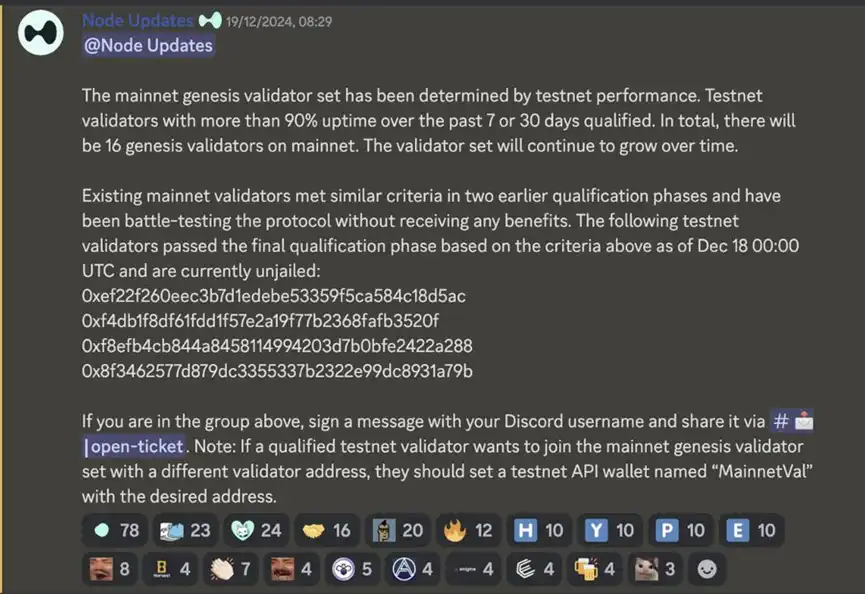
These validators are Validao, Bharvest, Hypurrstake, and Prrposefulnode. These validators were selected based on maintaining over 90% uptime in the past 7 or 30 days.
This is a significant achievement on many fronts, mainly because validator performance is still influenced by external factors such as Hyperliquid API downtime, unjailing issues, and continuous crashes of the binary files, all of which have a non-negligible impact on performance.
In addition to the 4 validators selected based on the testnet performance, 5 validators from the Hyperliquid Foundation are also running on the mainnet. Furthermore, 7 additional validators have been chosen to participate in the mainnet, but the reasons for their selection have not been publicly disclosed.
Subsequently, a black market for HYPE Testnet tokens emerged.
The Hyperliquid Testnet initially had a set of 50 validators. Initially, specific entities were whitelisted to join the Testnet, but as of December 12, the validator set became fully open.
The conditions were simple: you needed 10,000 HYPE Testnet tokens to register as a validator. However, to become an active validator, you also needed to be in the top 50, or else validators would remain inactive.
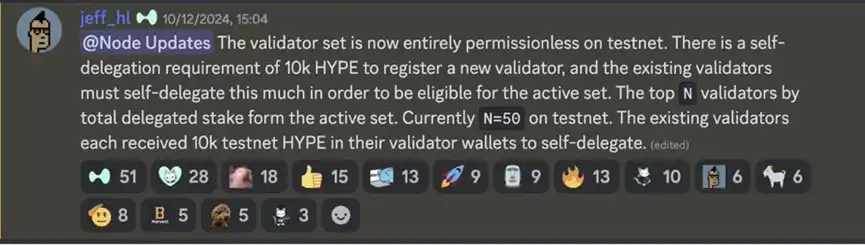
This decision led to a surge in the price of HYPE Testnet tokens. The price initially rose to over 3,000 simulated USDC, and a few days later, it even exceeded 28,000 simulated USDC. At the time of writing, the price is approximately 700 simulated USDC per token.
Unfortunately, the faucet only distributes 100 simulated USDC every 4 hours. To be among the top 50 validators on the Testnet currently requires over 528,747 HYPE Testnet tokens. Assuming a price of 700 simulated USDC per token and relying solely on the faucet, the calculation is as follows:
Days = (528,747 × 700) ÷ (100 × 6) = 616,871.5 days
This means that relying solely on the faucet would take approximately 616,871.5 days, or 1,690 years, to accumulate enough HYPE Testnet tokens to become an active validator on Hyperliquid.
However, those who received a HYPE airdrop on the mainnet also received the same amount of tokens on the Testnet. This provided an opportunity for validators to collaborate with these community members by staking Testnet HYPE tokens, enabling validators to ensure entry into the active set.
Simultaneously, this situation also offered another perspective for those holding Testnet HYPE tokens. Given the competitive nature of joining the Testnet validator set, many validators were eager to acquire as many HYPE Testnet tokens as possible. Consequently, a black market emerged, where whales holding a significant amount of Testnet HYPE tokens began selling their Testnet tokens to validators in exchange for mainnet USDC.
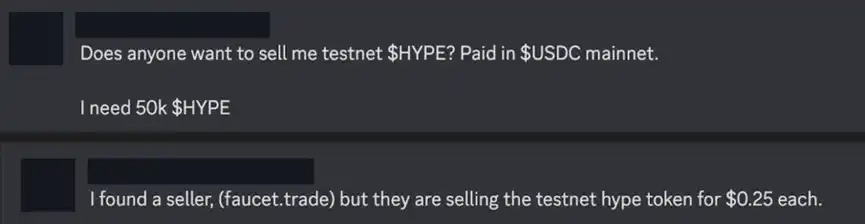
I have never seen such a chaotic situation before. Although the Hyperliquid team clearly does not endorse these practices, they are fully capable of addressing this issue. One potential solution is to implement a proper testnet validator selection process.
In most other PoS networks, the core team usually shares a form that any validator can fill out to express their willingness to run the chain. The team would then review these applications based on various criteria, such as the validator's node operation experience, past contributions, community involvement, or other factors.
This group of pre-selected validators can then participate in the testnet, closely collaborate with the engineering team, provide feedback, and ensure everything runs smoothly. We have tried multiple times to provide feedback, but so far have not been successful.
Mainnet and Decentralization
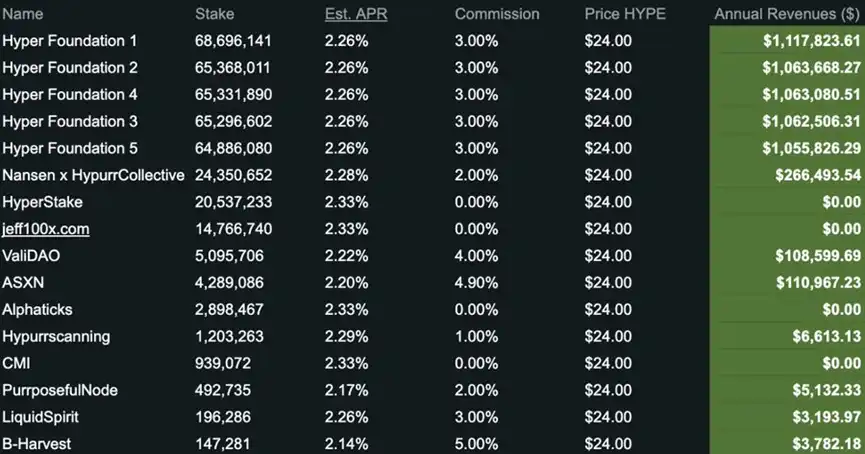
As mentioned earlier, the current validator set of the Hyperliquid mainnet consists of 16 validators, which can be viewed at the following URL: https://app.hyperliquid.xyz/staking
· 5 validators are from the Hyperliquid Foundation.
· 4 validators were selected based on their performance on the testnet, maintaining over 90% uptime in the last 7 days.
· 7 validators were self-selected by the Hyperliquid team.
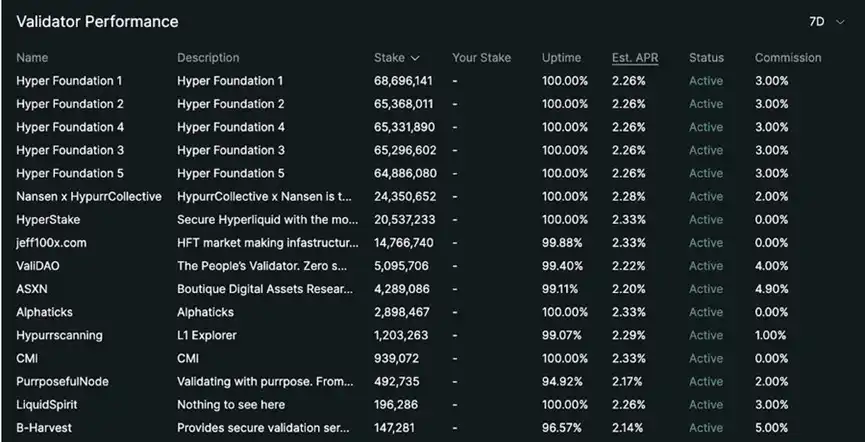
Out of the staked 404,495,250 HYPE tokens, approximately 329,578,724 HYPE tokens are staked on Foundation nodes, accounting for approximately 81.4% of the total stake. We know very little about HyperBFT, but assuming it operates as a Byzantine Fault Tolerant system, the core assumption of most BFT systems is that no more than 33% of the voting power behaves maliciously. If a single entity controls 1/3 of the stake, they can halt the chain. If they control 2/3 of the stake, they have full control of the network.
The Hyperliquid Foundation initially staked 60 million HYPE tokens on each Foundation node. However, many HYPE holders also chose to stake on Foundation nodes, which is not ideal for decentralization. The team should engage more with the community to encourage a more decentralized staking distribution.
There are three potential solutions:
· Educate the community on the importance of staking with external validators to enhance chain security and decentralization.
· Implement a 100% commission rate for foundation nodes to incentivize users to stake with external validators and promote decentralization.
· Reallocate foundation staking to external validators, which is a common practice in many chains.
Decentralizing staking to external validators will also help them achieve economic sustainability. Hyperliquid is a blockchain focused on high throughput, where infrastructure costs can be high, especially when nodes are deployed in Tokyo. Currently, validators at the bottom of the validator set earn between $3,000 and $5,000 annually, which is insufficient to cover costs. This is particularly challenging as they must self-stake the initial 10,000 HYPE tokens (worth around $250,000 at the current price) to validate on the mainnet.
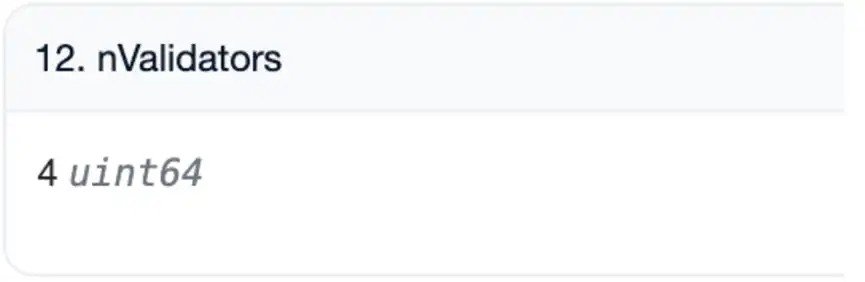
Currently, users interact with Hyperliquid by bridging USDC from Arbitrum to the Hyperliquid chain. Upon reviewing the bridge contract, it appears that the bridge is still managed by 4 validators. These validators do not seem to be associated with the chain's consensus or the 16 validators on the mainnet.
Hyperliquid has a great product, but the team still needs to make several infrastructure improvements to truly compete with major layer 1s. Some improvements are straightforward, such as:
Seek input from experienced validators who operate on multiple networks. While the team's current approach of working independently has been very effective in building its sustainable product, validators are a key pillar of a layer 1. It is equally important to seek their input to ensure everything runs smoothly.
Open-source the code. This will help validators better understand the issues they face when running a node on the Hyperliquid L1 and also help users trust the product. Open-sourcing the code will also enable validators to have more insights into the architecture and consensus algorithm. Currently, information on HyperBFT is very limited, and open-sourcing can provide much-needed transparency and understanding. Chorus One has a network handbook on the importance of open source. Operators should be able to build all software they operate from source code: https://handbook.chorus.one/node-software/open-source.html
Create an appropriate validator selection process to prevent black market trading of the HYPE Testnet token. Selecting validators based on normal operation time is a fair approach, but achieving good normal operation time should also be fair. This should not depend on whether one has a relationship to acquire testnet tokens, purchased testnet tokens, or external factors (such as relying on Hyperliquid API for normal operation time).
Overall, Hyperliquid does not need to make too many changes to compete with major layer 1s. The main focus should be on interacting more with external parties and incorporating their feedback. I look forward to seeing the changes in the coming weeks and months, and our team will be ready to provide support and feedback at any time.
Hyperliquid Founder Jeff and Official Account Respond
In response to this letter, Hyperliquid Founder Jeff has responded on Platform X.
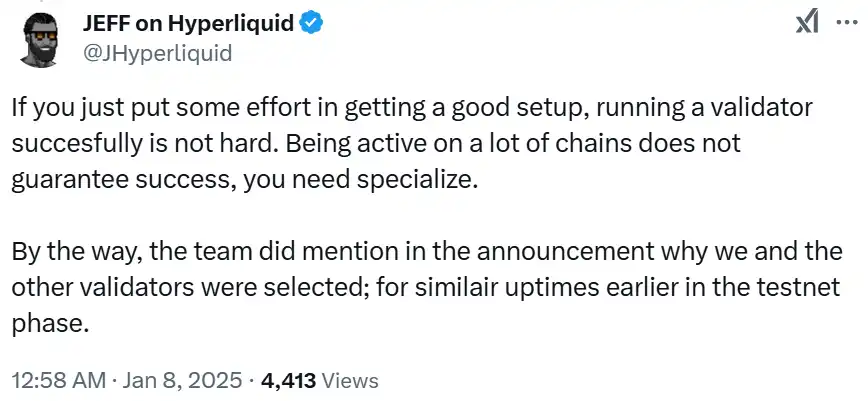
He emphasized that running a validator successfully is not difficult; the key lies in the validator's own setup and specialization. In addition, he pointed out that the validator selection criteria have been explained in the announcement and are based on the high normal operation time performance in the early stages of the testnet. This indicates that Jeff is more inclined to believe that the current issues stem more from the validators' own configuration rather than a flaw in system design.
Furthermore, the Hyperliquid official team has also released further clarifications, stating that the node code will be open-sourced in a secure manner.
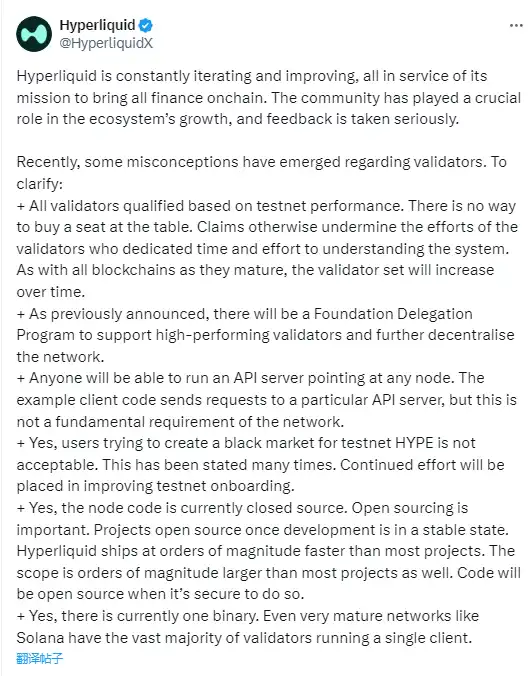
· All validators qualify based on testnet performance and cannot obtain a seat through purchase; unfounded remarks denigrate the efforts of validators who have invested time and effort to understand the system; as the blockchain matures, the validator set will gradually expand.
· As previously announced, a foundation delegation program will be launched to support high-performing validators and further decentralize the network.
· Anyone can run an API server pointing to any node; sample client code sends requests to specific API servers, but this is not a fundamental requirement of the network.
· It is unacceptable for users to create a black market for the HYPE testnet; this has been stated multiple times; we will continue to work on improving the testnet onboarding process.
· The node code is currently closed source; open sourcing is very important, and the project will be open sourced once development reaches a stable state; Hyperliquid's development speed is several orders of magnitude faster than most projects, and its scope is also several orders of magnitude larger than most projects; the code will be open sourced under safe conditions.
· Currently, there is only one binary file. Even in a mature network like Solana, the vast majority of validators run a single client.
You may also like

Gate founder Dr. Han: The crypto winter drives structural reshaping, and everything on-chain will become a new paradigm in finance

Is XRP a Good Investment in 2026? Why Is It Stuck at $1.45
XRP is up 6.7% this week, but exchange reserves remain high. Is a volatility spike imminent? We analyze price trend, ETF inflows, whale activity, and regulatory catalysts to answer: will XRP go up, why is XRP dropping, and is XRP a good investment right now?
TL; DR
What is XRP: XRP is a digital asset built for fast, low-cost international payments. It runs on the XRP Ledger and is used by Ripple for its On-Demand Liquidity (ODL) service. Unlike Bitcoin, XRP settles transactions in 3-5 seconds with near-zero fees.Why is XRP Dropping: XRP is not actively dropping, but it is struggling to rise. On the monthly chart, XRP has seen six consecutive months of decline. Currently, the price faces an additional supply wall at $1.45. About 1.24 billion XRP were bought in that range, and those holders sell when the price approaches, creating selling pressure that prevents a recovery.Will XRP Go Up: Potentially yes. XRP is trading near $1.43 and showing its best weekly performance since September 2025. If the price breaks above the $1.45 resistance, analysts expect a move toward $1.90, supported by strong institutional demand.Is XRP a Good Investment: The answer is not simple. Short-term traders may see opportunity in the coming volatility spike. Long-term investors face a bigger question that depends on one key regulatory event. However, the data reveals a surprising signal that most retail buyers are missing right now. To understand whether XRP is a smart buy or a trap at $1.43, you will need to read the full analysis below.What is XRP? A Digital Asset for Global SettlementBefore analyzing the charts, it is crucial to understand the asset in question. What is XRP? Unlike Bitcoin, which was designed as a decentralized digital gold, XRP operates on the XRP Ledger (XRPL). It was created to facilitate fast, low-cost international payments. Traditional bank transfers take days and incur high fees. XRP transactions settle in 3-5 seconds, costing fractions of a penny.
Ripple, the company associated with XRP, uses this asset for its "On-Demand Liquidity" (ODL) service. Banks and financial institutions use ODL to source liquidity during cross-border transactions without pre-funding accounts. This utility is the primary driver for institutional interest. Recently, the network hit a milestone of over 8 million active wallets, signaling growing usage despite recent price stagnation . Furthermore, Ripple is proactively preparing for the future, releasing a four-stage roadmap to make the XRPL "quantum-resistant," aiming to secure the ledger against future quantum computing threats by 2028 .
XRP Price Analysis: The Battle for $1.45The XRP price trend over the last month tells a story of exhaustion followed by cautious recovery. On the monthly chart, XRP experienced six consecutive months of decline. However, April shows signs of a bottoming process. Weekly charts reinforce this view: after four weeks of lower closes, the last two weeks have seen small rebounds.
According to data from April 22, 2026, XRP is trading at approximately $1.44. Over the last seven days, XRP has outperformed both Bitcoin and Ethereum, rising 6.7% while the broader market rose only 3.2%. Spot trading volume surged 23% to $3.79 billion, and derivative markets saw $40 billion in futures volume on a single day.
Despite this, the price remains 60% below its July 2025 high of $3.65. The current technical picture shows a "low volatility grind" higher. The 20-day EMA is at $1.3924, and the 50-day EMA is at $1.4119, both acting as support . However, the immediate hurdle is the $1.45 resistance level. This price point has rejected every rally attempt in 2026.
Why is XRP Dropping? And Will XRP Go Up?The primary reason for the recent "drop" (or lack of upward momentum) is not active selling, but rather the "supply wall." Data indicates that roughly 1.24 billion XRP tokens were purchased by investors in the $1.45 to $1.47 range. These investors have been waiting months to "break even." Every time the price approaches $1.45, these holders sell to exit their positions, creating a massive wall that retail buying cannot easily absorb.
However, the underlying momentum is shifting. Analysts suggest a xrp volatility spike imminent because the absorption capacity of buyers is increasing. Historically, when exchange reserves are high but the price refuses to drop significantly, it signals that buyers are absorbing the supply. The price has held above $1.39 despite the overhang, which is a sign of relative strength.
So, will XRP go up? Yes, potentially. But it needs a catalyst, if the price closes a daily candle above $1.45. If that happens, the next targets are $1.60 to $1.65, and eventually $1.90 .
XRP Exchange Netflow and XRP ETF Netflow: A Tale of Two MarketsThe current market dynamic is best understood by looking at two opposing data streams: XRP Exchange netflow and XRP ETF flows.
Exchange Dynamics (Retail / Whales):
Data shows a complex pattern of "large inflows and increasing reserves." Recently, a Ripple-associated wallet moved 75 million XRP (approx. $108 million) to Coinbase. This initially looks like a dump, but context matters. These transfers are likely to provide liquidity for Ripple’s ODL business, not necessarily spot market selling. However, the result is that exchange reserves have climbed to 2.76 billion XRP .
The Good News: While reserves are high, the rate of increase is slowing. Specifically, "whale" transfers to exchanges have dropped 98% from their April 11 peak. The Binance reserve has slightly decreased from 27.7 to 27.6 billion. The aggressive selling from large holders appears to have stopped.
Institutional Dynamics (ETF):
While whales were sending coins to exchanges, institutions were buying XRP ETF products. XRP ETF net flow is strongly positive.
US-listed XRP ETFs recorded four consecutive days of inflows totaling $38.86 million recently .The weekly inflow for mid-April hit $119.6 million, a multi-month high .Cumulative net inflows stand at $12.8 billion, with Assets Under Management (AUM) at roughly $10.8 billion.Analyzing the Divergence: Why Both Flows Are PositiveIt seems contradictory that exchange reserves are high (suggesting selling) while ETFs are buying (suggesting buying). However, this phenomenon reveals the current market structure.
Different Investor Profiles: The exchange inflows likely come from short-term traders, market makers, or Ripple itself providing ODL liquidity. These are "hot" coins ready to be sold. The ETF inflows represent "sticky" capital. Institutions buying ETFs are typically long-term holders (LTHs) or asset managers who do not day-trade. They are removing liquidity from the spot market by buying through custodians.The "De-risking" Trade: Sophisticated funds might be engaging in basis trading. They buy the ETF (taking a long position) while simultaneously shorting XRP futures or selling spot inventory to capture the funding rate. This keeps the price stable while volume increases.Absorption: The most likely scenario is that the market is simply absorbing the excess supply. The fact that the price is stable ($1.43) and not collapsing to $1.20 despite 2.76 billion coins sitting on exchanges is a massive win for the bulls. The ETF inflows are acting as a sponge, soaking up the selling pressure from the ODL wallets.The Regulatory Catalyst: The SEC and the CLARITY ActFundamentally, the recent price action cannot be separated from regulation. For years, the primary answer was the SEC lawsuit. That narrative is dying.
Ripple CEO Brad Garlinghouse recently praised SEC Chair Paul Atkins as "a breath of fresh air and sanity" . This regulatory thaw is critical. The SEC is reportedly considering dropping the long-standing lawsuit, and five XRP ETF applications are awaiting review.
The major catalyst on the horizon is the CLARITY Act. A Senate markup is expected before the end of April. Standard Chartered analysts project that if the bill advances, it could unlock $4 to $8 billion in institutional flows . Polymarket gives the bill a 60-66% chance of passing in 2026. If the CLARITY Act classifies XRP as a non-security (commodity), the institutional floodgates will open, likely overwhelming the $1.45 supply wall instantly.
Is XRP a Good Investment in 2026?Given all this data, is XRP a good investment? The answer depends entirely on your risk tolerance and time horizon.
The Bull Case (Why it is a good investment): The risk/reward ratio is asymmetrical to the upside. The price is near multi-year lows relative to its utility. Whale selling has stopped, ETF demand is rising, and the network is expanding (8 million wallets, quantum resistance roadmap). If the CLARITY Act passes, XRP could realistically trade between $1.60 and $1.80 in the short term, with a potential run to $3.00+ if the lawsuit is officially dropped.The Risk Case (Why it is NOT a good investment): There is a clear resistance wall at $1.45. If the CLARITY Act fails or is delayed past May (due to midterm election dynamics), the "buy the rumor, sell the news" dynamic could reverse. If the price fails to break $1.45 and loses support at $1.33, a drop back to $1.15 is technically possible .Verdict: XRP is a speculative buy for traders looking for a volatility spike. It is a hold for current investors. For new investors, it is only a good investment if you believe in regulatory clarity within the next 30 days. Technically, waiting for a confirmed break above $1.55 (to avoid the fakeout) is safer than buying at $1.43.
FAQQ: Will XRP go up if the CLARITY Act passes?
A: Yes, historically. Analysts predict that if the CLARITY Act passes, signaling that XRP is a commodity, it would remove the regulatory overhang. This could trigger a surge in institutional buying, pushing the price from the current $1.43 range to test the $1.80 - $2.00 resistance levels quickly.
Q: Why is XRP dropping when Bitcoin is going up?
A: XRP has specific supply dynamics. Unlike Bitcoin, which has a fixed supply issuance, XRP faces periodic sell-pressure from Ripple's treasury wallets used to fund ODL (liquidity) services. Additionally, the $1.45 "break-even" wall causes XRP to drop relative to BTC when short-term traders exit.
Q: Is a volatility spike imminent for XRP?
A: Yes. The Bollinger Bands on the daily chart are squeezing. The price is stuck between support at $1.33 and resistance at $1.45. Historically, when XRP volume surges 23% in a week (as it did on April 21), it precedes a violent move. The direction depends on whether the $1.45 resistance breaks.
Q: What is the XRP ETF netflow status?
A: As of late April 2026, XRP ETFs are seeing positive netflows. The US ETFs recorded a single week inflow of $119.6 million in mid-April. Cumulative inflows are strong at $12.8 billion, indicating that institutions are accumulating during this dip, which is a long-term bullish signal for price stabilization.
Q: Is XRP a good investment for beginners?
A: XRP is less volatile than "meme coins" but more volatile than Bitcoin. For beginners, it is a moderate-risk investment. Its value is tied to real utility (bank payments). However, beginners should wait to see if the price can close a weekly candle above $1.55 before entering, to avoid buying into the current resistance wall.
Disclaimer: None of the information in this article constitutes, or is intended to constitute, investment advice. Trading cryptocurrencies carries a high level of risk and may not be suitable for all investors. Always do your own research.
About WEEXFounded in 2018, WEEX has developed into a global crypto exchange with over 6.2 million users across more than 150 countries. The platform emphasizes security, liquidity, and usability, providing over 1,200 spot trading pairs and offering up to 400x leverage in crypto futures trading. In addition to the traditional spot and derivatives markets, WEEX is expanding rapidly in the AI era — delivering real-time AI news, empowering users with AI trading tools, and exploring innovative trade-to-earn models that make intelligent trading more accessible to everyone. Its 1,000 BTC Protection Fund further strengthens asset safety and transparency, while features such as copy trading and advanced trading tools allow users to follow professional traders and experience a more efficient, intelligent trading journey.
Follow WEEX on social mediaX: @WEEX_Official
Instagram: @WEEX Exchange
Tiktok: @weex_global
Youtube: @WEEX_Official
Discord: WEEX Community
Telegram: WeexGlobal Group

FC Barcelona vs Celta Vigo: Can Anyone Stop Barcelona at Home?
FC Barcelona vs Celta Vigo lineups, standings, and stats for April 22, 2026. FC Barcelona need a win to stay on track for the La Liga title. Full preview inside.

Carl Moon & WEEX Head to Mugello: The Crypto Trader's Ferrari Challenge
Forget the sidelines. WEEX is hitting the 300km/h mark at Mugello this weekend. Witness Carl Moon’s transformation from a supermarket cashier to a Ferrari racer, and discover why the world’s fastest trading floor belongs on the world’s most technical track at the official Ferrari Challenge.

How to Become a Pro Crypto Trader: WEEX Interview with Ferrari Racer Carl Moon
Ferrari racer Carl Moon on mastering crypto trading: 80/20 rule, AI tools, Bitcoin at $95K, and risk lessons from the track.

Morning Report | Amazon increases investment in Anthropic up to $25 billion; SEC plans to introduce an "innovation exemption" mechanism to support compliant on-chain trading of tokenized securities

Jeff Hoffman, founder of Booking.com: How Web3 and AI are reshaping the trillion-dollar social travel market

Top 12 Cryptocurrencies to Invest in April 2026
Key Takeaways: Bitcoin remains the dominant player with a $1.42 trillion market cap. Hyperliquid’s HYPE token gains traction,…
18 Best Crypto & Bitcoin Casinos in March 2026
Key Takeaways: Cryptocurrencies offer faster, cheaper, and more private payment options in online casinos. Top crypto casinos include…

Full Post-Mortem of the KelpDAO Incident: Why Did Aave, Which Was Not Compromised, End Up in Crisis Situation?
Key Takeaways: The KelpDAO incident exposed vulnerabilities in collateral pricing and cross-chain bridge operations, affecting Aave’s liquidity. rsETH…

Is MicroStrategy’s STRC Bitcoin’s Savior or Destroyer?
Key Takeaways: MicroStrategy’s STRC offers an annualized yield of 11.5%, driving significant Bitcoin buying pressure. Michael Saylor’s financial…

Ceasefire Expiration and Market Response: Bitcoin Defies Market Trends
Key Takeaways: The current ceasefire agreement is anticipated to expire on Wednesday in Washington, with low likelihood of…

Oil Price Dilemma: More Than a Price Hike
Key Takeaways: Global oil market has surpassed its breaking point, not solving with price hikes but facing significant…

On the Day Aave Launched rsETH, Spark Strategically Exited
Key Takeaways: Aave enabled rsETH lending at a 93% LTV, while Spark withdrew due to low utilization by…

Nasdaq Breaks Record and Crypto Transactions Surge
Key Takeaways: Nasdaq’s rise to a new intraday high indicates strong market momentum. A significant transfer of 35,000…

Powell: Fed Requires a Brand New Inflation Blueprint
Key Takeaways: Powell aims for transformative policy overhauls within the Fed if appointed. Past inflation response mistakes during…

Without Cook’s Apple, Can it Still Grow in the AI Era?
Key Takeaways: John Ternus acts more like a systematic integrator within Apple rather than a solo visionary. Apple’s…

Iran Stock Market and Crypto Developments in Focus
Key Takeaways: The Iranian stock market is set to reopen in 10 to 12 days, excluding companies impacted…
Gate founder Dr. Han: The crypto winter drives structural reshaping, and everything on-chain will become a new paradigm in finance
Is XRP a Good Investment in 2026? Why Is It Stuck at $1.45
XRP is up 6.7% this week, but exchange reserves remain high. Is a volatility spike imminent? We analyze price trend, ETF inflows, whale activity, and regulatory catalysts to answer: will XRP go up, why is XRP dropping, and is XRP a good investment right now?
TL; DR
What is XRP: XRP is a digital asset built for fast, low-cost international payments. It runs on the XRP Ledger and is used by Ripple for its On-Demand Liquidity (ODL) service. Unlike Bitcoin, XRP settles transactions in 3-5 seconds with near-zero fees.Why is XRP Dropping: XRP is not actively dropping, but it is struggling to rise. On the monthly chart, XRP has seen six consecutive months of decline. Currently, the price faces an additional supply wall at $1.45. About 1.24 billion XRP were bought in that range, and those holders sell when the price approaches, creating selling pressure that prevents a recovery.Will XRP Go Up: Potentially yes. XRP is trading near $1.43 and showing its best weekly performance since September 2025. If the price breaks above the $1.45 resistance, analysts expect a move toward $1.90, supported by strong institutional demand.Is XRP a Good Investment: The answer is not simple. Short-term traders may see opportunity in the coming volatility spike. Long-term investors face a bigger question that depends on one key regulatory event. However, the data reveals a surprising signal that most retail buyers are missing right now. To understand whether XRP is a smart buy or a trap at $1.43, you will need to read the full analysis below.What is XRP? A Digital Asset for Global SettlementBefore analyzing the charts, it is crucial to understand the asset in question. What is XRP? Unlike Bitcoin, which was designed as a decentralized digital gold, XRP operates on the XRP Ledger (XRPL). It was created to facilitate fast, low-cost international payments. Traditional bank transfers take days and incur high fees. XRP transactions settle in 3-5 seconds, costing fractions of a penny.
Ripple, the company associated with XRP, uses this asset for its "On-Demand Liquidity" (ODL) service. Banks and financial institutions use ODL to source liquidity during cross-border transactions without pre-funding accounts. This utility is the primary driver for institutional interest. Recently, the network hit a milestone of over 8 million active wallets, signaling growing usage despite recent price stagnation . Furthermore, Ripple is proactively preparing for the future, releasing a four-stage roadmap to make the XRPL "quantum-resistant," aiming to secure the ledger against future quantum computing threats by 2028 .
XRP Price Analysis: The Battle for $1.45The XRP price trend over the last month tells a story of exhaustion followed by cautious recovery. On the monthly chart, XRP experienced six consecutive months of decline. However, April shows signs of a bottoming process. Weekly charts reinforce this view: after four weeks of lower closes, the last two weeks have seen small rebounds.
According to data from April 22, 2026, XRP is trading at approximately $1.44. Over the last seven days, XRP has outperformed both Bitcoin and Ethereum, rising 6.7% while the broader market rose only 3.2%. Spot trading volume surged 23% to $3.79 billion, and derivative markets saw $40 billion in futures volume on a single day.
Despite this, the price remains 60% below its July 2025 high of $3.65. The current technical picture shows a "low volatility grind" higher. The 20-day EMA is at $1.3924, and the 50-day EMA is at $1.4119, both acting as support . However, the immediate hurdle is the $1.45 resistance level. This price point has rejected every rally attempt in 2026.
Why is XRP Dropping? And Will XRP Go Up?The primary reason for the recent "drop" (or lack of upward momentum) is not active selling, but rather the "supply wall." Data indicates that roughly 1.24 billion XRP tokens were purchased by investors in the $1.45 to $1.47 range. These investors have been waiting months to "break even." Every time the price approaches $1.45, these holders sell to exit their positions, creating a massive wall that retail buying cannot easily absorb.
However, the underlying momentum is shifting. Analysts suggest a xrp volatility spike imminent because the absorption capacity of buyers is increasing. Historically, when exchange reserves are high but the price refuses to drop significantly, it signals that buyers are absorbing the supply. The price has held above $1.39 despite the overhang, which is a sign of relative strength.
So, will XRP go up? Yes, potentially. But it needs a catalyst, if the price closes a daily candle above $1.45. If that happens, the next targets are $1.60 to $1.65, and eventually $1.90 .
XRP Exchange Netflow and XRP ETF Netflow: A Tale of Two MarketsThe current market dynamic is best understood by looking at two opposing data streams: XRP Exchange netflow and XRP ETF flows.
Exchange Dynamics (Retail / Whales):
Data shows a complex pattern of "large inflows and increasing reserves." Recently, a Ripple-associated wallet moved 75 million XRP (approx. $108 million) to Coinbase. This initially looks like a dump, but context matters. These transfers are likely to provide liquidity for Ripple’s ODL business, not necessarily spot market selling. However, the result is that exchange reserves have climbed to 2.76 billion XRP .
The Good News: While reserves are high, the rate of increase is slowing. Specifically, "whale" transfers to exchanges have dropped 98% from their April 11 peak. The Binance reserve has slightly decreased from 27.7 to 27.6 billion. The aggressive selling from large holders appears to have stopped.
Institutional Dynamics (ETF):
While whales were sending coins to exchanges, institutions were buying XRP ETF products. XRP ETF net flow is strongly positive.
US-listed XRP ETFs recorded four consecutive days of inflows totaling $38.86 million recently .The weekly inflow for mid-April hit $119.6 million, a multi-month high .Cumulative net inflows stand at $12.8 billion, with Assets Under Management (AUM) at roughly $10.8 billion.Analyzing the Divergence: Why Both Flows Are PositiveIt seems contradictory that exchange reserves are high (suggesting selling) while ETFs are buying (suggesting buying). However, this phenomenon reveals the current market structure.
Different Investor Profiles: The exchange inflows likely come from short-term traders, market makers, or Ripple itself providing ODL liquidity. These are "hot" coins ready to be sold. The ETF inflows represent "sticky" capital. Institutions buying ETFs are typically long-term holders (LTHs) or asset managers who do not day-trade. They are removing liquidity from the spot market by buying through custodians.The "De-risking" Trade: Sophisticated funds might be engaging in basis trading. They buy the ETF (taking a long position) while simultaneously shorting XRP futures or selling spot inventory to capture the funding rate. This keeps the price stable while volume increases.Absorption: The most likely scenario is that the market is simply absorbing the excess supply. The fact that the price is stable ($1.43) and not collapsing to $1.20 despite 2.76 billion coins sitting on exchanges is a massive win for the bulls. The ETF inflows are acting as a sponge, soaking up the selling pressure from the ODL wallets.The Regulatory Catalyst: The SEC and the CLARITY ActFundamentally, the recent price action cannot be separated from regulation. For years, the primary answer was the SEC lawsuit. That narrative is dying.
Ripple CEO Brad Garlinghouse recently praised SEC Chair Paul Atkins as "a breath of fresh air and sanity" . This regulatory thaw is critical. The SEC is reportedly considering dropping the long-standing lawsuit, and five XRP ETF applications are awaiting review.
The major catalyst on the horizon is the CLARITY Act. A Senate markup is expected before the end of April. Standard Chartered analysts project that if the bill advances, it could unlock $4 to $8 billion in institutional flows . Polymarket gives the bill a 60-66% chance of passing in 2026. If the CLARITY Act classifies XRP as a non-security (commodity), the institutional floodgates will open, likely overwhelming the $1.45 supply wall instantly.
Is XRP a Good Investment in 2026?Given all this data, is XRP a good investment? The answer depends entirely on your risk tolerance and time horizon.
The Bull Case (Why it is a good investment): The risk/reward ratio is asymmetrical to the upside. The price is near multi-year lows relative to its utility. Whale selling has stopped, ETF demand is rising, and the network is expanding (8 million wallets, quantum resistance roadmap). If the CLARITY Act passes, XRP could realistically trade between $1.60 and $1.80 in the short term, with a potential run to $3.00+ if the lawsuit is officially dropped.The Risk Case (Why it is NOT a good investment): There is a clear resistance wall at $1.45. If the CLARITY Act fails or is delayed past May (due to midterm election dynamics), the "buy the rumor, sell the news" dynamic could reverse. If the price fails to break $1.45 and loses support at $1.33, a drop back to $1.15 is technically possible .Verdict: XRP is a speculative buy for traders looking for a volatility spike. It is a hold for current investors. For new investors, it is only a good investment if you believe in regulatory clarity within the next 30 days. Technically, waiting for a confirmed break above $1.55 (to avoid the fakeout) is safer than buying at $1.43.
FAQQ: Will XRP go up if the CLARITY Act passes?
A: Yes, historically. Analysts predict that if the CLARITY Act passes, signaling that XRP is a commodity, it would remove the regulatory overhang. This could trigger a surge in institutional buying, pushing the price from the current $1.43 range to test the $1.80 - $2.00 resistance levels quickly.
Q: Why is XRP dropping when Bitcoin is going up?
A: XRP has specific supply dynamics. Unlike Bitcoin, which has a fixed supply issuance, XRP faces periodic sell-pressure from Ripple's treasury wallets used to fund ODL (liquidity) services. Additionally, the $1.45 "break-even" wall causes XRP to drop relative to BTC when short-term traders exit.
Q: Is a volatility spike imminent for XRP?
A: Yes. The Bollinger Bands on the daily chart are squeezing. The price is stuck between support at $1.33 and resistance at $1.45. Historically, when XRP volume surges 23% in a week (as it did on April 21), it precedes a violent move. The direction depends on whether the $1.45 resistance breaks.
Q: What is the XRP ETF netflow status?
A: As of late April 2026, XRP ETFs are seeing positive netflows. The US ETFs recorded a single week inflow of $119.6 million in mid-April. Cumulative inflows are strong at $12.8 billion, indicating that institutions are accumulating during this dip, which is a long-term bullish signal for price stabilization.
Q: Is XRP a good investment for beginners?
A: XRP is less volatile than "meme coins" but more volatile than Bitcoin. For beginners, it is a moderate-risk investment. Its value is tied to real utility (bank payments). However, beginners should wait to see if the price can close a weekly candle above $1.55 before entering, to avoid buying into the current resistance wall.
Disclaimer: None of the information in this article constitutes, or is intended to constitute, investment advice. Trading cryptocurrencies carries a high level of risk and may not be suitable for all investors. Always do your own research.
About WEEXFounded in 2018, WEEX has developed into a global crypto exchange with over 6.2 million users across more than 150 countries. The platform emphasizes security, liquidity, and usability, providing over 1,200 spot trading pairs and offering up to 400x leverage in crypto futures trading. In addition to the traditional spot and derivatives markets, WEEX is expanding rapidly in the AI era — delivering real-time AI news, empowering users with AI trading tools, and exploring innovative trade-to-earn models that make intelligent trading more accessible to everyone. Its 1,000 BTC Protection Fund further strengthens asset safety and transparency, while features such as copy trading and advanced trading tools allow users to follow professional traders and experience a more efficient, intelligent trading journey.
Follow WEEX on social mediaX: @WEEX_Official
Instagram: @WEEX Exchange
Tiktok: @weex_global
Youtube: @WEEX_Official
Discord: WEEX Community
Telegram: WeexGlobal Group
FC Barcelona vs Celta Vigo: Can Anyone Stop Barcelona at Home?
FC Barcelona vs Celta Vigo lineups, standings, and stats for April 22, 2026. FC Barcelona need a win to stay on track for the La Liga title. Full preview inside.
Carl Moon & WEEX Head to Mugello: The Crypto Trader's Ferrari Challenge
Forget the sidelines. WEEX is hitting the 300km/h mark at Mugello this weekend. Witness Carl Moon’s transformation from a supermarket cashier to a Ferrari racer, and discover why the world’s fastest trading floor belongs on the world’s most technical track at the official Ferrari Challenge.
How to Become a Pro Crypto Trader: WEEX Interview with Ferrari Racer Carl Moon
Ferrari racer Carl Moon on mastering crypto trading: 80/20 rule, AI tools, Bitcoin at $95K, and risk lessons from the track.


 App
App