
 Buy Crypto
- Markets
 Futures
- Spot
- Copy Trade
- Earn
- More
SVM Track Overview: MoveVM Landing, How Far Can SVM Go?




Original Title: "SVM Track Overview: MoveVM Landing, How Far Can SVM Go"
Original Author: jk, Odaily Planet Daily
As the need for high performance and scalability becomes increasingly urgent, the Solana Virtual Machine (SVM) is gradually becoming an important driver of decentralized ecosystem development. By combining Solana's speed with Ethereum's ecosystem advantages, innovative projects based on SVM are creating a new experience for developers and users, breaking through the performance bottlenecks of traditional blockchain architecture.
Not long ago, the launch of Move made us look forward to the virtual machine track. Following MoveVM, the most highlighted virtual machine hotspot is SVM.
This article will delve into three representative SVM projects—Sonic SVM, SOON, and Eclipse—which share similarities in technical details but also have significant differences; Odaily Planet Daily has compiled and interpreted the public information about these three projects, starting with the first project—Sonic, which has just had its TGE.
Sonic SVM: A Game-oriented SVM, or Could Be the Cradle of the Next "Yat Game"
According to the official website, Sonic SVM is the first atomic SVM chain designed to support the aggregation and settlement of sovereign in-game economies on Solana.
Sonic SVM is built on Solana's first concurrent scaling framework, HyperGrid, and Sonic is the first Grid instance managed by this framework. Specifically, HyperGrid and Sonic SVM both come from the team behind Sonic (formerly Mirror World), meaning the team itself has simultaneously built both the framework and the product, similar to the relationship between Virtuals and Luna.
The design intention of HyperGrid is to achieve high customization and scalability while maintaining native composability with Solana. According to the developer documentation, applications supported by HyperGrid can be written on EVM but ultimately executed on Solana, with Solana as the final settlement layer, making it easier to bring the EVM ecosystem applications to Solana. This is different from the direction of MoveVM technology, where the final settlement layer is Ethereum.
Another important issue to note is that Sonic SVM and the project of the same name Sonic (built by the Fantom team) are two completely different projects, readers need to be aware of the distinction between the projects and assets.
The team's vision is: The birth of Sonic is to unlock a brand-new experience for developers and players. "We designed Sonic to create an incubation ground for high-performance decentralized gaming, in stark contrast to the traditional in-game asset trading experience."
On the official website, the advantages of Sonic SVM mainly come from:
· High-speed, Low-cost: Sonic provides ultra-fast on-chain gaming experience for all players in the game-exclusive L1 chain through SVM technology.
· Atomic Interoperability: Executing transactions on Sonic does not require redeployment of Solana programs and accounts. It directly leverages Solana's underlying services and liquidity advantages.
· Write for EVM, Execute on SVM: Through HyperGrid's interpreter, seamlessly deploy dApps from an EVM chain to Solana.
· Composable Game Primitives and Sandbox Environment: Sonic, based on an on-chain ECS framework, provides native composable game primitives and extensible data types. Developers can use game engine sandbox tools to build business logic on-chain.
· Profitable Infrastructure: Sonic inherently supports game growth, traffic, payment, and settlement infrastructure, empowering developers.
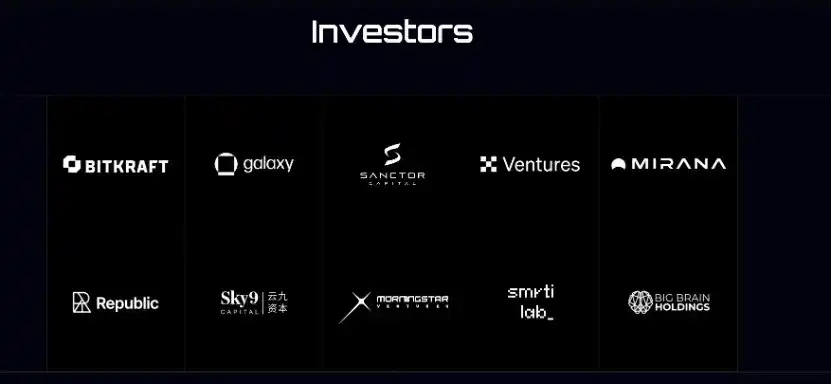
On the investor side, Sonic is led by Bitkraft, and the total investor lineup is as follows:
Source: Sonic SVM Official Website
Addressing Issues and Solutions
As infrastructure for gaming, Sonic SVM's targeted solution also addresses the underlying performance pressure of games running on Solana. The team's own description of this issue is:
「From 2022 to 2023, the wallet account number grew from 100,000 to 1 million, with an expected breakthrough to 5 million in 2024, and a further potential to reach 50 million in the coming years. However, accompanying the user growth is the explosive growth of dApp and DeFi activities. Daily transaction volume increased from 4 million transactions in 2022 to 200 million in 2024, with a conservative estimate to surpass 4 billion by 2026, potentially reaching hundreds of billions.
This growth trend puts Solana under tremendous performance pressure. Currently, its blockchain, under conditions of 2500-4000 TPS, experiences latency fluctuations between 6 and 80 seconds, mostly hovering around 40 seconds. When TPS exceeds 4000, the transaction success rate drops to 70% -85%. With future TPS possibly reaching tens of thousands, the performance bottleneck issue will become even more prominent.
The situation is particularly severe in gaming scenarios. Full-chain online games (FOCG) as well as highly concurrent small-scale games and single large-scale games may bring instant transaction peaks during special operational activities. This pressure not only affects Solana's main chain performance but also directly impacts the gameplay and user experience of games. For the gaming industry, poor user experience could be a fatal challenge.」
To address these issues, Sonic's innovative design focuses primarily on high concurrency and instant transaction requirements in gaming scenarios, providing developers and players with a smooth and efficient on-chain experience.
Sonic x TikTok: What Spark Will the Diversion Event of a Web2 Large-Scale Application Bring?
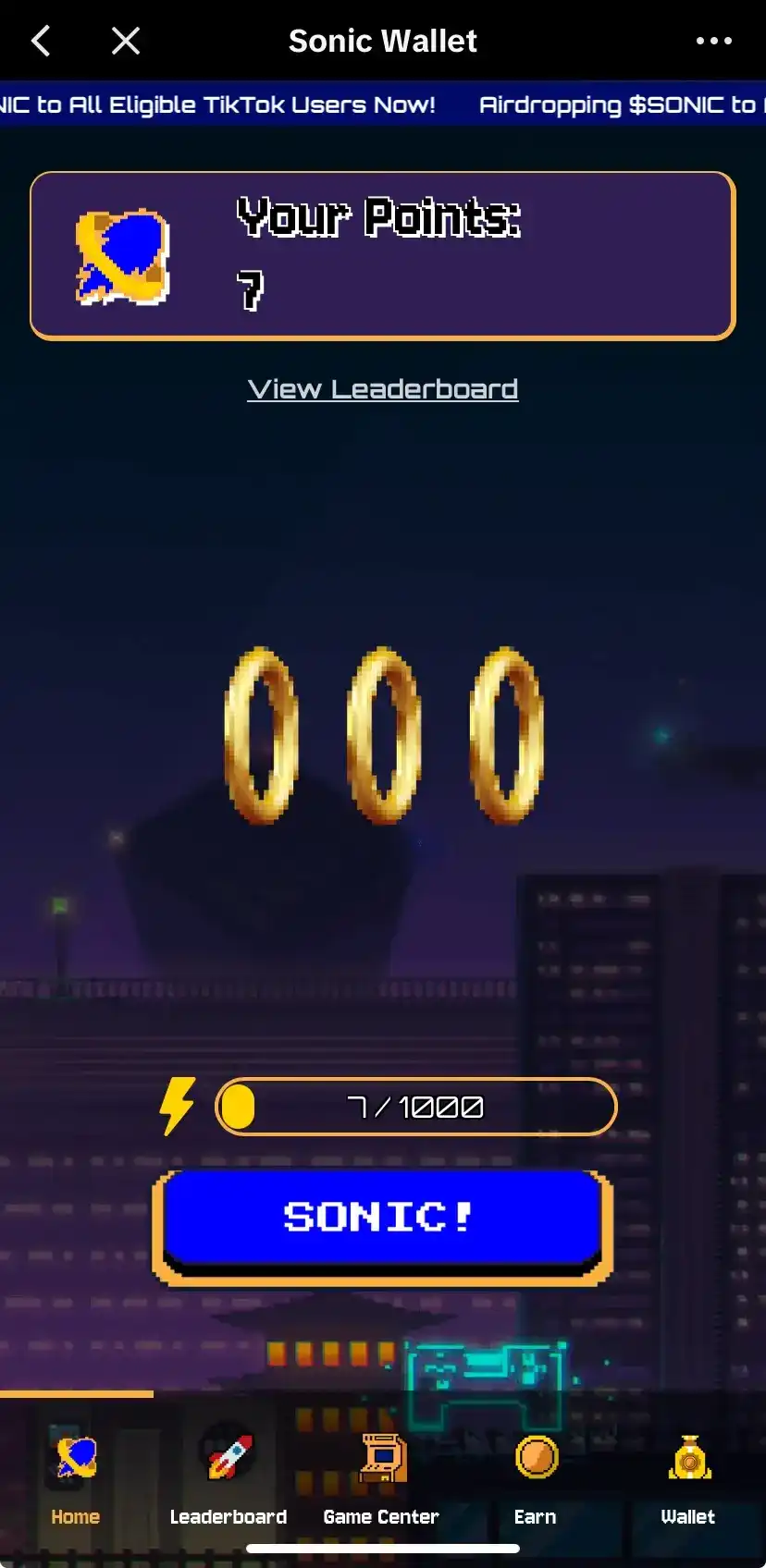
SonicX is Sonic's first TikTok Mini App, and also Sonic's gaming platform on TikTok. TikTok has over 1 billion monthly active users, and what Sonic aims to do is pick out users directly entering the Web3 gaming world from it, much like Telegram.
So, how does Sonic specifically do this? First, users must have a genuine TikTok account rather than a Douyin account to log in, thus bypassing TikTok's unavailable countries and regions. Subsequently, these KYC-verified users can engage in games and tasks through SonicX, interacting with the underlying infrastructure of Sonic SVM. Overall, SonicX's design is not fundamentally different from most of the Telegram mini-programs we can see, but as the user base comes directly from TikTok, the need for KYC is eliminated, while also ensuring that most users are authentic.
Source: SonicX
So, a natural question arises: If users mostly come from the TikTok Web2 platform, do they have to relearn Web3 concepts when they enter SonicX? How do they know what a wallet is? What is a private key? This is precisely the most interesting aspect to learn about in SonicX. Within SonicX, most operations, apart from actually transferring tokens to a third-party wallet, are completely abstracted, and users are hardly aware of the existence of a wallet. From Sonic's own Tap-to-Earn feature, to completing related tasks, to other games in the game center, SonicX automatically generates a wallet that is tightly integrated with the user's TikTok account, without needing any Web3 expertise to interact with the wallet. Even in the user center, you can see that the wallet's avatar has been imported from TikTok. In other words, theoretically, this infrastructure can support full account abstraction, and users do not need to have any knowledge of the crypto industry until they need to "sell" their account or withdraw game tokens to sell on an exchange.
Sonic himself also mentioned in a blog post: "TikTok's popularity in KYC-verified users has provided us with unique insights into user preferences, creating a powerful environment for Sonic games to gain attention. Through a carefully designed user flow, we have paved a convenient path for new Web3 players to explore and enjoy blockchain games, seamlessly integrating with their existing TikTok experience."
By simply logging in, earning rewards through on-chain operations, and following a user-friendly guidance process, SonicX has the potential to drive traffic through TikTok. If there is any downside, it is that SonicX itself and the settings of other games are still relatively simple, lacking a particularly eye-catching mechanism and gameplay like the explosive popularity of mini-programs. However, infrastructure is always the first step in the appearance of games. Through Web2 traffic diversion, it is still the most likely prerequisite for the success of Web3 games.
This is also currently the most unique advantage of Sonic SVM. Imagine that, as a developer, after developing a mobile game, you can seamlessly deploy the backend on Solana and the frontend on TikTok. If a video about this game goes viral, users can directly click to enter the game through the official account, without the need to register a wallet, but the in-game tokens are real on-chain tokens. So, is it possible that the next on-chain version of JumpJump or Goatling will appear? Could this be the mechanism for breaking the barrier of Web3 games?
These are all very easy-to-think-of questions. What's surprising is that they really made a "Sheep-a-Sheep" game.
In late October 2024, Sonic SVM announced a strategic partnership with Mahjong Verse. Mahjong Verse, formerly known as Mahjong Meta, is also a well-established project in the Web3 gaming industry, backed by top investors such as Dragonfly and Folius. They created a replica of the "Sheep-a-Sheep" game on Sonic SVM's TikTok platform, but with a twist where the mechanic has been changed to collecting three Mahjong tiles to clear them. In other aspects, the levels are similar to "Sheep-a-Sheep," with layers of Mahjong tiles requiring strong strategic thinking and a bit of luck to pass through.
This Mahjong-themed game is also the first game on Sonic Applayer, now available in Sonic X's Game Center. In Sonic's announcement, they mentioned, "Integrating Mahjong Verse into our ecosystem not only showcases how our infrastructure supports complex gaming experiences, but also maintains the ease of use that TikTok users expect." It can be seen that this is also the future vision of Sonic Applayer.
In summary, Sonic SVM focuses on game infrastructure, with a clear application example already present in the TikTok Applayer. It has now reached the stage of token issuance, and the next game released through Sonic SVM is highly anticipated to see what it will be like and whether it can break into new audiences through the TikTok traffic gateway.
Timeline
In June, Sonic announced the completion of a $12 million Series A funding round, led by Bitkraft Ventures, with participation from Galaxy Interactive, Big Brain Holdings, among others. The fully diluted token valuation in this round of funding reached $100 million. Sonic's corporate entity, Mirror World Labs, has developed a proprietary technology called the HyperGrid Framework, enabling horizontal scaling through Solana chain rollups.
In September, Odaily reported that Sonic SVM recently disclosed information about the HyperFuse Guardian Nodes sale, claimed to be the first node sale in the Solana ecosystem.
The official announcement stated that HyperFuse Guardian Nodes are an essential part of the Sonic Hypergrid framework's security and functionality within the SVM ecosystem. Node operators will assist in validating state transitions and improving network efficiency. Early adopters have the opportunity to purchase Sonic tokens at a price lower than what was offered to venture capitalists during the Sonic $12 million Series A funding round. This node sale is a key part of Sonic's plan to develop the SVM ecosystem and the Solana gaming track. The company also revealed that it has partnered with over 40 game studios, with over 2 million active wallets on the platform.
At the end of December, Sonic SVM announced that it would airdrop SONIC tokens to all users who joined its games on the Solana blockchain, with the snapshot yet to be taken, and the airdrop scheduled for January.
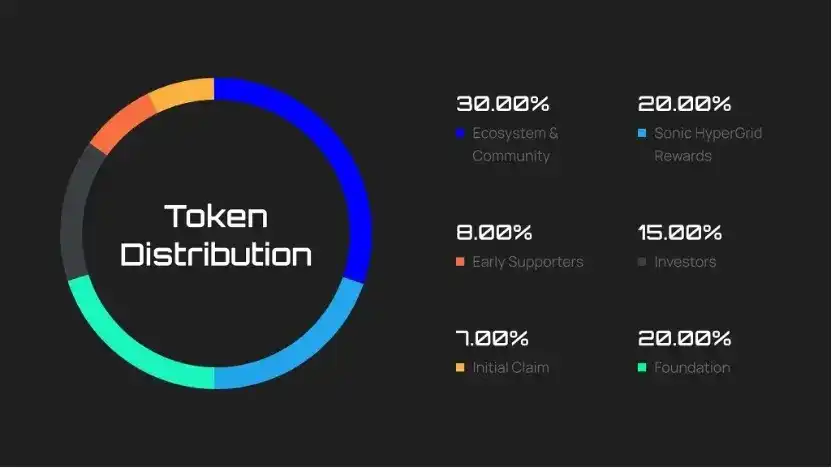
Meanwhile, Sonic SVM revealed the tokenomics of its native token $SONIC. The total token supply of SONIC is 2.4 billion, with 57% allocated to the community, including community and ecosystem development (30%), initial claim (7%), and HyperGrid rewards (20%).
Sonic SVM's Tokenomics. Source: X
On January 3, Sonic SVM posted on X platform announcing that the SONIC initial claim will soon be open to reward supporters and contributors. The SONIC eligibility checker is now live, and users can check their eligibility for the initial claim.
On January 7, Sonic SVM will officially hold its TGE, with exchanges confirmed to list including OKX, Upbit, Bybit, KuCoin, Backpack, and others.
SOON: The Strongest Execution Layer on Ethereum with No VC Participation
30K+ TPS, Source: SOON Official Website
SOON's product is called the Super Adoption Stack, which includes the SOON Stack and the SOON Mainnet.
The SOON Stack is a Rollup framework based on the OP Stack and a unique Decoupled SVM (Decoupled Secure Virtual Machine), designed to achieve maximum performance, supporting the deployment and operation of an SVM Layer 2 on any underlying Layer 1. The chain deployed through the SOON Stack is referred to as the SOON Chain. Currently, the SOON Stack supports Ethereum as the settlement layer, Avail as the Data Availability (DA) layer, and integrates support for Caldera and Altlayer.
The SOON Mainnet is the SOON Chain deployed on Ethereum using the SOON Stack, aiming to be the highest-performing L2 on Ethereum.
InterSOON is a cross-chain messaging protocol designed to ensure seamless interaction between networks. It enables interoperability between the SOON Mainnet, SOON Stack (SOON Chain), and other Layer 1 blockchains, connecting all networks through a seamless interface. The underlying cross-chain messaging of InterSOON is supported by Hyperlane.
Key Advantages of SOON
Currently, many scalability-focused projects are based on the SVM, but what sets SOON apart is that it is a highly efficient performance-oriented optimal SVM Rollup framework. By decoupling the SVM from its Transaction Processing Unit (TPU), SOON achieves a significant performance boost and maximizes efficiency.
Why did SOON choose decoupling over Forked SVM?
Limitations of Forked SVM:
· Waste in default architecture: Many projects using the SVM outside of the Solana L1 are Forked SVMs. This approach directly inherits the existing Solana client, makes minor adjustments, but does not modify key TPU or TVU (Transaction Verification Unit).
· Data availability waste: The biggest issue with Forked SVM is the inefficient use of blobspace in the Data Availability (DA) layer. For example, even with just one "sorting node," each block still generates vote transactions, consuming significant resources.
SOON adopts a customized decoupled SVM to optimize transaction processing efficiency and Data Availability (DA) by removing voting transactions and peer-to-peer network overhead. Particularly, in scenarios without an L1 consensus mechanism (such as Proof of History and Leader Schedule), decoupling the SVM allows for more flexible optimization.
Key benefits of decoupling:
· Support for Fraud Proofs: Decoupled SVM provides native support for fraud proofs in L2, which is crucial for L2 network security. Fraud proofs validate user transactions from L1 deposits (export pipeline) and L2 sequencer nodes to ensure the security of the L2 state.
· Performance and Security Enhancements: By optimizing transaction processing and DA usage, the SOON Stack significantly reduces resource waste while enhancing network security, meeting the high throughput and security requirements of Web3 applications.
The SOON team has provided a detailed analysis of Decoupled SVM in this blog post. Interested readers can refer to it for more information.
SOON's Mission and Vision
The SOON Stack aims to achieve the following objectives:
· Provide a high-performance Rollup solution in any L1 ecosystem.
· Reduce transaction costs by 10x.
· Drive widespread adoption of SVM.
· Unlock innovative cross-ecosystem application scenarios.
Addressing the Issue: Why a Higher-Performance Rollup and Tech Stack Are Needed
The problem that the SOON team addresses is fundamentally different from Sonic SVM. SOON's provided tech stack will ultimately settle on the Ethereum main chain, targeting the issue of Ethereum main chain's insufficient performance. So, what problems do they plan to address? The following content is excerpted and summarized from SOON's blog:
· Single-Thread Bottleneck Limits Scalability: Most current Rollup frameworks still operate in a single-threaded environment, leading to low processing efficiency. During periods of high demand, this setup can cause network congestion and high transaction fees, severely hampering the scalability potential of decentralized applications.
· Developer Ecosystem Disparity: There is a significant gap between the quality of dApps and developer capabilities in the EVM ecosystem compared to the SVM ecosystem. The SVM ecosystem has attracted more high-level developers who have produced high-quality products, such as Jupiter, through a stronger engineering culture and tool support.
· EVM Liquidity Fragmentation: The multi-chain phenomenon in the EVM ecosystem has led to developers redundantly deploying the same products, resulting in decreased product quality and user appeal. In contrast, the Solana ecosystem has significantly enhanced product and community experience through a unified environment and centralized resources.
· Ethereum Fee Market Issue: Ethereum's global fee market mechanism has caused high-demand transactions (e.g., NFTs) to drive up all transaction fees, limiting the affordability of daily transactions. The SVM's localized fee market addresses this issue by independently calculating fees to prevent unrelated transactions from impacting each other.
· Complexity of zk-VM: Although zk-VM technology has the potential for privacy and scalability benefits, its widespread adoption is hindered by high development barriers and operation costs, making it challenging to achieve large-scale applications in the short term.
· Leveraging Rust's Advantages for SVM: SVM utilizes Rust as the smart contract language, offering a higher-performance, more secure development environment. Compared to Solidity, Rust resolves issues such as memory safety and concurrency and is more suitable for high-performance blockchain application development.
· Parallel Processing Enhancing Network Performance: EVM's sequential processing limits network throughput, while SVM achieves significantly improved network performance by implementing parallel processing to handle multiple transactions simultaneously. This ensures rapid response and low cost even during periods of high demand.
In other words, Sonic SVM and SOON strictly belong to the SVM track, and they are not direct competitors. Sonic SVM addresses Solana's performance limitations, with Solana as the final settlement layer. On the other hand, SOON will build an L2 on top of Ethereum to address Ethereum's performance bottlenecks.
Ecosystem Applications on SOON
Removing all infrastructure applications, let's explore the interesting toC applications on SOON. The primary focus is in the DeFi direction;
The SOON website showcased six DeFi-focused applications, most of which are expected to be native DeFi applications. The X platform's followers are not very numerous, but the functionality can meet the needs of most DeFi directions, including Portal Finance (lending protocol), Raptor (AMM), Alita (native DEX), Sponge (staking). The other two are projects with some following:
EnzoFi, a cross-chain liquidity management hub, offers products such as lending, bridging, staking, and earning, as well as its own points system. It is currently live on Solana, Sui, Eclipse, SOON, and Movement, with 163K followers on the X platform.
Blendy, which is an interesting project: This is a project that specializes in providing money market services using Meme coins and AI agent-related assets. The collateral is all Meme coins, aligning well with the current trend. It is still in the testnet phase, and the project team announced on Twitter that the transaction count has exceeded 150,000.
In terms of other applications that users can directly experience, SOON also has the following four interesting applications:
· Aeronyx: Aeronyx is based on SOON's DePIN protocol, connecting millions of devices and tokenizing computing resources to drive the widespread application of distributed computing.
· Gigentic: Gigentic is a collaborative platform based on SOON, where AI agents can collaborate and earn rewards through on-chain mechanisms, building a bridge between humans and AI interactions.
· CoindPay: CoindPay is a multi-functional payment and DeFi application that supports cross-industry payments based on SOON, providing users with efficient payment solutions.
· Polyquest: Polyquest is a decentralized prediction market where users can predict events on the SOON platform, exploring a new blockchain-based prediction economy model.
Timeline:
On August 27, as reported by The Block, Solana Optimistic Network (SOON) completed a co-builder round of financing, with participation from Solana Foundation Chair Lily Liu, Solana Labs co-founder Anatoly Yakovenko, Coinbase Ventures head Jonathan King, Celestia Labs co-founder Mustafa Al-Bassam, Avail co-founder Robinson Burkey, Wormhole Foundation co-founder Robinson Burkey, among others. The specific amount of financing has not been disclosed.

SOON Co-Builder Round, Source: SOON
This funding round is specifically aimed at co-builders and does not involve any venture capital firms. SOON has only this round of funding, meaning that none of SOON's funds come from venture capital.
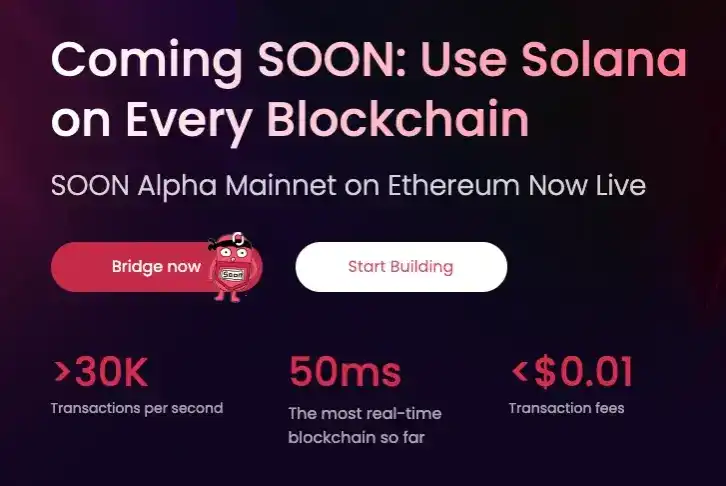
On November 8th, SOON announced the official launch of the public testnet, which has a performance benchmark of 30,000 TPS and a block time of 50 milliseconds. SOON recommends all Genesis Hackathon participants to migrate their projects to the new public testnet.
On January 3rd, SOON announced that the Alpha mainnet is now live and revealed the SOON tokenomics. The initial total token supply of SOON is 1 billion (with a 3% annual inflation), with a community allocation of 51% distributed through a fair launch. Additionally, ecosystem allocation accounts for 25%, airdrop and liquidity allocation for 8%, foundation/treasury allocation for 6%, and team and co-builder allocation for 10%.
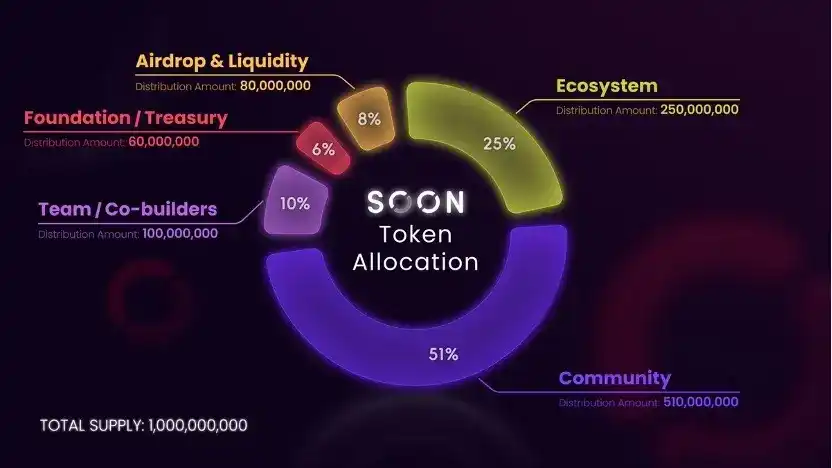
SOON Tokenomics, Source: SOON
In a blog post published on the Alpha mainnet, SOON stated:
"The $SOON token distribution follows a fair launch model: no tokens were pre-mined, no pre-allocation to team or private investors, and no special rights or opportunities for venture capital firms. This distribution method is similar to the infrastructure token issuances of the 2017 ICO era, such as Solana, Polkadot, and Avalanche. Everyone can participate in the investment at the same time, with the vast majority of tokens being allocated to builders and the community. More detailed information will be released next week, so stay tuned!"
Eclipse: The Earliest SVM to Go Live, But No Token Issued
Eclipse is a competitor to SOON and is also deployed on Ethereum's L2 as an SVM. From the official website, Eclipse is an L2 with a strong focus on research and ecosystem, and its design is quite stylish. In terms of progress, Eclipse is not behind the two competitors mentioned earlier. The mainnet has actually been launched, but no tokens have been issued. Strategically, it stands out, positioning itself closer to the Ethereum ecosystem, aiming for a pure 'experience Solana's speed on Ethereum' approach.
The introduction of Eclipse states,
「Eclipse is Ethereum's first Layer 2 based on the Solana Virtual Machine (SVM), combining Solana's high speed with Ethereum's liquidity. This innovative architecture provides users with a high-performance L2 solution that can leverage the rich liquidity of the Ethereum ecosystem while maintaining strict verifiability constraints. Through this design, Eclipse has achieved a balance between performance and security, providing robust technical support for decentralized applications.」
Eclipse adopts Celestia as its DA.
One very obvious difference is that Eclipse did not issue its own token but instead uses Ethereum as the Gas token for the entire L2, effectively hitching itself to Ethereum's bandwagon. At the same time, Eclipse issued re-stakable Ethereum tokens to drive L2.
「Turbo ETH (tETH) is a unified re-stakable token (URT) launched by Eclipse in collaboration with Nucleus, aiming to integrate the highest-yielding protocols on Ethereum into a simple and user-friendly default yield token. tETH provides users with a convenient way to earn staking rewards by eliminating liquidity fragmentation and complex operations.
Users can mint tETH by depositing five liquidity re-stakable tokens (LRT), including WETH, weETH, ezETH, rswETH, apxETH, and pufETH. tETH's design not only diversifies risk but also maximizes user rewards through its unified yield mechanism, bringing a new liquidity management tool to on-chain users.
tETH is a token with exchange rate rewards, similar to Compound's cTokens and Lido's stETH, where the ETH-based rewards increase the exchange rate over time, and non-ETH rewards can be claimed through a separate interface.」
As of the publication date, according to DeFiLlama data, Eclipse's total value locked (TVL) on the chain reached $19.33 million, which is not very high. The platform has 195k followers.
Eclipse Ecosystem
In the DeFi ecosystem, the largest DEX on Eclipse is Orca, with a current TVL of $9.2 million, followed by the lending protocol Save with a TVL of $3.55 million, and the second-largest DEX, Invariant, with a TVL of $3.25 million. These figures have seen significant growth in the past month.
Now, let's take a look at consumer applications. Here are some of the most-followed applications on the Eclipse ecosystem:
· After School Club: an NFT series, also the Genesis NFT of Eclipse;
· SEND Arcade, a platform where you can earn ETH by playing games;
· Dscvr.one, a social protocol with around 80,000 followers on the X platform;
· HedgeHog: a prediction market also on Solana;
· AllDomains: Eclipse domain service;
· Moonlaunch.fun: Eclipse's Pump.fun; Blobscriptions: Inscriptions on Eclipse.
Timeline:
In September 2022, Eclipse announced a unicorn valuation and completed a $15 million Pre-Seed and Seed funding round, with a $9 million Seed round led by Tribe Capital and Tabiya, with participation from Caballeros Capital, Infinity Ventures Crypto, Soma Capital, Struck Capital, and CoinList; and another $6 million in Pre-Seed funding, led by Polychain Capital, with participation from Tribe Capital, Tabiya, Galileo, Polygon Ventures, The House Fund, and Accel. Reportedly, Eclipse is developing a customizable Rollup aggregator designed to be a "universal Layer 2" platform compatible with multiple L1 blockchains.
In February 2023, Eclipse launched the Solana-based scaling solution SVM, enabling applications to be compatible with Polygon. Through this solution, dApps built on the Solana blockchain can migrate to or become multi-chain via Polygon SVM, opening doors for communities using and building on different blockchains.
In December 2023, the Eclipse Testnet was launched;
In March 2024, Eclipse Labs announced the completion of a $50 million Series A funding round, led by Placeholder and Hack VC, bringing the total funding to $65 million. This round of funding also attracted participation from investors such as RockTree Capital, Polychain Capital, Delphi Digital, Maven 11, DBA, funds managed by Apollo, Fenbushi Capital, ParaFi Capital, as well as strategic investments from Flow Traders, GSR, Auros, and OKX Ventures. Numerous researchers and developers participated in its seed round investment, including Barnabé Monnot (Ethereum Foundation), John Adler (Celestia Labs), Austin Federa (Solana Foundation), ZachXBT, and Meltem Demirors.
In May 2024, Eclipse founder and CEO Neel Somani resigned amid rumors of sexual harassment, and was succeeded by Vijay Chetty, who was promoted from Chief Growth Officer to assume all CEO responsibilities. Chetty has over a decade of native cryptocurrency experience, having held leadership roles not only in BlackRock's investments but also at Uniswap Labs, dYdX Trading, and Ripple Labs.
In July 2024, the Eclipse developer mainnet was launched;
In September 2024, Eclipse announced the launch of the staked token tETH, supported by Nucleus.
In November, Eclipse announced that Ben Livshits had joined the team as Chief Technology Officer. Ben holds a Ph.D. from Stanford University and has over twenty years of research experience, having worked at Intel, Microsoft, Brave, and Matter Labs.
That same month, the Eclipse mainnet went live.
You may also like

Gate founder Dr. Han: The crypto winter drives structural reshaping, and everything on-chain will become a new paradigm in finance

Is XRP a Good Investment in 2026? Why Is It Stuck at $1.45
XRP is up 6.7% this week, but exchange reserves remain high. Is a volatility spike imminent? We analyze price trend, ETF inflows, whale activity, and regulatory catalysts to answer: will XRP go up, why is XRP dropping, and is XRP a good investment right now?
TL; DR
What is XRP: XRP is a digital asset built for fast, low-cost international payments. It runs on the XRP Ledger and is used by Ripple for its On-Demand Liquidity (ODL) service. Unlike Bitcoin, XRP settles transactions in 3-5 seconds with near-zero fees.Why is XRP Dropping: XRP is not actively dropping, but it is struggling to rise. On the monthly chart, XRP has seen six consecutive months of decline. Currently, the price faces an additional supply wall at $1.45. About 1.24 billion XRP were bought in that range, and those holders sell when the price approaches, creating selling pressure that prevents a recovery.Will XRP Go Up: Potentially yes. XRP is trading near $1.43 and showing its best weekly performance since September 2025. If the price breaks above the $1.45 resistance, analysts expect a move toward $1.90, supported by strong institutional demand.Is XRP a Good Investment: The answer is not simple. Short-term traders may see opportunity in the coming volatility spike. Long-term investors face a bigger question that depends on one key regulatory event. However, the data reveals a surprising signal that most retail buyers are missing right now. To understand whether XRP is a smart buy or a trap at $1.43, you will need to read the full analysis below.What is XRP? A Digital Asset for Global SettlementBefore analyzing the charts, it is crucial to understand the asset in question. What is XRP? Unlike Bitcoin, which was designed as a decentralized digital gold, XRP operates on the XRP Ledger (XRPL). It was created to facilitate fast, low-cost international payments. Traditional bank transfers take days and incur high fees. XRP transactions settle in 3-5 seconds, costing fractions of a penny.
Ripple, the company associated with XRP, uses this asset for its "On-Demand Liquidity" (ODL) service. Banks and financial institutions use ODL to source liquidity during cross-border transactions without pre-funding accounts. This utility is the primary driver for institutional interest. Recently, the network hit a milestone of over 8 million active wallets, signaling growing usage despite recent price stagnation . Furthermore, Ripple is proactively preparing for the future, releasing a four-stage roadmap to make the XRPL "quantum-resistant," aiming to secure the ledger against future quantum computing threats by 2028 .
XRP Price Analysis: The Battle for $1.45The XRP price trend over the last month tells a story of exhaustion followed by cautious recovery. On the monthly chart, XRP experienced six consecutive months of decline. However, April shows signs of a bottoming process. Weekly charts reinforce this view: after four weeks of lower closes, the last two weeks have seen small rebounds.
According to data from April 22, 2026, XRP is trading at approximately $1.44. Over the last seven days, XRP has outperformed both Bitcoin and Ethereum, rising 6.7% while the broader market rose only 3.2%. Spot trading volume surged 23% to $3.79 billion, and derivative markets saw $40 billion in futures volume on a single day.
Despite this, the price remains 60% below its July 2025 high of $3.65. The current technical picture shows a "low volatility grind" higher. The 20-day EMA is at $1.3924, and the 50-day EMA is at $1.4119, both acting as support . However, the immediate hurdle is the $1.45 resistance level. This price point has rejected every rally attempt in 2026.
Why is XRP Dropping? And Will XRP Go Up?The primary reason for the recent "drop" (or lack of upward momentum) is not active selling, but rather the "supply wall." Data indicates that roughly 1.24 billion XRP tokens were purchased by investors in the $1.45 to $1.47 range. These investors have been waiting months to "break even." Every time the price approaches $1.45, these holders sell to exit their positions, creating a massive wall that retail buying cannot easily absorb.
However, the underlying momentum is shifting. Analysts suggest a xrp volatility spike imminent because the absorption capacity of buyers is increasing. Historically, when exchange reserves are high but the price refuses to drop significantly, it signals that buyers are absorbing the supply. The price has held above $1.39 despite the overhang, which is a sign of relative strength.
So, will XRP go up? Yes, potentially. But it needs a catalyst, if the price closes a daily candle above $1.45. If that happens, the next targets are $1.60 to $1.65, and eventually $1.90 .
XRP Exchange Netflow and XRP ETF Netflow: A Tale of Two MarketsThe current market dynamic is best understood by looking at two opposing data streams: XRP Exchange netflow and XRP ETF flows.
Exchange Dynamics (Retail / Whales):
Data shows a complex pattern of "large inflows and increasing reserves." Recently, a Ripple-associated wallet moved 75 million XRP (approx. $108 million) to Coinbase. This initially looks like a dump, but context matters. These transfers are likely to provide liquidity for Ripple’s ODL business, not necessarily spot market selling. However, the result is that exchange reserves have climbed to 2.76 billion XRP .
The Good News: While reserves are high, the rate of increase is slowing. Specifically, "whale" transfers to exchanges have dropped 98% from their April 11 peak. The Binance reserve has slightly decreased from 27.7 to 27.6 billion. The aggressive selling from large holders appears to have stopped.
Institutional Dynamics (ETF):
While whales were sending coins to exchanges, institutions were buying XRP ETF products. XRP ETF net flow is strongly positive.
US-listed XRP ETFs recorded four consecutive days of inflows totaling $38.86 million recently .The weekly inflow for mid-April hit $119.6 million, a multi-month high .Cumulative net inflows stand at $12.8 billion, with Assets Under Management (AUM) at roughly $10.8 billion.Analyzing the Divergence: Why Both Flows Are PositiveIt seems contradictory that exchange reserves are high (suggesting selling) while ETFs are buying (suggesting buying). However, this phenomenon reveals the current market structure.
Different Investor Profiles: The exchange inflows likely come from short-term traders, market makers, or Ripple itself providing ODL liquidity. These are "hot" coins ready to be sold. The ETF inflows represent "sticky" capital. Institutions buying ETFs are typically long-term holders (LTHs) or asset managers who do not day-trade. They are removing liquidity from the spot market by buying through custodians.The "De-risking" Trade: Sophisticated funds might be engaging in basis trading. They buy the ETF (taking a long position) while simultaneously shorting XRP futures or selling spot inventory to capture the funding rate. This keeps the price stable while volume increases.Absorption: The most likely scenario is that the market is simply absorbing the excess supply. The fact that the price is stable ($1.43) and not collapsing to $1.20 despite 2.76 billion coins sitting on exchanges is a massive win for the bulls. The ETF inflows are acting as a sponge, soaking up the selling pressure from the ODL wallets.The Regulatory Catalyst: The SEC and the CLARITY ActFundamentally, the recent price action cannot be separated from regulation. For years, the primary answer was the SEC lawsuit. That narrative is dying.
Ripple CEO Brad Garlinghouse recently praised SEC Chair Paul Atkins as "a breath of fresh air and sanity" . This regulatory thaw is critical. The SEC is reportedly considering dropping the long-standing lawsuit, and five XRP ETF applications are awaiting review.
The major catalyst on the horizon is the CLARITY Act. A Senate markup is expected before the end of April. Standard Chartered analysts project that if the bill advances, it could unlock $4 to $8 billion in institutional flows . Polymarket gives the bill a 60-66% chance of passing in 2026. If the CLARITY Act classifies XRP as a non-security (commodity), the institutional floodgates will open, likely overwhelming the $1.45 supply wall instantly.
Is XRP a Good Investment in 2026?Given all this data, is XRP a good investment? The answer depends entirely on your risk tolerance and time horizon.
The Bull Case (Why it is a good investment): The risk/reward ratio is asymmetrical to the upside. The price is near multi-year lows relative to its utility. Whale selling has stopped, ETF demand is rising, and the network is expanding (8 million wallets, quantum resistance roadmap). If the CLARITY Act passes, XRP could realistically trade between $1.60 and $1.80 in the short term, with a potential run to $3.00+ if the lawsuit is officially dropped.The Risk Case (Why it is NOT a good investment): There is a clear resistance wall at $1.45. If the CLARITY Act fails or is delayed past May (due to midterm election dynamics), the "buy the rumor, sell the news" dynamic could reverse. If the price fails to break $1.45 and loses support at $1.33, a drop back to $1.15 is technically possible .Verdict: XRP is a speculative buy for traders looking for a volatility spike. It is a hold for current investors. For new investors, it is only a good investment if you believe in regulatory clarity within the next 30 days. Technically, waiting for a confirmed break above $1.55 (to avoid the fakeout) is safer than buying at $1.43.
FAQQ: Will XRP go up if the CLARITY Act passes?
A: Yes, historically. Analysts predict that if the CLARITY Act passes, signaling that XRP is a commodity, it would remove the regulatory overhang. This could trigger a surge in institutional buying, pushing the price from the current $1.43 range to test the $1.80 - $2.00 resistance levels quickly.
Q: Why is XRP dropping when Bitcoin is going up?
A: XRP has specific supply dynamics. Unlike Bitcoin, which has a fixed supply issuance, XRP faces periodic sell-pressure from Ripple's treasury wallets used to fund ODL (liquidity) services. Additionally, the $1.45 "break-even" wall causes XRP to drop relative to BTC when short-term traders exit.
Q: Is a volatility spike imminent for XRP?
A: Yes. The Bollinger Bands on the daily chart are squeezing. The price is stuck between support at $1.33 and resistance at $1.45. Historically, when XRP volume surges 23% in a week (as it did on April 21), it precedes a violent move. The direction depends on whether the $1.45 resistance breaks.
Q: What is the XRP ETF netflow status?
A: As of late April 2026, XRP ETFs are seeing positive netflows. The US ETFs recorded a single week inflow of $119.6 million in mid-April. Cumulative inflows are strong at $12.8 billion, indicating that institutions are accumulating during this dip, which is a long-term bullish signal for price stabilization.
Q: Is XRP a good investment for beginners?
A: XRP is less volatile than "meme coins" but more volatile than Bitcoin. For beginners, it is a moderate-risk investment. Its value is tied to real utility (bank payments). However, beginners should wait to see if the price can close a weekly candle above $1.55 before entering, to avoid buying into the current resistance wall.
Disclaimer: None of the information in this article constitutes, or is intended to constitute, investment advice. Trading cryptocurrencies carries a high level of risk and may not be suitable for all investors. Always do your own research.
About WEEXFounded in 2018, WEEX has developed into a global crypto exchange with over 6.2 million users across more than 150 countries. The platform emphasizes security, liquidity, and usability, providing over 1,200 spot trading pairs and offering up to 400x leverage in crypto futures trading. In addition to the traditional spot and derivatives markets, WEEX is expanding rapidly in the AI era — delivering real-time AI news, empowering users with AI trading tools, and exploring innovative trade-to-earn models that make intelligent trading more accessible to everyone. Its 1,000 BTC Protection Fund further strengthens asset safety and transparency, while features such as copy trading and advanced trading tools allow users to follow professional traders and experience a more efficient, intelligent trading journey.
Follow WEEX on social mediaX: @WEEX_Official
Instagram: @WEEX Exchange
Tiktok: @weex_global
Youtube: @WEEX_Official
Discord: WEEX Community
Telegram: WeexGlobal Group

FC Barcelona vs Celta Vigo: Can Anyone Stop Barcelona at Home?
FC Barcelona vs Celta Vigo lineups, standings, and stats for April 22, 2026. FC Barcelona need a win to stay on track for the La Liga title. Full preview inside.

Carl Moon & WEEX Head to Mugello: The Crypto Trader's Ferrari Challenge
Forget the sidelines. WEEX is hitting the 300km/h mark at Mugello this weekend. Witness Carl Moon’s transformation from a supermarket cashier to a Ferrari racer, and discover why the world’s fastest trading floor belongs on the world’s most technical track at the official Ferrari Challenge.

How to Become a Pro Crypto Trader: WEEX Interview with Ferrari Racer Carl Moon
Ferrari racer Carl Moon on mastering crypto trading: 80/20 rule, AI tools, Bitcoin at $95K, and risk lessons from the track.

Morning Report | Amazon increases investment in Anthropic up to $25 billion; SEC plans to introduce an "innovation exemption" mechanism to support compliant on-chain trading of tokenized securities

Jeff Hoffman, founder of Booking.com: How Web3 and AI are reshaping the trillion-dollar social travel market

Top 12 Cryptocurrencies to Invest in April 2026
Key Takeaways: Bitcoin remains the dominant player with a $1.42 trillion market cap. Hyperliquid’s HYPE token gains traction,…
18 Best Crypto & Bitcoin Casinos in March 2026
Key Takeaways: Cryptocurrencies offer faster, cheaper, and more private payment options in online casinos. Top crypto casinos include…

Full Post-Mortem of the KelpDAO Incident: Why Did Aave, Which Was Not Compromised, End Up in Crisis Situation?
Key Takeaways: The KelpDAO incident exposed vulnerabilities in collateral pricing and cross-chain bridge operations, affecting Aave’s liquidity. rsETH…

Is MicroStrategy’s STRC Bitcoin’s Savior or Destroyer?
Key Takeaways: MicroStrategy’s STRC offers an annualized yield of 11.5%, driving significant Bitcoin buying pressure. Michael Saylor’s financial…

Ceasefire Expiration and Market Response: Bitcoin Defies Market Trends
Key Takeaways: The current ceasefire agreement is anticipated to expire on Wednesday in Washington, with low likelihood of…

Oil Price Dilemma: More Than a Price Hike
Key Takeaways: Global oil market has surpassed its breaking point, not solving with price hikes but facing significant…

On the Day Aave Launched rsETH, Spark Strategically Exited
Key Takeaways: Aave enabled rsETH lending at a 93% LTV, while Spark withdrew due to low utilization by…

Nasdaq Breaks Record and Crypto Transactions Surge
Key Takeaways: Nasdaq’s rise to a new intraday high indicates strong market momentum. A significant transfer of 35,000…

Powell: Fed Requires a Brand New Inflation Blueprint
Key Takeaways: Powell aims for transformative policy overhauls within the Fed if appointed. Past inflation response mistakes during…

Without Cook’s Apple, Can it Still Grow in the AI Era?
Key Takeaways: John Ternus acts more like a systematic integrator within Apple rather than a solo visionary. Apple’s…

Iran Stock Market and Crypto Developments in Focus
Key Takeaways: The Iranian stock market is set to reopen in 10 to 12 days, excluding companies impacted…
Gate founder Dr. Han: The crypto winter drives structural reshaping, and everything on-chain will become a new paradigm in finance
Is XRP a Good Investment in 2026? Why Is It Stuck at $1.45
XRP is up 6.7% this week, but exchange reserves remain high. Is a volatility spike imminent? We analyze price trend, ETF inflows, whale activity, and regulatory catalysts to answer: will XRP go up, why is XRP dropping, and is XRP a good investment right now?
TL; DR
What is XRP: XRP is a digital asset built for fast, low-cost international payments. It runs on the XRP Ledger and is used by Ripple for its On-Demand Liquidity (ODL) service. Unlike Bitcoin, XRP settles transactions in 3-5 seconds with near-zero fees.Why is XRP Dropping: XRP is not actively dropping, but it is struggling to rise. On the monthly chart, XRP has seen six consecutive months of decline. Currently, the price faces an additional supply wall at $1.45. About 1.24 billion XRP were bought in that range, and those holders sell when the price approaches, creating selling pressure that prevents a recovery.Will XRP Go Up: Potentially yes. XRP is trading near $1.43 and showing its best weekly performance since September 2025. If the price breaks above the $1.45 resistance, analysts expect a move toward $1.90, supported by strong institutional demand.Is XRP a Good Investment: The answer is not simple. Short-term traders may see opportunity in the coming volatility spike. Long-term investors face a bigger question that depends on one key regulatory event. However, the data reveals a surprising signal that most retail buyers are missing right now. To understand whether XRP is a smart buy or a trap at $1.43, you will need to read the full analysis below.What is XRP? A Digital Asset for Global SettlementBefore analyzing the charts, it is crucial to understand the asset in question. What is XRP? Unlike Bitcoin, which was designed as a decentralized digital gold, XRP operates on the XRP Ledger (XRPL). It was created to facilitate fast, low-cost international payments. Traditional bank transfers take days and incur high fees. XRP transactions settle in 3-5 seconds, costing fractions of a penny.
Ripple, the company associated with XRP, uses this asset for its "On-Demand Liquidity" (ODL) service. Banks and financial institutions use ODL to source liquidity during cross-border transactions without pre-funding accounts. This utility is the primary driver for institutional interest. Recently, the network hit a milestone of over 8 million active wallets, signaling growing usage despite recent price stagnation . Furthermore, Ripple is proactively preparing for the future, releasing a four-stage roadmap to make the XRPL "quantum-resistant," aiming to secure the ledger against future quantum computing threats by 2028 .
XRP Price Analysis: The Battle for $1.45The XRP price trend over the last month tells a story of exhaustion followed by cautious recovery. On the monthly chart, XRP experienced six consecutive months of decline. However, April shows signs of a bottoming process. Weekly charts reinforce this view: after four weeks of lower closes, the last two weeks have seen small rebounds.
According to data from April 22, 2026, XRP is trading at approximately $1.44. Over the last seven days, XRP has outperformed both Bitcoin and Ethereum, rising 6.7% while the broader market rose only 3.2%. Spot trading volume surged 23% to $3.79 billion, and derivative markets saw $40 billion in futures volume on a single day.
Despite this, the price remains 60% below its July 2025 high of $3.65. The current technical picture shows a "low volatility grind" higher. The 20-day EMA is at $1.3924, and the 50-day EMA is at $1.4119, both acting as support . However, the immediate hurdle is the $1.45 resistance level. This price point has rejected every rally attempt in 2026.
Why is XRP Dropping? And Will XRP Go Up?The primary reason for the recent "drop" (or lack of upward momentum) is not active selling, but rather the "supply wall." Data indicates that roughly 1.24 billion XRP tokens were purchased by investors in the $1.45 to $1.47 range. These investors have been waiting months to "break even." Every time the price approaches $1.45, these holders sell to exit their positions, creating a massive wall that retail buying cannot easily absorb.
However, the underlying momentum is shifting. Analysts suggest a xrp volatility spike imminent because the absorption capacity of buyers is increasing. Historically, when exchange reserves are high but the price refuses to drop significantly, it signals that buyers are absorbing the supply. The price has held above $1.39 despite the overhang, which is a sign of relative strength.
So, will XRP go up? Yes, potentially. But it needs a catalyst, if the price closes a daily candle above $1.45. If that happens, the next targets are $1.60 to $1.65, and eventually $1.90 .
XRP Exchange Netflow and XRP ETF Netflow: A Tale of Two MarketsThe current market dynamic is best understood by looking at two opposing data streams: XRP Exchange netflow and XRP ETF flows.
Exchange Dynamics (Retail / Whales):
Data shows a complex pattern of "large inflows and increasing reserves." Recently, a Ripple-associated wallet moved 75 million XRP (approx. $108 million) to Coinbase. This initially looks like a dump, but context matters. These transfers are likely to provide liquidity for Ripple’s ODL business, not necessarily spot market selling. However, the result is that exchange reserves have climbed to 2.76 billion XRP .
The Good News: While reserves are high, the rate of increase is slowing. Specifically, "whale" transfers to exchanges have dropped 98% from their April 11 peak. The Binance reserve has slightly decreased from 27.7 to 27.6 billion. The aggressive selling from large holders appears to have stopped.
Institutional Dynamics (ETF):
While whales were sending coins to exchanges, institutions were buying XRP ETF products. XRP ETF net flow is strongly positive.
US-listed XRP ETFs recorded four consecutive days of inflows totaling $38.86 million recently .The weekly inflow for mid-April hit $119.6 million, a multi-month high .Cumulative net inflows stand at $12.8 billion, with Assets Under Management (AUM) at roughly $10.8 billion.Analyzing the Divergence: Why Both Flows Are PositiveIt seems contradictory that exchange reserves are high (suggesting selling) while ETFs are buying (suggesting buying). However, this phenomenon reveals the current market structure.
Different Investor Profiles: The exchange inflows likely come from short-term traders, market makers, or Ripple itself providing ODL liquidity. These are "hot" coins ready to be sold. The ETF inflows represent "sticky" capital. Institutions buying ETFs are typically long-term holders (LTHs) or asset managers who do not day-trade. They are removing liquidity from the spot market by buying through custodians.The "De-risking" Trade: Sophisticated funds might be engaging in basis trading. They buy the ETF (taking a long position) while simultaneously shorting XRP futures or selling spot inventory to capture the funding rate. This keeps the price stable while volume increases.Absorption: The most likely scenario is that the market is simply absorbing the excess supply. The fact that the price is stable ($1.43) and not collapsing to $1.20 despite 2.76 billion coins sitting on exchanges is a massive win for the bulls. The ETF inflows are acting as a sponge, soaking up the selling pressure from the ODL wallets.The Regulatory Catalyst: The SEC and the CLARITY ActFundamentally, the recent price action cannot be separated from regulation. For years, the primary answer was the SEC lawsuit. That narrative is dying.
Ripple CEO Brad Garlinghouse recently praised SEC Chair Paul Atkins as "a breath of fresh air and sanity" . This regulatory thaw is critical. The SEC is reportedly considering dropping the long-standing lawsuit, and five XRP ETF applications are awaiting review.
The major catalyst on the horizon is the CLARITY Act. A Senate markup is expected before the end of April. Standard Chartered analysts project that if the bill advances, it could unlock $4 to $8 billion in institutional flows . Polymarket gives the bill a 60-66% chance of passing in 2026. If the CLARITY Act classifies XRP as a non-security (commodity), the institutional floodgates will open, likely overwhelming the $1.45 supply wall instantly.
Is XRP a Good Investment in 2026?Given all this data, is XRP a good investment? The answer depends entirely on your risk tolerance and time horizon.
The Bull Case (Why it is a good investment): The risk/reward ratio is asymmetrical to the upside. The price is near multi-year lows relative to its utility. Whale selling has stopped, ETF demand is rising, and the network is expanding (8 million wallets, quantum resistance roadmap). If the CLARITY Act passes, XRP could realistically trade between $1.60 and $1.80 in the short term, with a potential run to $3.00+ if the lawsuit is officially dropped.The Risk Case (Why it is NOT a good investment): There is a clear resistance wall at $1.45. If the CLARITY Act fails or is delayed past May (due to midterm election dynamics), the "buy the rumor, sell the news" dynamic could reverse. If the price fails to break $1.45 and loses support at $1.33, a drop back to $1.15 is technically possible .Verdict: XRP is a speculative buy for traders looking for a volatility spike. It is a hold for current investors. For new investors, it is only a good investment if you believe in regulatory clarity within the next 30 days. Technically, waiting for a confirmed break above $1.55 (to avoid the fakeout) is safer than buying at $1.43.
FAQQ: Will XRP go up if the CLARITY Act passes?
A: Yes, historically. Analysts predict that if the CLARITY Act passes, signaling that XRP is a commodity, it would remove the regulatory overhang. This could trigger a surge in institutional buying, pushing the price from the current $1.43 range to test the $1.80 - $2.00 resistance levels quickly.
Q: Why is XRP dropping when Bitcoin is going up?
A: XRP has specific supply dynamics. Unlike Bitcoin, which has a fixed supply issuance, XRP faces periodic sell-pressure from Ripple's treasury wallets used to fund ODL (liquidity) services. Additionally, the $1.45 "break-even" wall causes XRP to drop relative to BTC when short-term traders exit.
Q: Is a volatility spike imminent for XRP?
A: Yes. The Bollinger Bands on the daily chart are squeezing. The price is stuck between support at $1.33 and resistance at $1.45. Historically, when XRP volume surges 23% in a week (as it did on April 21), it precedes a violent move. The direction depends on whether the $1.45 resistance breaks.
Q: What is the XRP ETF netflow status?
A: As of late April 2026, XRP ETFs are seeing positive netflows. The US ETFs recorded a single week inflow of $119.6 million in mid-April. Cumulative inflows are strong at $12.8 billion, indicating that institutions are accumulating during this dip, which is a long-term bullish signal for price stabilization.
Q: Is XRP a good investment for beginners?
A: XRP is less volatile than "meme coins" but more volatile than Bitcoin. For beginners, it is a moderate-risk investment. Its value is tied to real utility (bank payments). However, beginners should wait to see if the price can close a weekly candle above $1.55 before entering, to avoid buying into the current resistance wall.
Disclaimer: None of the information in this article constitutes, or is intended to constitute, investment advice. Trading cryptocurrencies carries a high level of risk and may not be suitable for all investors. Always do your own research.
About WEEXFounded in 2018, WEEX has developed into a global crypto exchange with over 6.2 million users across more than 150 countries. The platform emphasizes security, liquidity, and usability, providing over 1,200 spot trading pairs and offering up to 400x leverage in crypto futures trading. In addition to the traditional spot and derivatives markets, WEEX is expanding rapidly in the AI era — delivering real-time AI news, empowering users with AI trading tools, and exploring innovative trade-to-earn models that make intelligent trading more accessible to everyone. Its 1,000 BTC Protection Fund further strengthens asset safety and transparency, while features such as copy trading and advanced trading tools allow users to follow professional traders and experience a more efficient, intelligent trading journey.
Follow WEEX on social mediaX: @WEEX_Official
Instagram: @WEEX Exchange
Tiktok: @weex_global
Youtube: @WEEX_Official
Discord: WEEX Community
Telegram: WeexGlobal Group
FC Barcelona vs Celta Vigo: Can Anyone Stop Barcelona at Home?
FC Barcelona vs Celta Vigo lineups, standings, and stats for April 22, 2026. FC Barcelona need a win to stay on track for the La Liga title. Full preview inside.
Carl Moon & WEEX Head to Mugello: The Crypto Trader's Ferrari Challenge
Forget the sidelines. WEEX is hitting the 300km/h mark at Mugello this weekend. Witness Carl Moon’s transformation from a supermarket cashier to a Ferrari racer, and discover why the world’s fastest trading floor belongs on the world’s most technical track at the official Ferrari Challenge.
How to Become a Pro Crypto Trader: WEEX Interview with Ferrari Racer Carl Moon
Ferrari racer Carl Moon on mastering crypto trading: 80/20 rule, AI tools, Bitcoin at $95K, and risk lessons from the track.


 App
App