
 Buy Crypto
- Markets
 Futures
- Spot
- Copy Trade
- Earn
- More
Venus Exploit Post-Mortem: How to Profit in a Flash Loan Window?




Original Article Title: "Retrospect of How I Profited from the Venus THE Attack"
Original Article Author: Weilin (William) Li, Crypto Trader
Editor's Note: Last night, the BNB Chain's leading lending protocol, Venus Protocol, was attacked, with abnormal activity in THE liquidity pool. THE experienced a short-lived spike of 116% to $0.6, followed by a rapid drop of over 60%. The Venus Protocol team responded, stating: "We are actively investigating the abnormal activity in THE liquidity pool, and to prevent further abuse, we have taken precautionary measures: immediately suspending all borrowing and withdrawal operations for THE. Other markets remain unaffected and will continue to operate as normal."
Amidst THE's sharp price swings, many traders seized the brief opportunity window to profit. This article, from crypto trader Weilin (William) Li, recounts the Venus Protocol attack and the profits made. The original content is as follows:
Two hours ago, VenuV's THE suffered a very typical Mango Markets-style price manipulation attack.
The attacker targeted the low liquidity collateral asset THE:
· Initially collateralize THE
· Borrow other assets
· Further buy THE with borrowed assets
· Continuously push THE price up
· Upon average oracle update, obtain higher collateral value, then continue the borrowing loop.
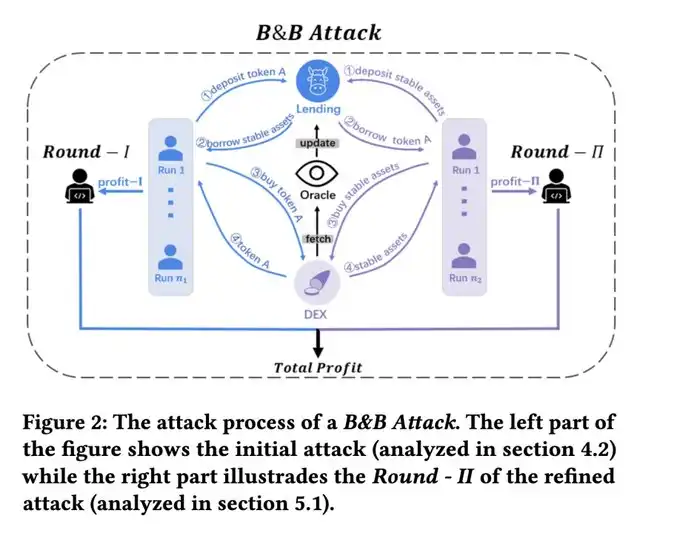
From my paper: Unmasking Role-Play Attack Strategies in Exploiting Decentralized Finance (DeFi) Systems (https://dl.acm.org/doi/10.1145/3605768.3623545)
Due to THE on-chain illiquidity, the price was brutally dragged from $0.27 to nearly $5. The oracle price was then updated to 0.5 (time-weighted average), allowing the attacker to further leverage up.
More crucially, THE itself has a supply cap.
Normally, this would restrict the attacker from further expanding their position. But they used a classic trick to bypass this: the Compound fork's donation attack. After depositing a large amount of THE, directly transferring THE to the vTHE contract, they continued raising the recognized collateral value through a "donation" to further surpass the cap.
Attack Transaction: 0x4f477e941c12bbf32a58dc12db7bb0cb4d31d41ff25b2457e6af3c15d7f5663f
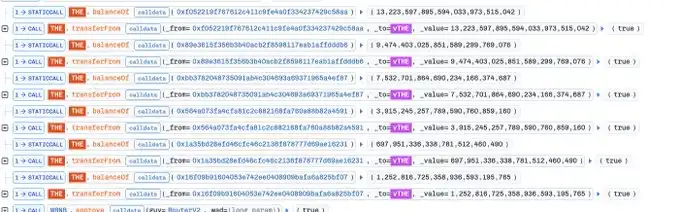
Attack Transaction: 0x4f477e941c12bbf32a58dc12db7bb0cb4d31d41ff25b2457e6af3c15d7f5663f. Expanding collateral through donation
After the first wave of attacks, THE price roughly stabilized around $0.5.
By this point, the attacker could have already walked away with the borrowed assets. However, they evidently wanted to maximize profits and continued to pour the borrowed assets into buying THE, attempting another round of surge.
But here's the issue: While the price was exceptionally high, the market selling pressure also became extremely exaggerated. The attacker kept buying but could hardly move the price further. Eventually, he nearly depleted his own collateral capacity, with a health factor close to 1, on the brink of liquidation.
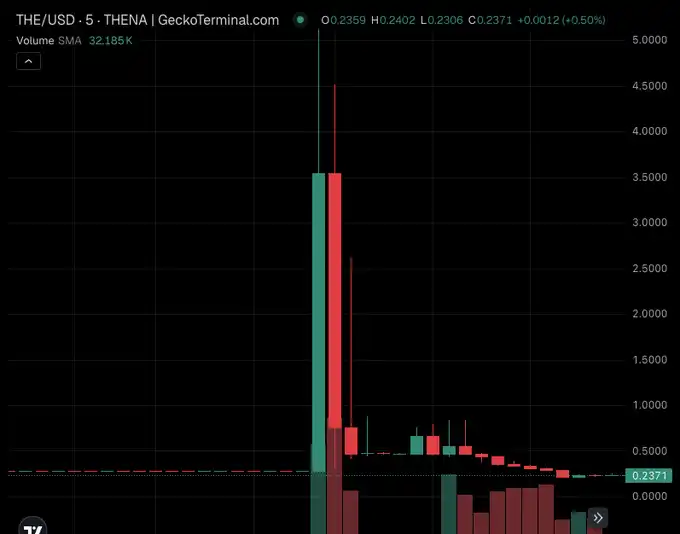
THE Price Movement
At this point, the situation became very clear: The collateral in the attacker's possession, including their pre-allocated assets and the THE purchased during the attack, had a nominal value of approximately 30M. However, the core issue with this collateral was — there was simply not enough liquidity to absorb it. Once the liquidation began, this THE could only be aggressively dumped on the market. Yet in the market, no one would be willing to buy such a large amount at that inflated price.
So what did I do?
At the start of the liquidation, I directly opened a short position on THE. And this position could actually have a relatively higher leverage.
The reason is very simple: overvaluation, low liquidity, massive passive selling pressure, no buyers.
The result was not surprising either: after the liquidation, THE price plummeted to around $0.24, even lower than the price before the attack, as the original holder also sold during the process.
Here, I closed the short position, making a profit of about 15K.
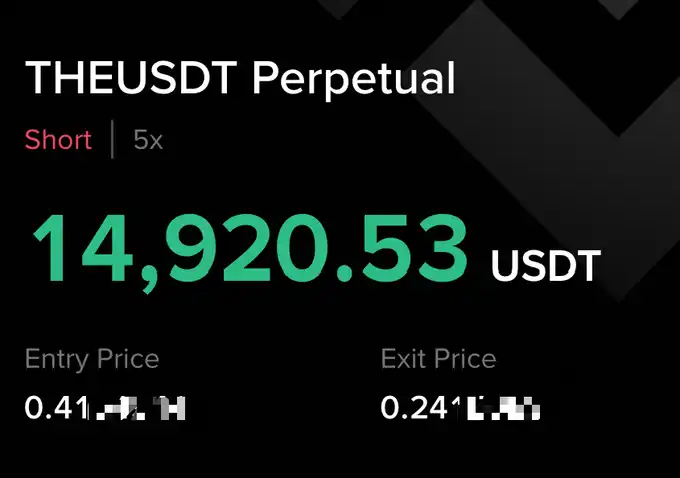
My Short Position
In the end, Venus was left with around 2M bad debt.
As for how much the attacker actually made, I have not completed a full calculation yet; but from the operations of some of the addresses, he most likely barely made any money, and may have even wrecked himself. However, the attacker may still have off-exchange perpetual positions to make money (just like our operation).
Venus's around 2M bad debt address: https://debank.com/profile/0x1a35bd28efd46cfc46c2136f878777d69ae16231
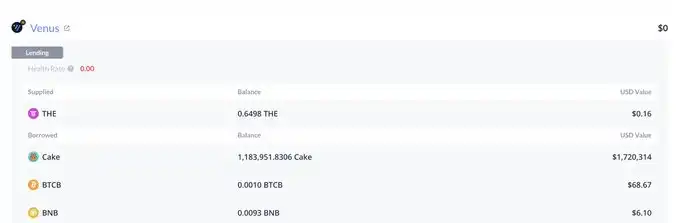
Venus's ~2M Bad Debt:
https://debank.com/profile/0x1a35bd28efd46cfc46c2136f878777d69ae16231
This incident once again illustrates:
In DeFi, “Nominal Collateral Value” does not equal “Liquidation Value.” When the collateral itself lacks liquidity, the system may see 30M, but what the market can truly realize may be close to zero.
I published a paper in my 23rd year, titled Unmasking Role-Play Attack Strategies in Exploiting Decentralized Finance (DeFi) Systems, where I provided a detailed mathematical model of this attack. Interested readers can refer to: https://dl.acm.org/doi/10.1145/3605768.3623545
You may also like

Naval personally takes the stage: The historic collision between ordinary people and venture capital

a16z Crypto: 9 Charts to Understand the Evolution Trends of Stablecoins

Refutation of Yang Haipo's "The End of Cryptocurrency"

Can a hairdryer earn $34,000? Interpreting the reflexivity paradox of prediction markets

6MV Founder: In 2026, the "landmark turning point" for crypto investment has arrived

Abraxas Capital Mints $2.89 Billion USDT: Liquidity Boost or Just More Stablecoin Arbitrage?
Abraxas Capital just received $2.89 billion in freshly minted USDT from Tether. Is this a bullish liquidity injection for crypto markets, or is it business as usual for a stablecoin arbitrage giant? We analyze the data and the likely impact on Bitcoin, altcoins, and DeFi.
A VC from the Crypto world said AI is too crazy, and they are very conservative
The Evolutionary History of Contract Algorithms: A Decade of Perpetual Contracts, the Curtain Has Yet to Fall

Kicked out by PayPal, Musk aims to make a comeback in the cryptocurrency market

Solana ETF News: What Is a Solana ETF and Why Is Goldman Sachs Betting $108 Million on SOL?
Solana ETF news today shows Goldman Sachs disclosed a $108M position while total SOL ETF inflows reached $1.45B. Analysts now expect up to $6B in institutional demand as Solana trades 71% below its all-time high.

Bitcoin ETF News Today: $2.1B Inflows Signal Strong Institutional Demand for BTC
Bitcoin ETFs news recorded $2.1B inflows over 8 consecutive days, marking one of the strongest recent accumulation streaks. Here’s what the latest Bitcoin ETF news means for BTC price and whether the $80K breakout level is next.
Michael Saylor: Winter is Over – Is He Right? 5 Key Data Points (2026)
Michael Saylor tweeted yesterday “Winter‘s Over.” It is short. It is bold. And it has the crypto world talking.
But is he right? Or is this just another CEO pumping his bags?
Let us look at the data. Let us be neutral. Let us see if the ice has really melted.

WEEX Bubbles App Now Live Visualizes the Crypto Market at a Glance
WEEX Bubbles is a standalone app designed to help users quickly understand complex crypto market movements through an intuitive bubble visualization.

Polygon co-founder Sandeep: Writing after the chain bridge chain explosion

Major Upgrade on Web: 10+ Advanced Chart Styles for Deeper Market Insights
To deliver more powerful and professional analysis tools, WEEX has rolled out a major upgrade to its web trading charts—now supporting up to 14 advanced chart styles.
Morning Report | Aethir secures a $260 million enterprise contract with Axe Compute; New Fire Technology acquires Avenir Group's trading team; Polymarket's trading volume surpassed by Kalshi

Why a Million-Follower Crypto KOL Chooses WEEX VIP?
Discover why top crypto KOL Carl Moon partnered with WEEX. Explore the WEEX VIP ecosystem, 1,000 BTC protection fund, and exclusive rewards for serious traders.

CoinEx Founder: The Crypto Endgame in My Eyes
Naval personally takes the stage: The historic collision between ordinary people and venture capital
a16z Crypto: 9 Charts to Understand the Evolution Trends of Stablecoins
Refutation of Yang Haipo's "The End of Cryptocurrency"
Can a hairdryer earn $34,000? Interpreting the reflexivity paradox of prediction markets
6MV Founder: In 2026, the "landmark turning point" for crypto investment has arrived
Abraxas Capital Mints $2.89 Billion USDT: Liquidity Boost or Just More Stablecoin Arbitrage?
Abraxas Capital just received $2.89 billion in freshly minted USDT from Tether. Is this a bullish liquidity injection for crypto markets, or is it business as usual for a stablecoin arbitrage giant? We analyze the data and the likely impact on Bitcoin, altcoins, and DeFi.


 App
App